

Key takeaways
- Air pollution and health are tightly linked in India: a national study tied 1.67 million deaths in 2019 to polluted air.
- Fine particles (PM2.5) harm the lungs, heart and blood vessels. Check the AQI daily and cut exposure on bad days.
- What works: fitted N95 masks, sized purifiers, smarter ventilation and timing. Cloth masks and steam do not.
In 2019, air pollution was linked to 17.8% of all deaths in India, more than one in six, according to a Global Burden of Disease study.
The short answer: air pollution and health go together because tiny particles reach deep into your lungs and blood. You cannot fix the city’s air alone. But you can cut your own exposure a lot: check the AQI, wear a fitted N95 outside, clean the air at home, and time your exercise.
Jump to:
- How pollution harms your body
- How big the problem is in India
- Reading the AQI
- Exercise and timing
- Who is most at risk
- Masks that work
- At work and on the road
- Cleaner air at home
- Your eyes
- Cough and sore throat
- Diwali and smog season
- Deeper guides: N95 masks, purifier size, windows, purifier vs humidifier, exercise and AQI, eye irritation, eye drops, red-eye drops, pollution cough
1. Air Pollution and Health: How Pollution Harms Your Body
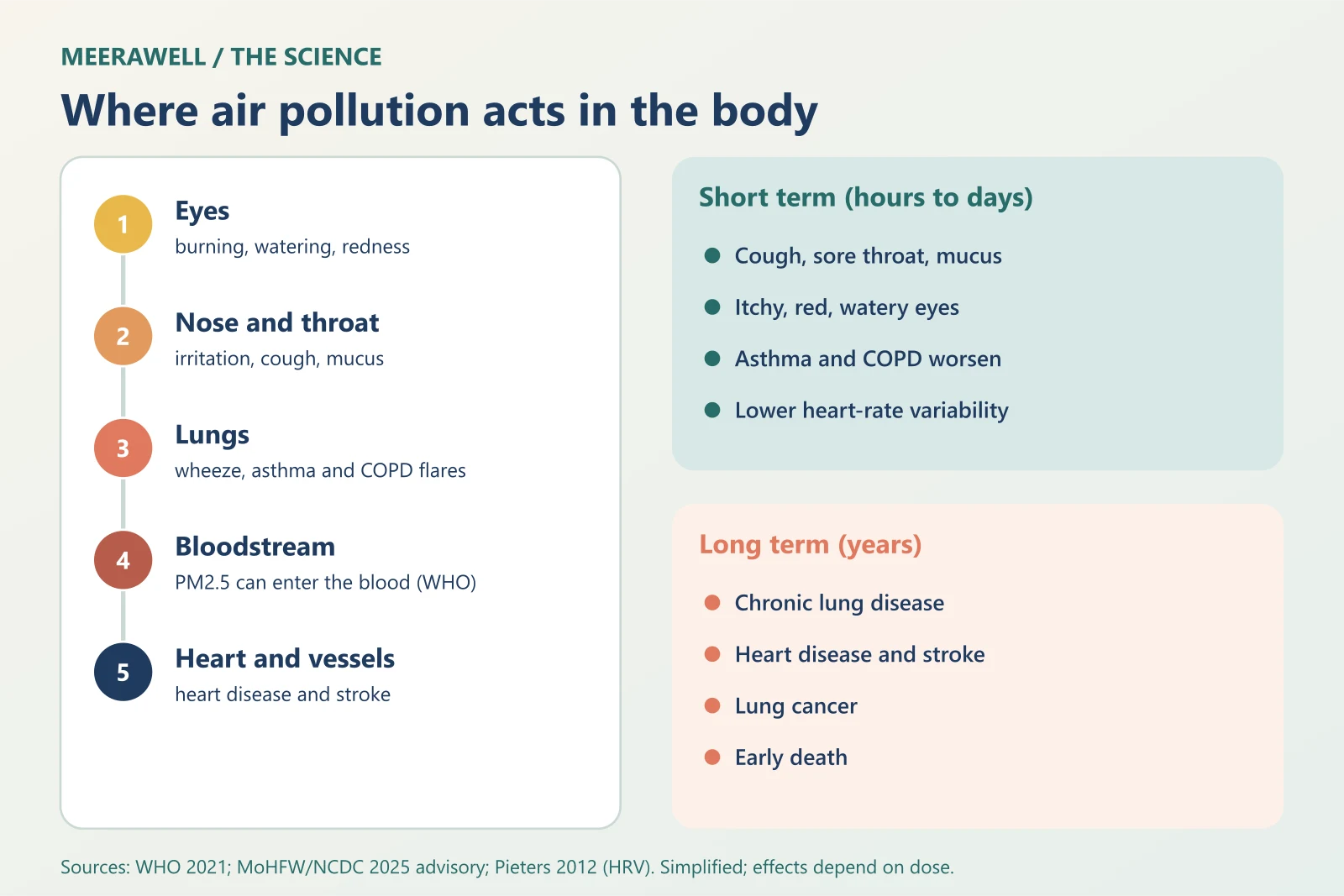
Air pollution is a mix of particles and gases. The particles matter most for health. PM10 means particles 10 micrometres across or smaller. PM2.5 means 2.5 micrometres or smaller. The US EPA notes a human hair is about 30 times wider than the largest of them.
The WHO says both can travel deep into the lungs, and PM2.5 can even enter the bloodstream. Gases such as ozone and nitrogen dioxide add to the irritation.
What happens next depends on the dose and on you.
- Airways: particles irritate the lining of the nose, throat and lungs. You cough, make more mucus and may wheeze.
- Heart and vessels: India’s 2025 health advisory lists heart disease and stroke among the effects.
- Long term: the same advisory says years of exposure, even to lower levels, can lead to chronic lung and heart disease, lung cancer and early death.
Smog even nudges the nervous system. A meta-analysis of 29 studies found each 10 µg/m³ more PM2.5 was linked to slightly lower heart-rate variability. That is one reason a smart watch may show a dip on smoky days, as our HRV drop guide explains.
2. Air Pollution and Health in India: How Big the Problem Is
The numbers are large, and they come from careful national studies.
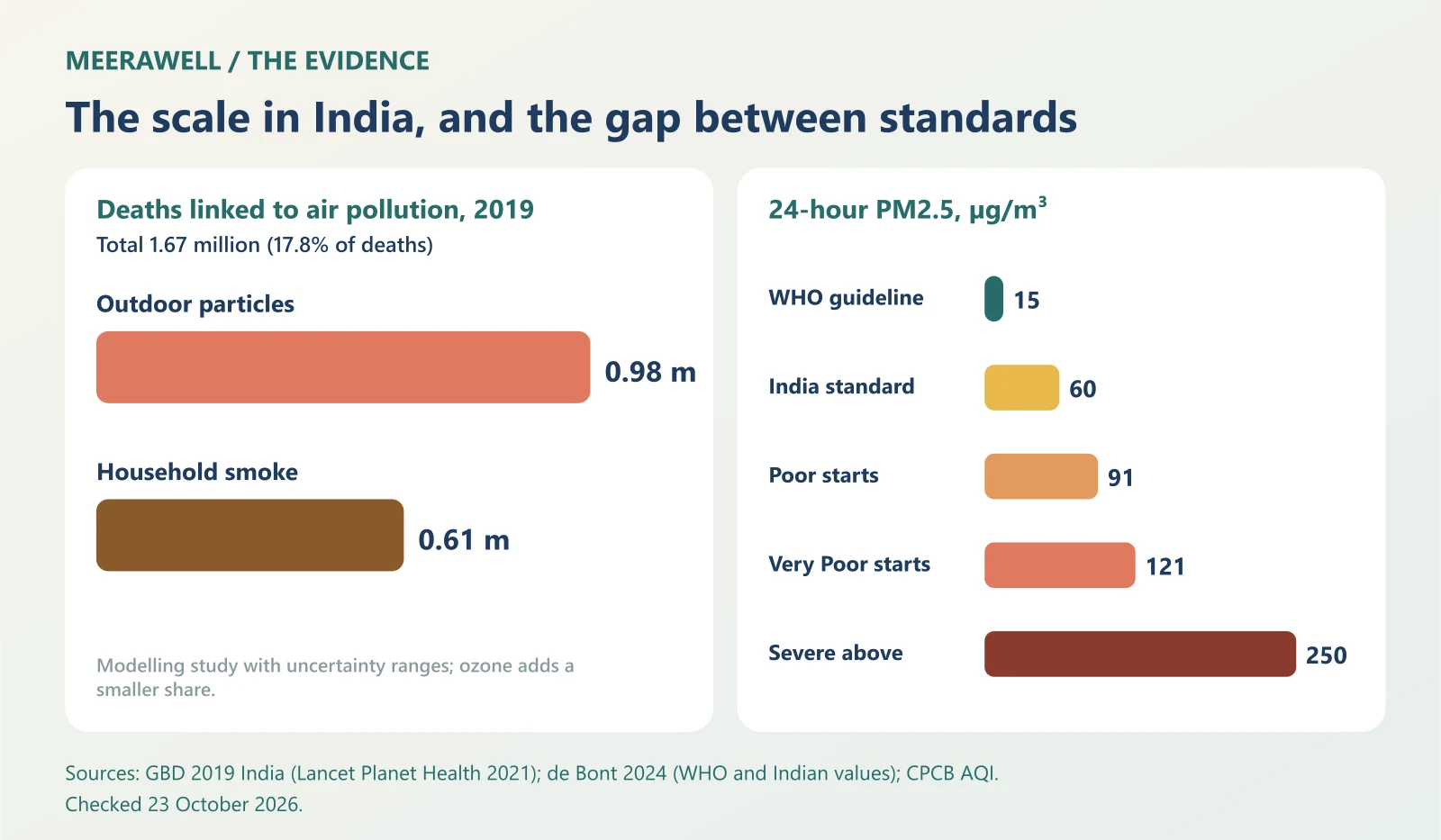
The Global Burden of Disease India study linked 1.67 million deaths in 2019 to air pollution. Of these, 0.98 million were tied to outdoor particles and 0.61 million to household smoke from cooking fuels. It is a modelling study, so the figures carry uncertainty ranges. The same study put the cost of lost output at 1.36% of India’s GDP in 2019.
Two trends stand out. The death rate linked to household smoke fell by 64% from 1990 to 2019. The rate linked to outdoor particles more than doubled, and the rate linked to ozone also rose.
Day-to-day exposure matters too. A study of ten Indian cities from 2008 to 2019 found each 10 µg/m³ rise in PM2.5 was linked to 1.4% more deaths that day. The risk per step was about twice as high on days below India’s own standard. The authors estimated 7.2% of daily deaths were linked to PM2.5 above the WHO guideline.
The lesson for you: the study found extra risk even below India’s standard. Cutting exposure is worthwhile even on “Moderate” days. The cheapest first step is a well-fitted mask.
3. Reading the AQI and Planning Your Day
The Central Pollution Control Board’s National Air Quality Index turns several pollutants into one number from 0 to 500. For PM2.5, the 24-hour bands are:
| AQI category | AQI | PM2.5 (24-hour, µg/m³) |
|---|---|---|
| Good | 0–50 | 0–30 |
| Satisfactory | 51–100 | 31–60 |
| Moderately polluted | 101–200 | 61–90 |
| Poor | 201–300 | 91–120 |
| Very Poor | 301–400 | 121–250 |
| Severe | 401–500 | above 250 |
India’s 24-hour PM2.5 standard is 60 µg/m³. The WHO’s guideline is far lower, at 15, as the ten-city study notes. So a “Satisfactory” day in India can still be four times the WHO level.
India’s health advisory gives simple steps. On Poor or worse days, avoid strenuous outdoor activity and stay indoors where you can. Reschedule outdoor plans by the AQI, and follow local forecasts.
Use the station nearest you, not a city average, and check it before you head out. The AQI also tells you when to air your home; our ventilation guide explains how.
4. Air Pollution and Health on Smoggy Days: Exercise and Timing
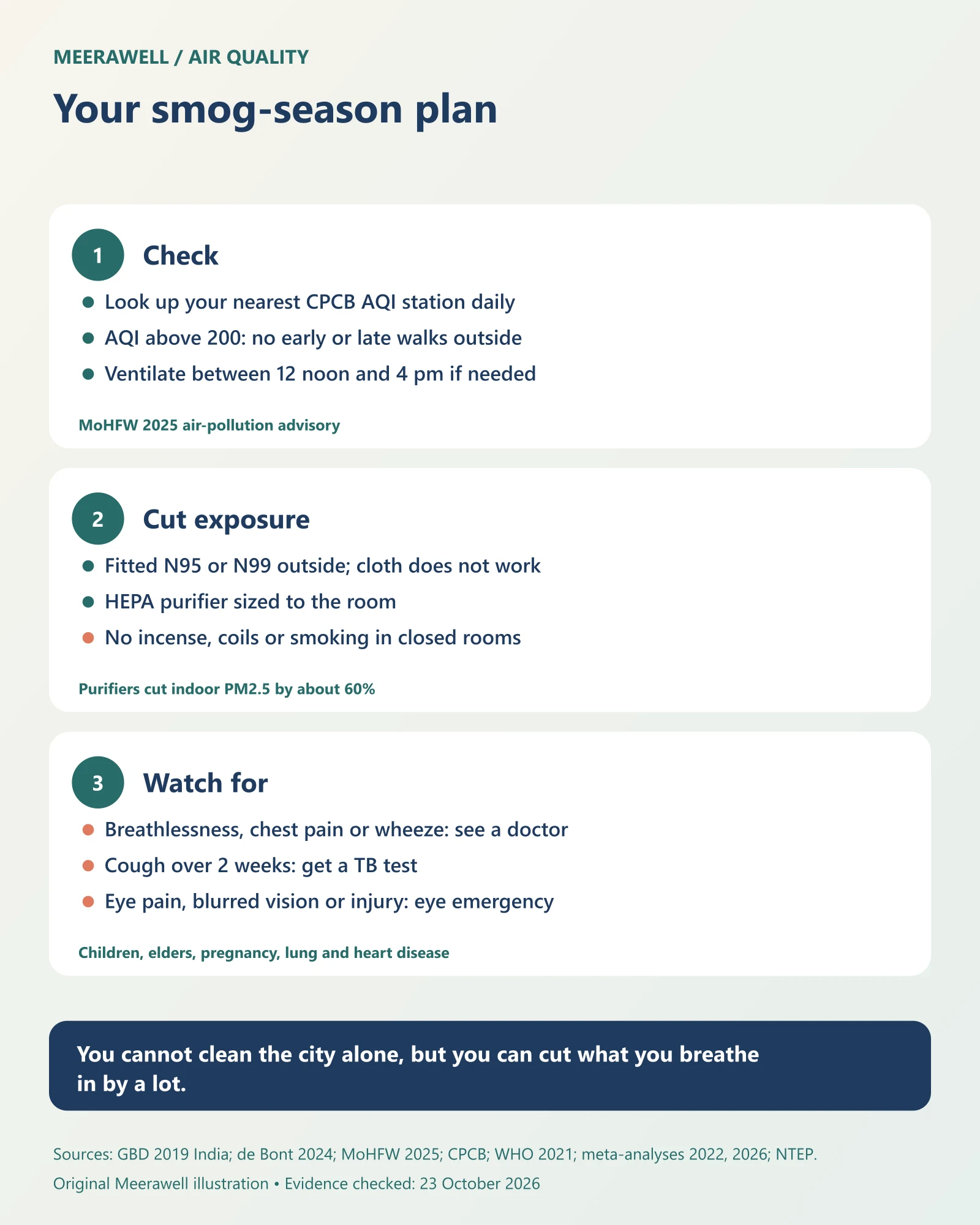
Timing is the cheapest protection you have. On days when the AQI is above 200, India’s health advisory makes several specific suggestions:
- Skip outdoor walks in the early morning and late evening.
- Avoid jogging, running and other hard exercise outside.
- Keep outer doors and windows shut in the morning and late evening. If a room needs fresh air, ventilate between 12 noon and 4 pm.
- Avoid hotspots such as slow, heavy traffic, construction and demolition sites, and brick kilns.
- Pregnant women, young children and older adults should limit time outdoors as far as possible.
Exercise itself is still good for you. The aim is to move it, not drop it. Shift your run indoors, swap a long walk for a shorter one, or train at the cleaner time of day. Hard effort makes you breathe faster and deeper, so you take in more of whatever is in the air.
If you feel breathless, cough, have chest pain or feel dizzy while exercising on a smoggy day, stop. The advisory says to see the nearest doctor promptly.
For the link between air pollution and health in active people, and how to adjust intensity at each AQI band, see our exercise and AQI guide.
5. Who Is Most at Risk
Everyone breathes the same air, but the air pollution and health burden is not shared equally. India’s 2025 air-pollution advisory names these groups:
- Children, especially under five, and older adults.
- Pregnant women, because exposure may affect the baby.
- People with lung, heart or blood-vessel disease, including asthma and COPD.
- People in poor housing or using solid fuel for cooking, heating or light.
- Outdoor workers, such as traffic police, construction workers, drivers, road sweepers and street vendors.
- Women who cook on biomass or sweep dust at home.
If you are in one of these groups, the advisory asks you to take extra care. Avoid exposure where you can, stay indoors on high-AQI days and avoid strenuous effort. Keep prescribed medicines at hand, and follow your doctor’s plan closely. Seek medical advice quickly if symptoms get worse.
Children deserve special mention. On bad days, move play indoors and clean the air in their room. Never give cough and cold medicines to children under two. India’s DGHS advises against them, as our pollution cough guide explains.
6. Masks That Work, and Masks That Don’t
A mask helps only if it filters fine particles and seals to your face.
India’s health advisory says a disposable N95 or N99 is useful if you follow the instructions. It must fit closely over your mouth and nose. The same advisory says paper masks, handkerchiefs, scarves and cloth are not effective.
Fit matters as much as the filter. If air leaks around the edges, it skips the filter altogether.
The advisory adds two limits. Masks help most when the period of exposure is short, such as a commute or an errand. And they should be replaced after use as the maker instructs. A mask lowers what you breathe in; it does not make heavy smog safe. So pair it with less time outside on the worst days.
Buying a genuine respirator in India takes care, because markings and fit vary. Our N95 and KN95 mask guide explains how to check certification, test the seal and decide when to reuse or replace one.
7. At Work and on the Road
Many people cannot simply stay indoors. Drivers, delivery riders, traffic police, vendors and construction workers spend hours in the worst air. India’s advisory has advice for them too.
- Protect your airways. Wear the mask or respirator your employer provides, and learn how to fit it.
- Protect eyes and skin. Construction workers are advised to wear safety goggles and long sleeves, and to wash hands and face often.
- Wash off the dust. Change your outer clothes before going home, and bathe after work.
- Drink enough water, and take regular breaks. Employers are asked to rotate tasks so no one stays in heavy dust for too long.
- Watch for symptoms. Persistent cough, wheeze or difficulty breathing needs medical attention, especially if it is getting worse.
In a car or bus, the advisory suggests running the air conditioner on “recirculate” so outside air stays out. On a two-wheeler, a well-fitted respirator is the practical option.
Employers also have duties under the advisory, including training on protective equipment and regular lung checks at construction sites. If you manage outdoor staff, those are worth asking about.
A good mask is the single most useful item for outdoor work. Our N95 and KN95 mask guide explains how to choose one that fits.
8. Cleaner Air at Home
Indoor air is not automatically clean, and much of the air pollution and health story plays out at home. Outdoor smog seeps in, and homes add their own smoke.
Purifiers. A 2022 meta-analysis of 14 trials found portable HEPA cleaners cut indoor PM2.5 by 61.5% on average. A 2026 review of 27 trials confirmed lower particles but found no significant change in lung function or symptoms. Cleaner air is still the logical goal; the symptom benefit is just not yet proven. Size the purifier to the room with our CADR guide.
Windows. Keep them mostly shut at peak smog hours, then air out when outdoor levels fall. Our ventilation guide explains when.
Indoor smoke. India’s advisory asks you to avoid burning mosquito coils and incense in closed rooms, and not to smoke indoors. Ventilate cooking areas with open windows or an exhaust fan. Mop with a wet cloth instead of sweeping. If you vacuum, use one with a HEPA filter.
What not to buy. The US EPA advises avoiding air cleaners that make ozone, a lung irritant. A humidifier is not a purifier: it adds water vapour and removes no particles, as our purifier vs humidifier guide explains.
9. Air Pollution and Health of Your Eyes
Your eyes meet the same smog as your lungs. Fine particles and gases unsettle the tear film, the thin layer that keeps the eye’s surface smooth. The result is burning, watering and redness, usually in both eyes, that eases indoors.
India’s health advisory suggests rinsing your eyes with running water and seeing a doctor for red or watery, irritated eyes. In practice, three steps help most:
- Protect: wear wraparound glasses outdoors, or keep a helmet visor down on a two-wheeler.
- Soothe: rinse closed lids, use a cold compress and lubricating drops. Preservative-free drops are gentler if you need them often.
- Avoid: do not rub, and do not use redness-relief drops for long. Never start steroid drops without an examination. In India they are prescription-only, and they can raise eye pressure silently.
Get prompt care for eye pain, light sensitivity, blurred vision or one very red eye.
Our pollution eye irritation guide explains the science. The lubricating drops guide helps you choose a drop. And our guide to eye drops for red eyes shows which bottles to avoid without a prescription.
10. Cough and Sore Throat on Smoggy Days
A pollution cough is usually irritation, not infection. Particles land on the airway lining, nerve endings fire, and extra mucus keeps the tickle going. It tends to ease within days of cleaner air.
What helps is simple. Cut exposure first: stay indoors with a purifier on bad days, and wear a fitted N95 outside. Warm fluids can soothe. Honey eased cough in respiratory-infection trials, but it is unsafe for babies under one.
What does not help is just as useful to know. Antibiotics do not treat irritation. Steam inhalation has no proven benefit, and a Dutch burns-centre study found most people scalded by it were children. Cough syrups have little good evidence. India’s DGHS says they should not be given to children under two.
Know when it is more than smog. India’s advisory says that if cough, wheezing or chest tightness starts when the AQI is above 200, you should slow down and see the nearest doctor. A cough lasting more than two weeks needs a TB test, says the national TB programme.
Our pollution cough guide has the full remedy table.
11. Diwali and Smog Season
Diwali is the sharpest yearly test of air pollution and health. India’s Health Ministry notes that air quality in several regions often reaches poor to severe levels in winter. Diwali adds firecracker smoke on top.
India’s health advisory asks people to wear an N95 or N99 to cut exposure from firecrackers. It also says anyone who develops breathing difficulty during Diwali should see a doctor straight away. People with asthma or heart disease should keep their medicines close and stay indoors when the smoke is thickest.
Firecrackers also injure eyes. In a 2026 study from three Indian eye centres, 67 people came in with Diwali eye injuries. Most were children, and one in three was a bystander. More than 40% arrived with very poor vision.
If an eye is hit, do not rub it. Go straight to an eye emergency. For a chemical splash, rinse with plenty of clean water for at least 20 minutes, as the NHS advises, and then get help.
For smoke-irritated eyes after the festival, see our guide to eye drops for red eyes.
Did you know? London’s Great Smog of 5 to 9 December 1952 was followed by about 4,000 known deaths, says the Met Office. It led to the Clean Air Acts of 1956 and 1968.
When to see a doctor
Seek urgent care for breathlessness at rest, chest pain, fainting or coughing blood. See a doctor soon for wheeze, fever, a cough over two weeks, or eye pain or blurred vision. People with asthma, COPD or heart disease should act early if symptoms worsen.
Frequently asked questions
How are air pollution and health linked?
Fine particles reach deep into the lungs and blood. Short term, they cause cough and irritated eyes. Long term, exposure is linked to lung and heart disease, stroke, lung cancer and early death.
What AQI level is safe?
India calls 0–50 Good, but a ten-city study found extra risk even below India’s standard. Even “Satisfactory” PM2.5 can be several times the WHO guideline of 15 µg/m³. Cut exposure most on Poor, Very Poor and Severe days.
Do air purifiers really help with pollution?
Yes, for indoor particles: trials show HEPA purifiers cut indoor PM2.5 by about 60%. Proof of symptom benefit is weaker. Choose one sized for your room and keep windows mostly shut at peak hours.
Start here
For air pollution and health, the quickest win is a well-fitted N95. Learn how to pick a genuine one.
Sources and evidence
Evidence checked on 23 October 2026. General education, not a diagnosis. Respiratory and heart topics are outside the author’s specialty; this guide is source-led.
- GBD 2019 India: health and economic impact of air pollution in the states of India (Lancet Planet Health, 2021)
- de Bont et al., 2024: ambient air pollution and daily mortality in ten Indian cities (Lancet Planet Health)
- MoHFW / NCDC, 1 November 2025: health advisory on air pollution
- Central Pollution Control Board: National Air Quality Index
- WHO, 2021: new global air quality guidelines
- 2022 meta-analysis: portable air cleaners and PM2.5 (Am Heart J Plus)
- 2026 meta-analysis: personal protective measures and respiratory health (Indian J Occup Environ Med)
- US EPA: guide to air cleaners in the home
- US EPA: particulate matter basics
- 2026 multicentre study: firecracker eye injuries at Diwali (Indian J Ophthalmol)