

Key takeaways
- An HRV drop after a late night, drinks, a hard workout or a starting cold is common. It is not a diagnosis.
- Best-supported causes: alcohol, hard training, illness, lost sleep and stress.
- Check the measurement, judge the 7-day trend, and see a doctor for symptoms, not numbers.
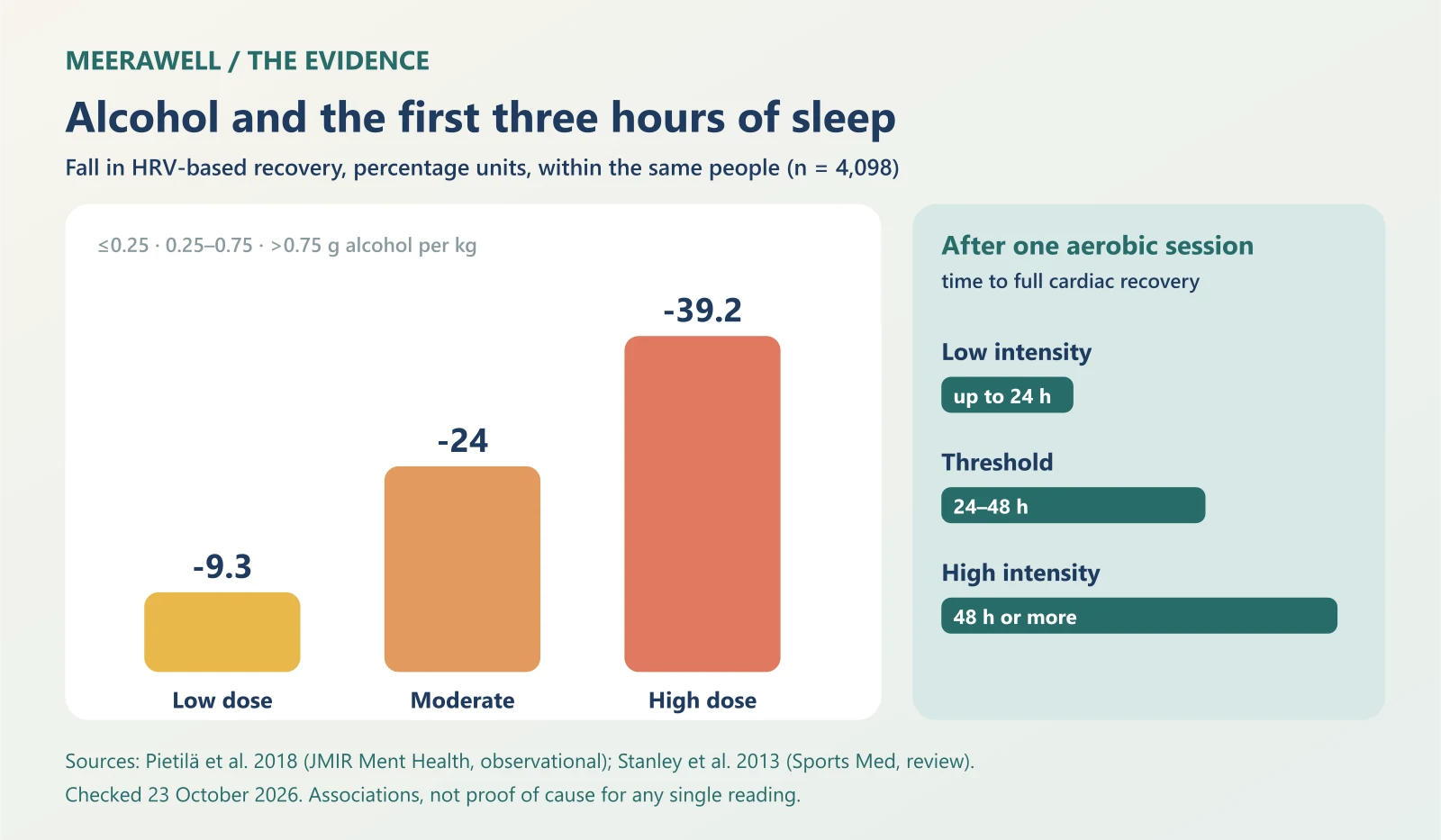
In a study of 4,098 Finnish employees, even a low dose of alcohol cut their HRV-based recovery score in early sleep by 9.3 percentage units. Moderate drinking cut it by 24.0, and heavy drinking by 39.2.
The short answer: one HRV drop usually has an ordinary cause from the last 24 to 72 hours. Rule out a measurement problem, look for the likely cause, and watch the 7-day trend. There is no universal alarm number.
New to HRV? Start with our HRV baseline guide.
1. The Science: Why an HRV Drop Happens
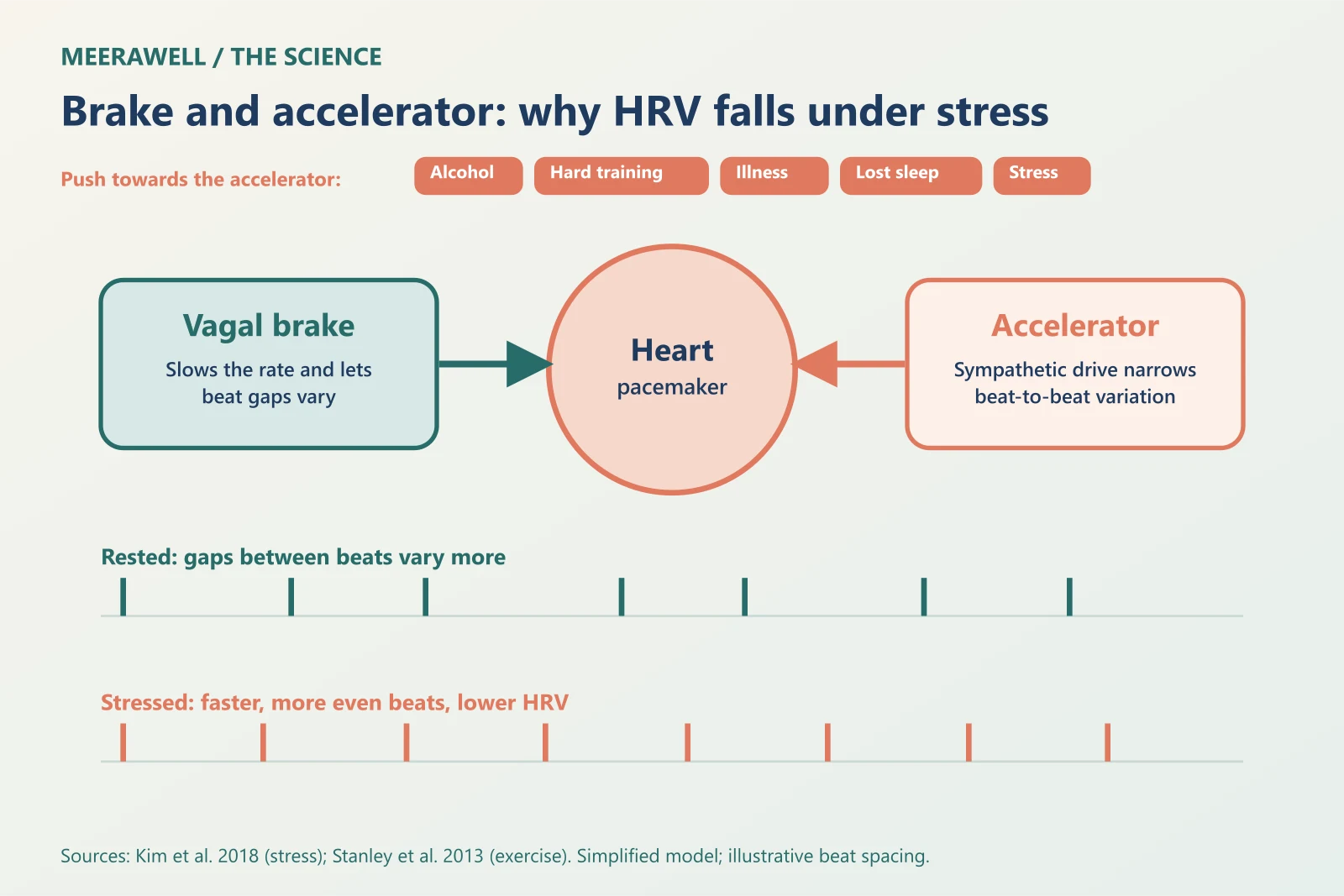
At rest, the vagus nerve acts as a brake on your heart. It lets the gap between beats vary. Stressors ease off that brake, and the beat-to-beat variation narrows.
A review of 37 studies found low parasympathetic activity was the change most often seen under stress. Exercise does the same for a while. A Sports Medicine review estimated full recovery took up to 24 hours after easy sessions and at least 48 hours after high-intensity work.
So an HRV drop often means your body is busy recovering, fighting an infection or clearing alcohol.
2. Common Causes of an HRV Drop, Ranked by Evidence
| Possible cause | What studies found | Evidence type |
|---|---|---|
| Alcohol | Dose-dependent fall in early-sleep recovery (4,098 people) | Large observational |
| Hard training | Recovery took 24–48 hours or more | Review of exercise studies |
| Illness | Apple Watch HRV shifted in the week before COVID-19 diagnosis (13 cases) | Small observational |
| Lost sleep | RMSSD fell; SDNN did not change significantly (11 trials) | Meta-analysis of trials |
| Menstrual cycle | Lower in the luteal phase (37 studies) | Meta-analysis, observational |
| Polluted air | Each 10 µg/m³ more PM2.5 linked to 2.18% lower RMSSD | Meta-analysis, observational |
The sleep finding shows why the statistic matters: a short night lowered RMSSD more clearly than SDNN. The cycle effect was largest in the premenstrual days.
Most of these are associations, not proof for your particular night. They also stack, as a festive weekend tends to show. The illness study, sleep, cycle and pollution reviews give the details.
3. Is It a Real HRV Drop? A 7-Day Check
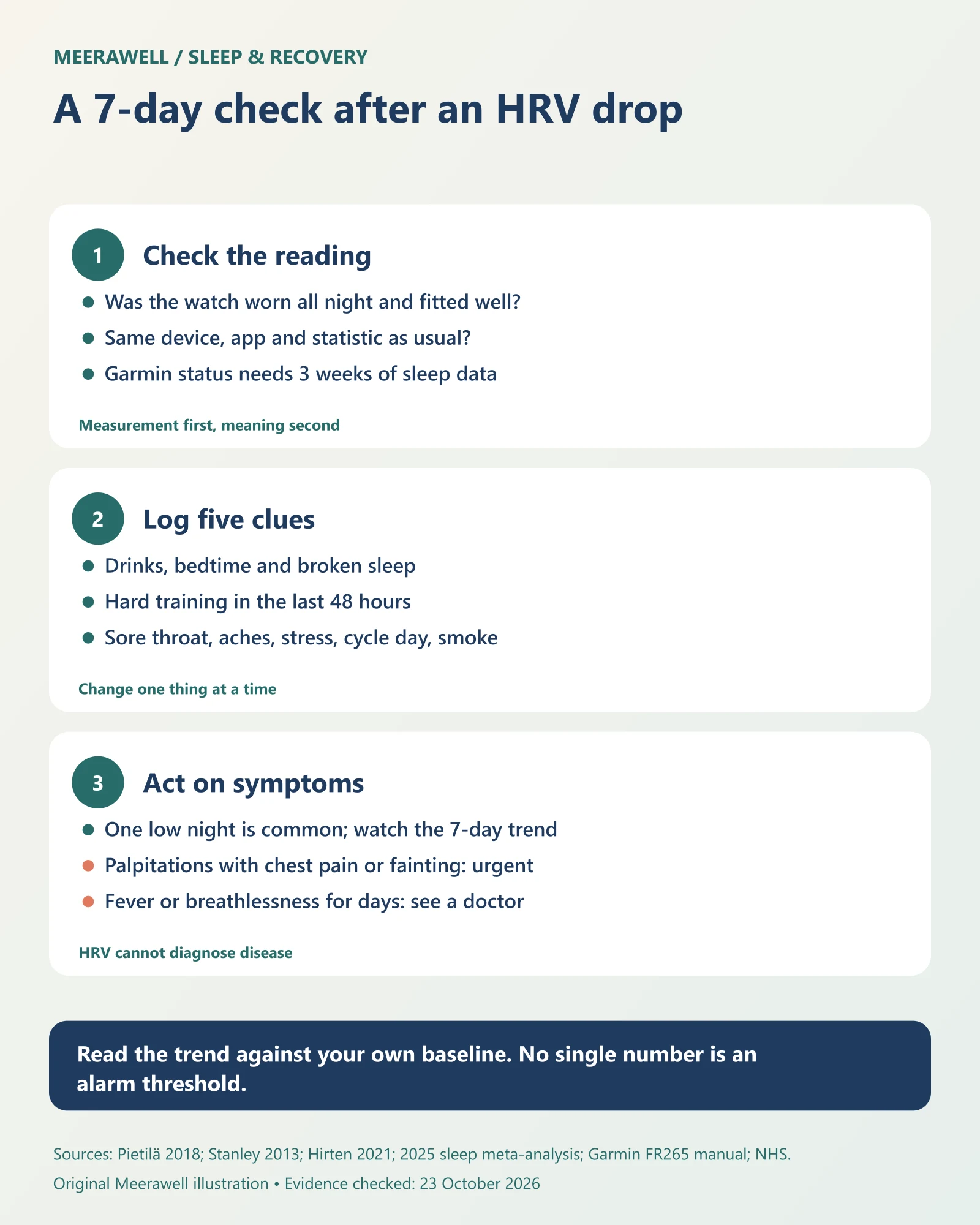
First, check the reading. The Garmin Forerunner 265 manual says it measures HRV during sleep and needs three weeks of data first. Its status then compares your 7-day average with your baseline. Apple samples HRV only while you are still. A watch removed to charge, or a loose strap, changes the data. Apple reports SDNN; many others use RMSSD, so don’t compare them directly.
Then, for a week, note each morning: drinks, bedtime, hard training in the last 48 hours, illness signs, and anything unusual such as stress, smoke or your cycle day. Change one thing at a time. If alcohol keeps lining up with low nights, try a dry week. After hard sessions, give the drop 24 to 48 hours. If you feel unwell, rest rather than train through it.
Garmin’s manual says an unbalanced status may point to fatigue, greater recovery needs or increased stress. Treat it as a question, not a verdict.
If you feel fine, our low-HRV guide helps you read the pattern calmly.
Did you know? Garmin’s “Poor” HRV status compares you with your age group. Balanced, Unbalanced and Low compare you with your own baseline.
When to see a doctor
An HRV drop alone is not an emergency. Call for help if palpitations persist or come with chest pain, breathlessness or fainting (NHS). See a doctor if fever or breathlessness lasts days.
Frequently asked questions
Why is my HRV suddenly low?
Look at the last day or two: alcohol, a late night, hard training, stress or an infection starting. Check the watch measured properly, then watch the 7-day trend.
Does alcohol lower HRV?
Yes, in a dose-dependent way. In 4,098 Finnish employees, even low doses reduced HRV-based recovery in early sleep. Being young or active did not protect people.
Should I skip training if my HRV drops?
Not automatically. Check how you feel and what you did in the last 48 hours. After a hard session or with illness signs, an easier day makes sense.
Next step
An HRV drop only means something against your own baseline. Learn how to build one.
Sources and evidence
Evidence checked on 23 October 2026. General education, not a diagnosis. No device was tested; HRV cannot diagnose disease.
- Pietilä et al., 2018: alcohol and nocturnal HRV (JMIR Ment Health)
- Stanley et al., 2013: cardiac recovery after exercise (Sports Med)
- Hirten et al., 2021: Apple Watch HRV and COVID-19 (J Med Internet Res)
- 2025 meta-analysis: sleep deprivation and HRV (Front Neurol)
- Kim et al., 2018: stress and HRV (Psychiatry Investig)
- Schmalenberger et al., 2019: HRV across the menstrual cycle (J Clin Med)
- Pieters et al., 2012: HRV and particulate air pollution (Heart)
- Garmin: Forerunner 265 manual, HRV status
- Apple Support: heart rate on Apple Watch (14 September 2026)
- NHS: heart palpitations