

Key takeaways
- Garmin HRV status compares your seven-day average of overnight HRV with your own baseline. It needs about three weeks of sleep data.
- Body Battery is a fuel gauge for right now. Training Readiness is a daily “how hard today?” score.
- None is a diagnosis. We found no independent study testing whether these scores predict performance or illness.
Your Forerunner 265 says HRV status Balanced, Body Battery low and Training Readiness Low. Contradiction? Usually not.
The short answer: Garmin HRV status is a slow trend check: is my recent HRV normal for me? Body Battery estimates your reserve right now. Training Readiness turns six inputs into a training decision. Read the trend first, then plan the day.
1. What Each Garmin Score Answers
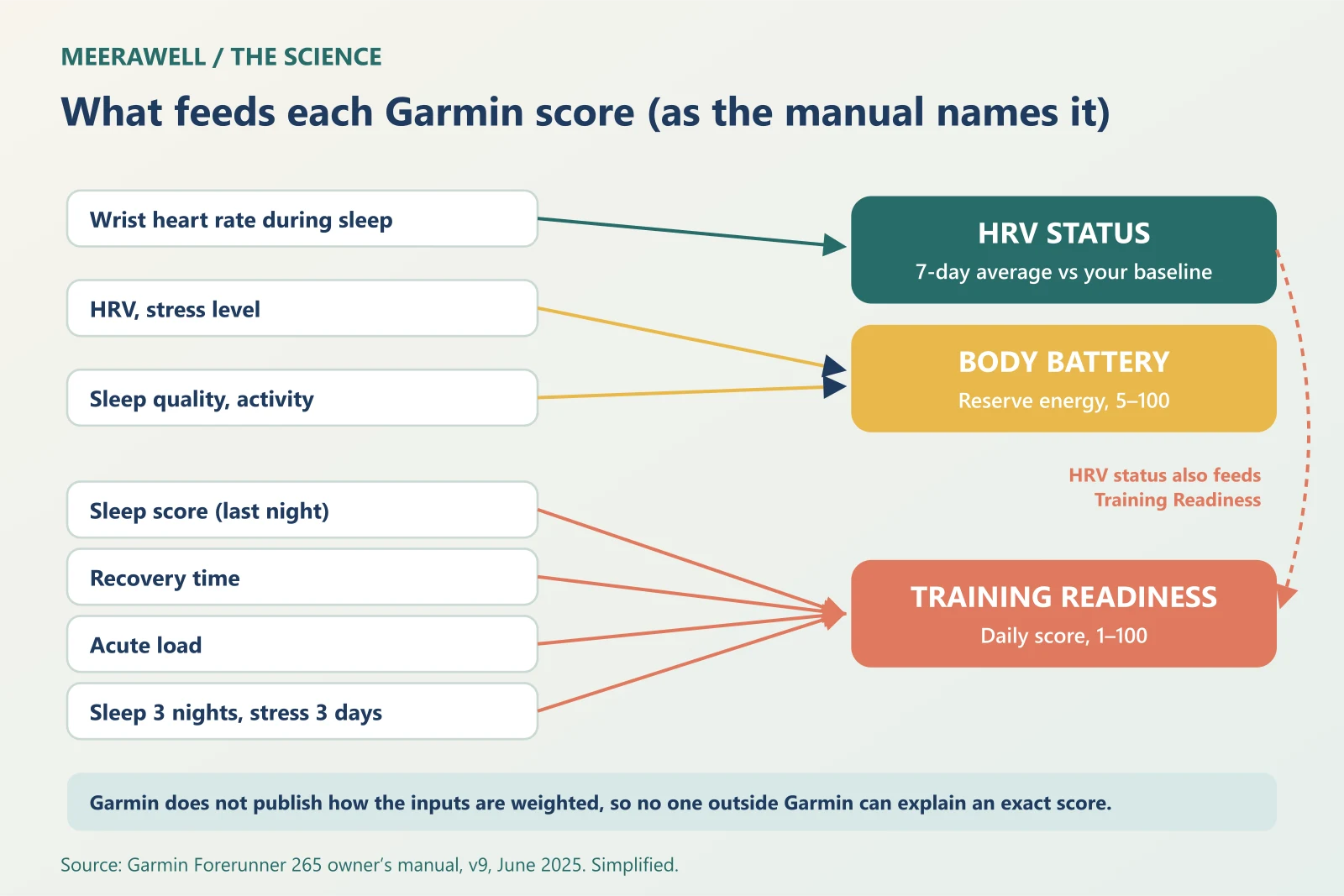
Garmin’s Forerunner 265 manual names the inputs for each score. It does not publish how they are weighted.
| Garmin HRV status | Body Battery | Training Readiness | |
|---|---|---|---|
| Question | Is my HRV trend normal for me? | How much reserve now? | How hard should I train today? |
| Inputs Garmin names | Wrist heart rate during sleep | HRV, stress, sleep quality, activity | Sleep score, recovery time, HRV status, acute load, 3 nights’ sleep, 3 days’ stress |
| Output | Balanced, Unbalanced, Low, Poor | 5 to 100 | 1 to 100 |
The four Garmin HRV status results are simple. Balanced means your seven-day average sits inside your baseline range. Unbalanced means it is above or below that range.
Low means it is well below it. Poor means your values average well below the normal range for your age. Until enough nights are recorded, the watch shows no status at all. Garmin’s Singapore guide says the baseline takes about 21 nights, and that HRV cannot diagnose illness. New to HRV? Start with our HRV baseline guide.
Models differ. The Forerunner 165 manual covers HRV status and Body Battery but not Training Readiness.
2. How Accurate Is Garmin HRV Status?
The scores depend on the overnight HRV underneath. In a 2025 study, 13 adults wore five wearables and an ECG chest strap for 536 nights.
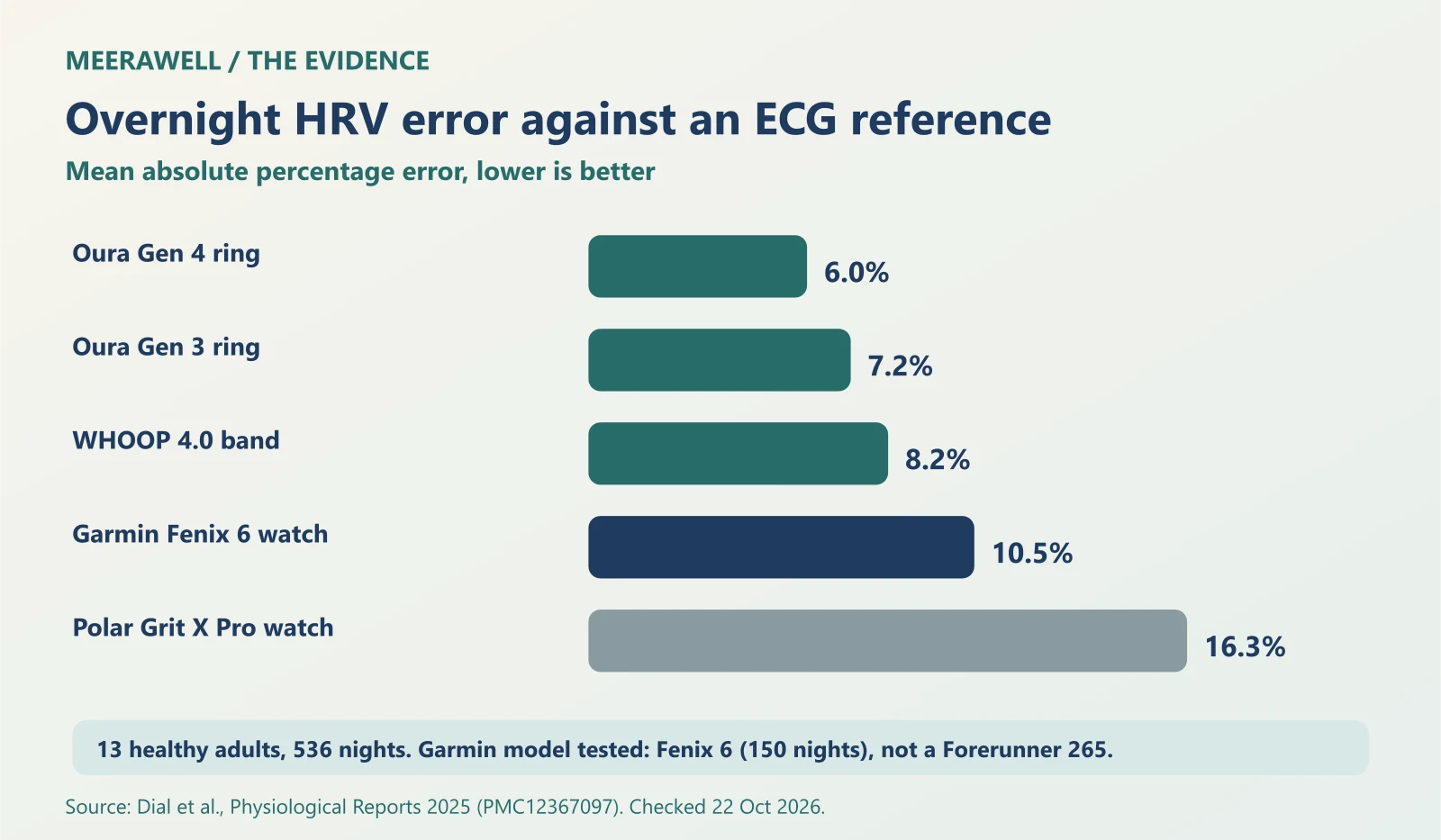
Garmin’s overnight HRV was off by about 10.5% on average, or roughly 5 milliseconds. Two Oura rings and a WHOOP band did better; a Polar watch did worse. But the Garmin tested was an older Fenix 6, not a Forerunner 265, and the sample was small. A letter from WHOOP researchers, a rival company, noted that devices average HRV over different parts of the night.
Does HRV-guided training work? A 2021 meta-analysis of eight studies (199 people) found HRV-guided plans raised HRV more than fixed plans. Fitness gains were small and not statistically significant. Those studies used morning readings, not Garmin scores.
Did you know? Garmin’s manual says food and caffeine are not Body Battery inputs. A late coffee only shows up if it disturbs your sleep.
3. How to Use Garmin HRV Status Day to Day
- Wear it to bed for three weeks so a baseline can form.
- Read the week, not the morning. A Low Garmin HRV status for several days is worth a look. Our guide to why HRV drops covers the usual causes.
- Use Training Readiness to set intensity. A low score means swap intervals for an easy session.
- Feel fine but scores look bad? Read our guide to low HRV when you feel fine.
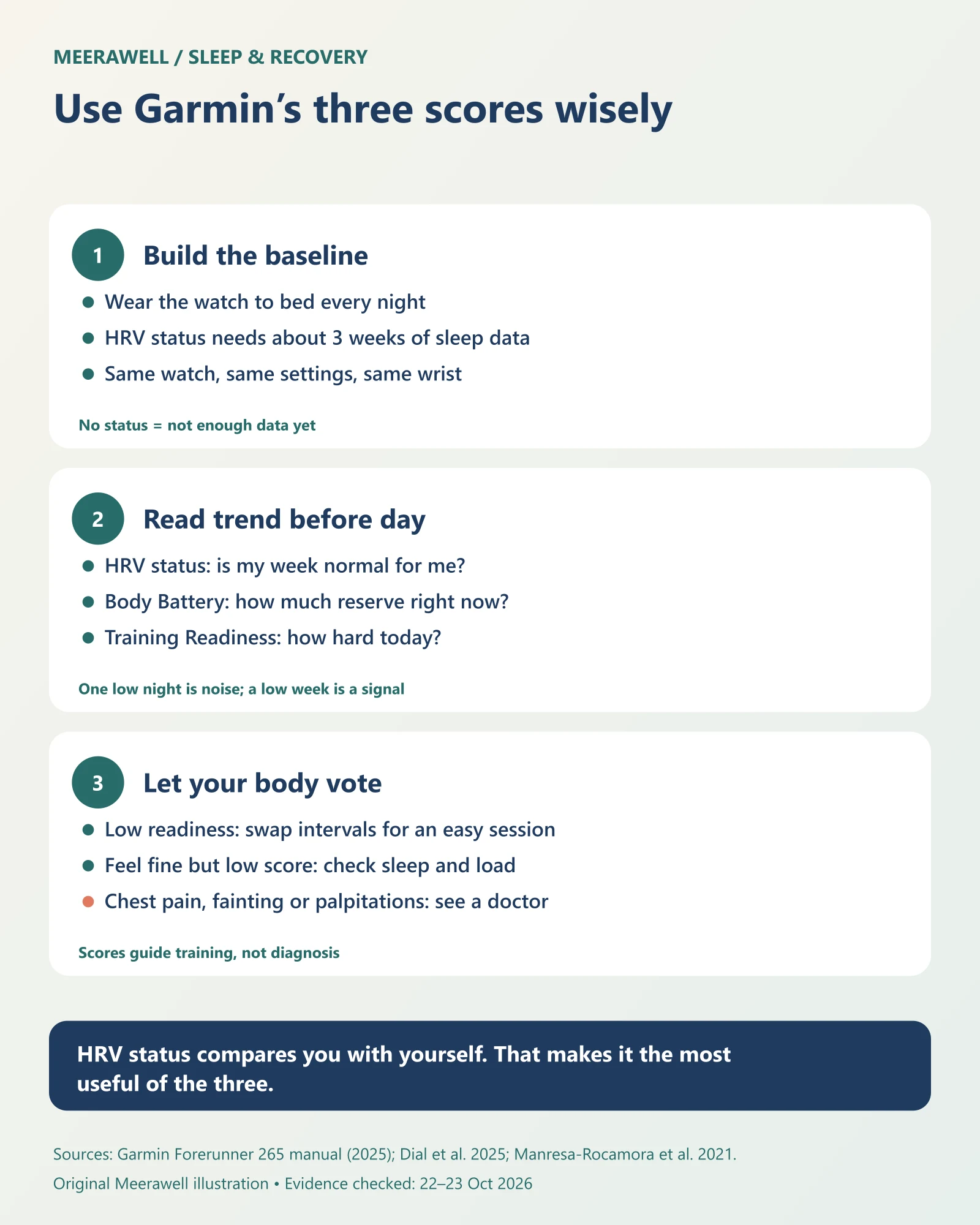
The Verdict: Garmin HRV status is the most useful of the three, because it compares you only with yourself. The other two are handy summaries, not validated health measures.
When symptoms matter more than scores
See a doctor for chest pain, fainting, a racing or irregular heartbeat, or new breathlessness, whatever your scores say. Chest pain with sweating or breathlessness is an emergency.
Frequently asked questions
What is a good HRV status on Garmin?
A Balanced Garmin HRV status means your seven-day average is inside your own baseline range. There is no single good number for everyone, so compare with your own trend.
Why is my Body Battery low after a good night’s sleep?
Body Battery also uses stress and activity data. A stressful evening or late hard workout can leave less charge. Watch the trend over several days.
Does the Forerunner 265 have Training Readiness?
Yes. The Forerunner 265 manual lists it, built from sleep score, recovery time, HRV status, acute load, sleep history and stress history.
Next step
Learn what HRV measures and why your own baseline matters most.
Sources and evidence
Evidence checked on 22–23 October 2026. Features vary by model and software; check your manual. No watch was tested. General education, not a diagnosis.
- Garmin: Forerunner 265 Series owner's manual, v9, June 2025 (PDF)
- Garmin: Forerunner 165 Series owner's manual (PDF)
- Garmin Singapore: how HRV status works (28 August 2026)
- Dial et al., 2025: nocturnal heart rate and HRV in five consumer wearables (Physiol Rep)
- Grosicki and Presby, 2025: letter on comparing wearables (Physiol Rep)
- Manresa-Rocamora et al., 2021: HRV-guided training meta-analysis (IJERPH)