

Key takeaways
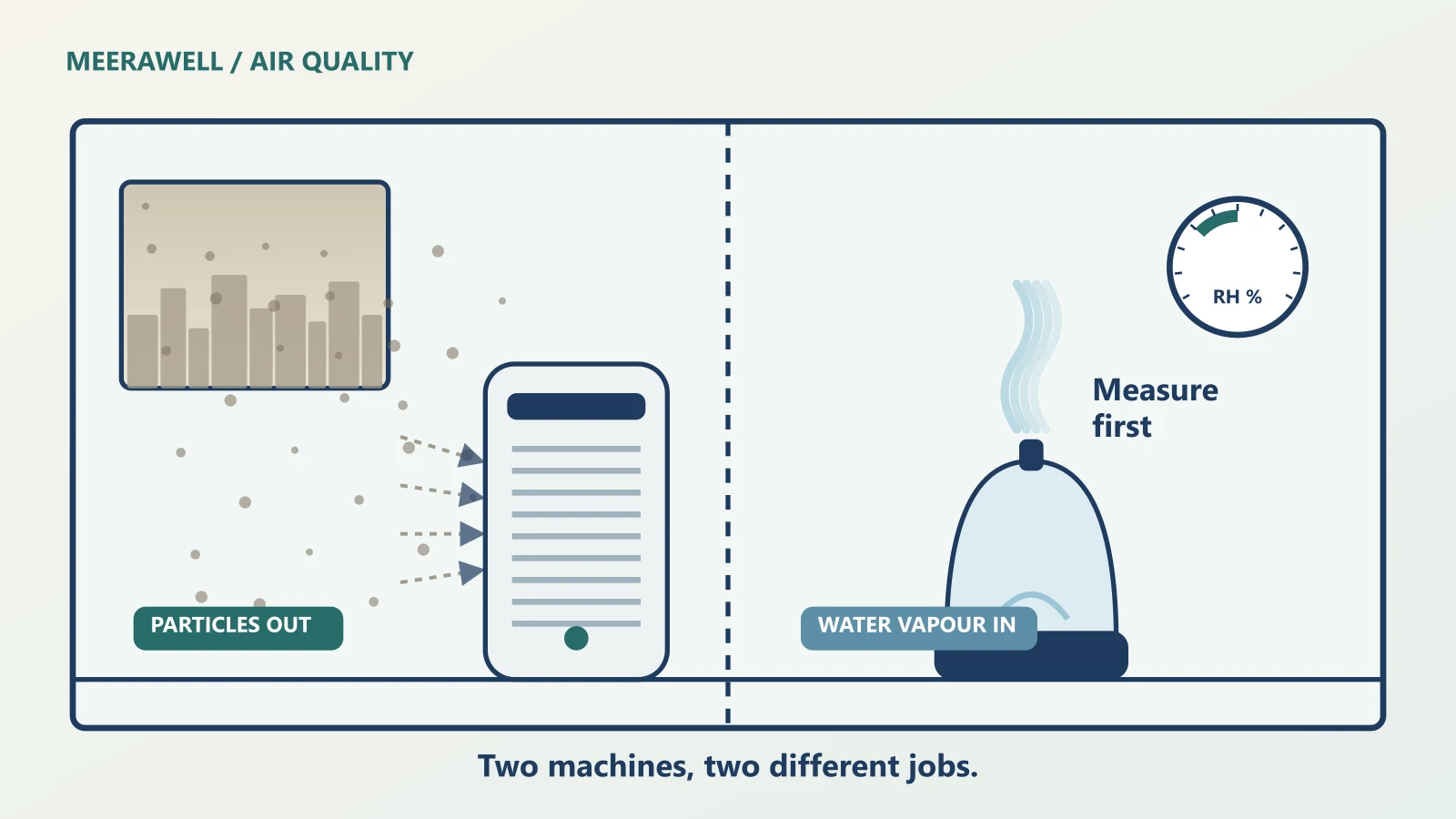
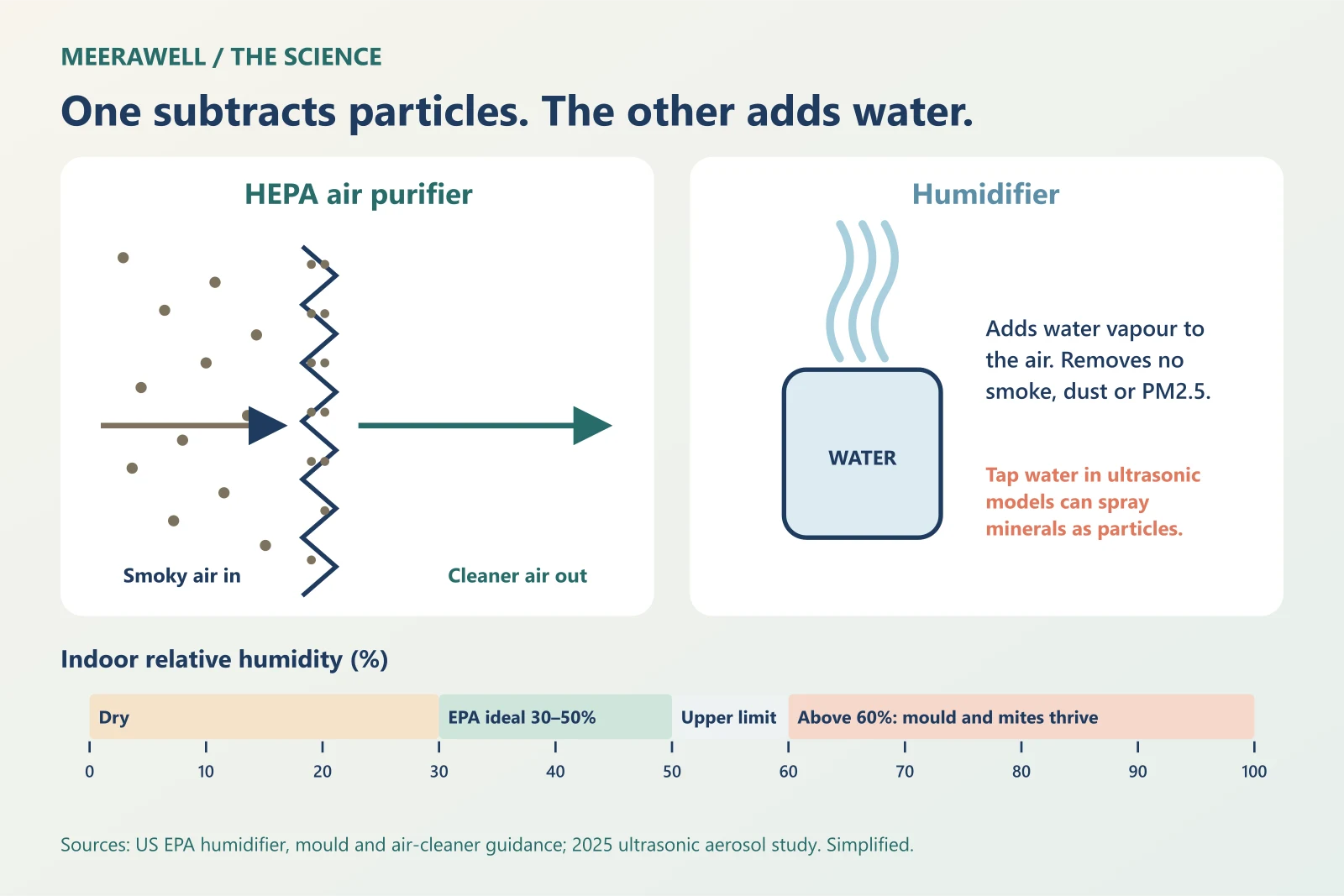
- Air purifier vs humidifier: they fix different problems. A HEPA purifier removes particles such as PM2.5. A humidifier only adds water vapour.
- Measure first. The US EPA advises indoor humidity of 30–50%, and below 60%.
- If you humidify, use distilled water, empty the tank daily and never add disinfectant.
An ultrasonic humidifier filled with tap water can spray minerals into your room as fine particles, the US EPA notes. That is the very thing your purifier is trying to remove.
The short answer: in the air purifier vs humidifier choice, match the device to the problem. Smoke or a high AQI calls for a purifier. Dry air below about 30% calls for a clean humidifier. Most homes do not need both.
1. The Science: Particles and Humidity Are Different Problems
PM2.5 means particles 2.5 micrometres across or smaller. A HEPA filter traps them as air passes through. The EPA’s air-cleaner guide notes that CADR ratings cover particles only. Most filters do little for gases.
Humidity is water vapour. A humidifier raises it but catches no smoke, dust or PM2.5. Too much is a problem too: the EPA advises staying below 60%, because mould grows in damp homes. In a 2025 lab study, ultrasonic humidifiers released up to 3 mg of aerosol per cubic metre, rich in metals from the water.
| What you notice | What usually helps |
|---|---|
| Haze, smoke smell, AQI Poor or worse | HEPA purifier sized by CADR; windows mostly shut at peak hours |
| Dry, irritated eyes or throat; hygrometer below 30% | Cool-mist humidifier, set to stop at 50% |
| Musty smell, damp walls, hygrometer above 60% | Do not humidify; ventilate or dehumidify |
| Cooking smells, incense, fumes | Exhaust fan and fresh air |
2. Air Purifier vs Humidifier: What the Evidence Shows
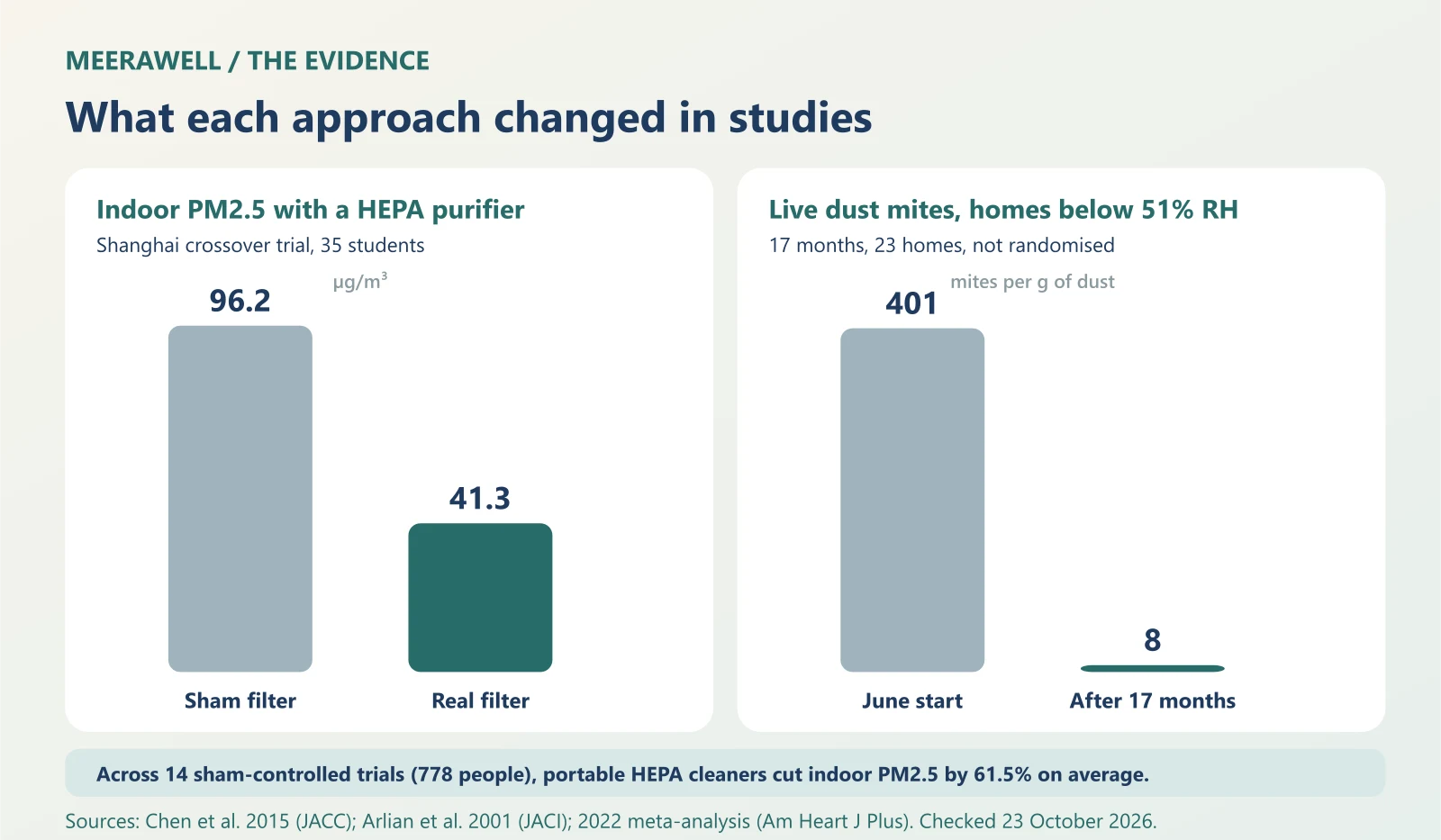
Purifiers reliably cut particles. A 2022 meta-analysis of 14 sham-controlled trials found HEPA cleaners lowered indoor PM2.5 by 61.5% on average. In a Shanghai trial of 35 students, PM2.5 fell from 96.2 to 41.3 µg/m³ within hours.
Symptom benefits are less certain. A 2026 meta-analysis of 27 trials found lower particles but no significant change in lung function or symptoms. That is an absence of proof, not proof that cleaner air does nothing for your airways.
Lower humidity starves dust mites. In a two-summer study, homes kept below 51% humidity saw live mites fall from 401 to 8 per gram of dust. The homes were compared, not randomised.
Humid air for colds is unproven. A Cochrane review of six trials found no clear benefit.
Did you know? In 2011, South Korea linked severe lung injuries to disinfectants sold for humidifier water. A 2024 review says thousands were poisoned.
3. Air Purifier vs Humidifier This Winter: What to Do
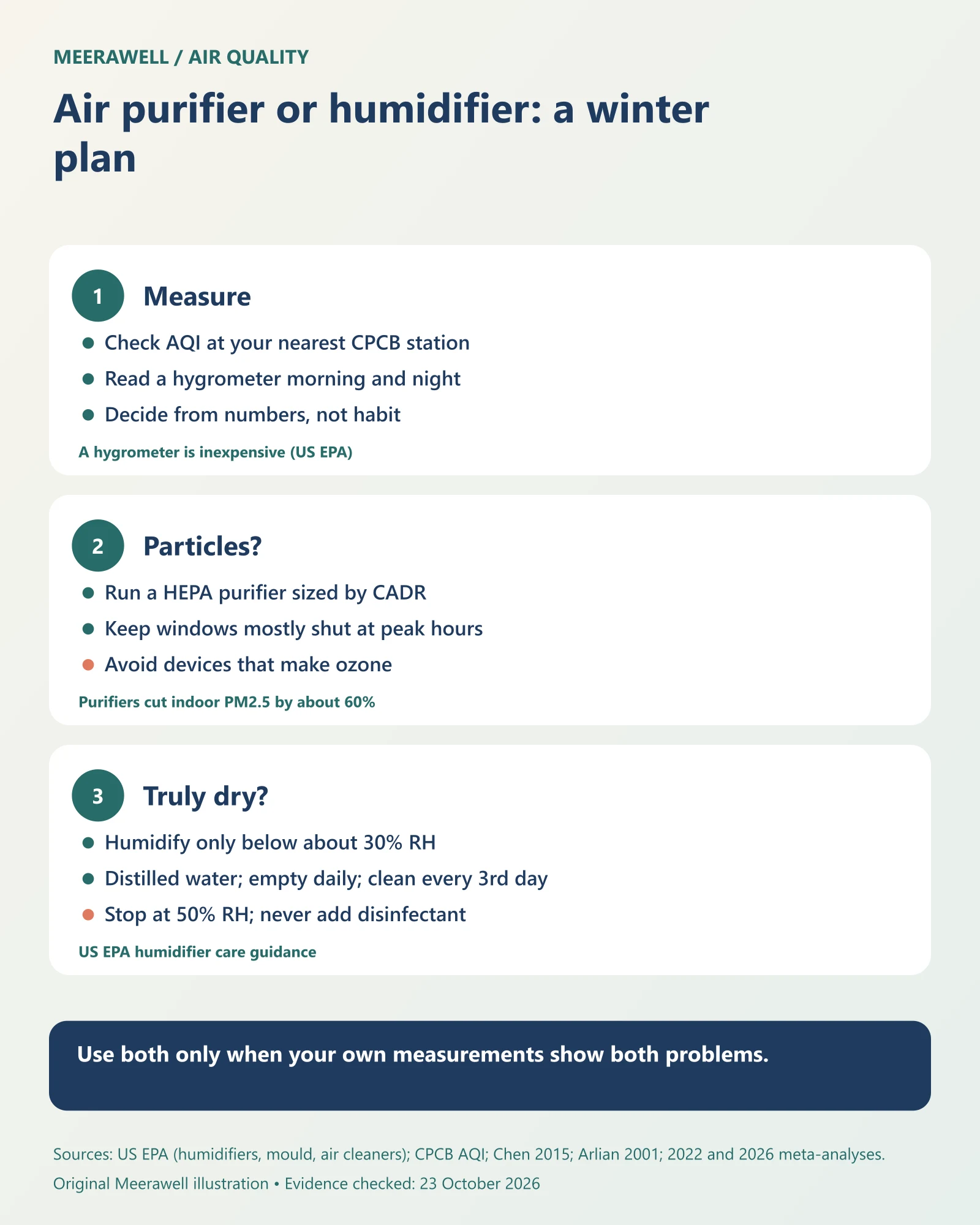
- Measure. Check your nearest CPCB AQI station. A cheap hygrometer shows indoor humidity.
- For particles, run a HEPA purifier sized for your room. See our CADR guide. Avoid devices that make ozone, a lung irritant.
- For dry air, use distilled water, empty the tank daily and clean it every third day. Stop at 50% humidity.
- Around children, prefer cool mist. Hot steam can scald: in a Dutch burns-centre study, most people burned during steam inhalation were children.
In the air purifier vs humidifier decision, “both” fits only when your readings show both problems. For airing out, see when to open windows.
When to see a doctor
See a doctor if fever, cough or breathlessness returns whenever the humidifier runs. A case report linked this to an ultrasonic humidifier. Breathlessness at rest needs urgent care.
Frequently asked questions
Air purifier vs humidifier: which is better for cough?
Neither treats a cough. A purifier lowers irritant particles, while humid air showed no clear benefit for colds. See a doctor for a cough over two weeks or with breathlessness.
Can I use an air purifier and a humidifier together?
Yes, if a hygrometer shows dry air as well as a particle problem. Use distilled water so the humidifier adds no mineral particles, and stay at or below 50%.
Is a humidifier good for a baby’s room?
Only if the room is measurably dry. Choose cool mist, use distilled water, clean it often and keep it out of reach. It does not treat a cough.
Next step
Before buying a second machine, check that your purifier is big enough for the room.
Sources and evidence
Evidence checked on 23 October 2026. General education, not medical advice. No device was tested.
- US EPA: use and care of home humidifiers
- US EPA: mold, moisture and your home (humidity 30–50%)
- US EPA: guide to air cleaners in the home
- 2025 study: ultrasonic humidifier aerosols (J Environ Sci)
- 2022 meta-analysis: portable air cleaners and PM2.5 (Am Heart J Plus)
- Chen et al., 2015: air purifier crossover trial (J Am Coll Cardiol)
- 2026 meta-analysis: personal protective measures (Indian J Occup Environ Med)
- Arlian et al., 2001: humidity and dust mites (J Allergy Clin Immunol)
- Cochrane review, 2017: heated, humidified air for colds
- Review, 2024: Korea's humidifier disinfectant tragedy (J Korean Med Sci)
- Baartmans et al., 2012: scalds from steam inhalation (Br J Gen Pract)