

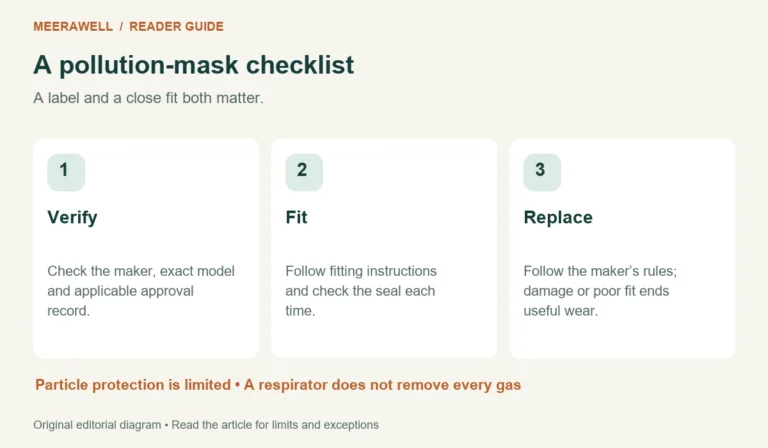
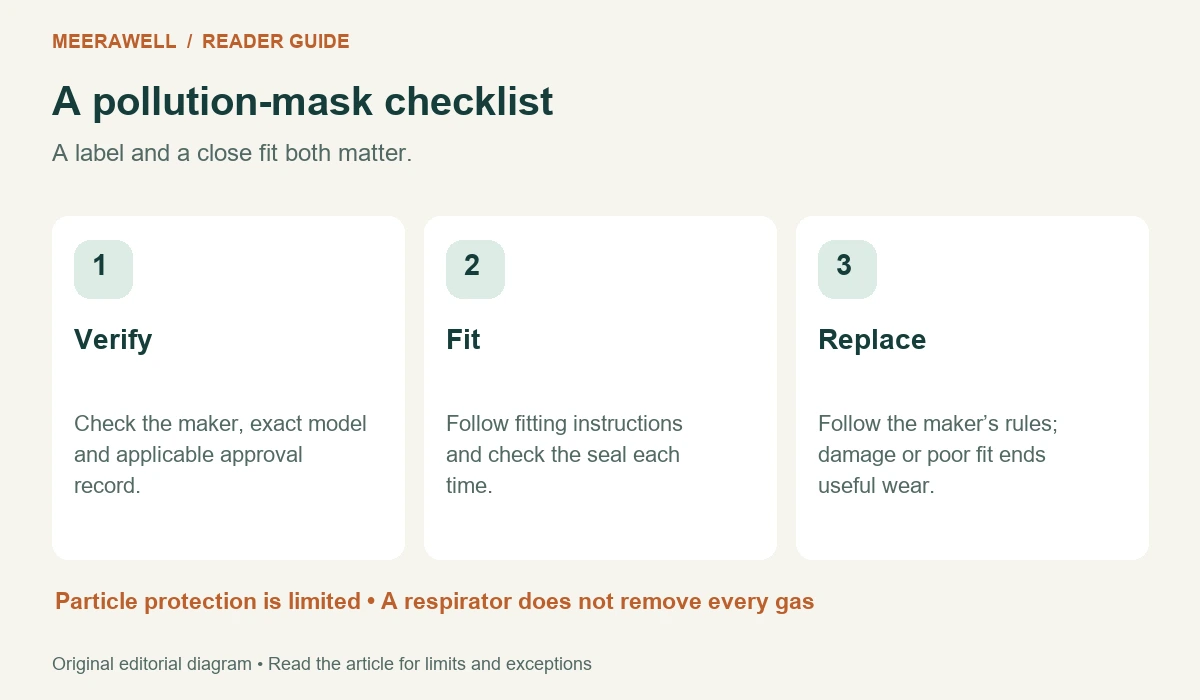
The useful pollution mask is one you can authenticate, fit closely and wear consistently. A label saying “five layers” or “anti-pollution” is not enough to establish protection.
For particle pollution, start with a genuine particulate respirator that seals well to your face. It reduces exposure; it does not make polluted air safe, remove every pollutant or replace reducing time outdoors when air quality is poor.
N95 and KN95 are not interchangeable approval labels
N95 describes a class within the US NIOSH approval system. A KN95 label is not NIOSH approval. Other standards frameworks, including FFP classifications, have their own requirements; do not treat the names as interchangeable certification. The letters alone do not prove that a marketplace product is genuine or fits your face.
A surgical mask is loose-fitting and is not the same as a tight-fitting particulate respirator. A cloth face covering should not be treated as an equivalent substitute for reliable particle protection.
On a narrow screen, scroll the table sideways.| Buying question | What to check |
|---|---|
| Who made it? | Manufacturer and exact model, not just the seller's listing title |
| What approval is claimed? | The applicable standard and traceable approval or licence details |
| Does the record match? | The same manufacturer, model and approval markings |
| Will it fit? | Available sizes, strap design and the manufacturer's fitting instructions |
| Can I use it correctly? | Instructions for fitting, replacement and any permitted reuse |
The NIOSH filtering-facepiece guide explains the required markings, including NIOSH, the protection class and a TC approval number. Match the model and approval number in its linked Certified Equipment List. NIOSH also explains that it does not validate international-standard claims.
For an Indian standards claim, the BIS catalogue search for 9473 lists IS 9473:2002, particle-filtering half masks, reaffirmed in January 2026. Check the licence number and maker through the BIS licence lookup. A standard number printed on a pack is not proof of a valid licence. This guide has not authenticated any particular mask.
Fit is part of the protection
Follow the instructions for the particular respirator. Position it over nose, mouth and chin, place the straps as directed and shape the nose clip if it has one. Perform the manufacturer's seal check each time you put it on.
Air should not obviously leak around the edges. Facial hair crossing the sealing surface can prevent a reliable seal. A different size or shape may work better than repeatedly tightening an unsuitable mask.
A home seal check is not a professional fit test. Workplace protection requirements may include formal fit testing and other controls.
The EPA's public smoke guidance recommends two head straps and trying another size or model if leakage persists. That guidance concerns smoke particles; it is useful for fitting principles, not an India-specific AQI threshold or evidence that every pollution mixture is controlled.
If your glasses keep fogging
Fogging can be a clue that warm exhaled air is escaping near the nose, but it is not a precise fit test. Refit the respirator according to its instructions and check the nose area and straps. No fogging does not prove that the seal is sound.
Try a different well-fitting model if the problem persists. Do not cut the respirator, alter the straps or add an improvised vent to solve fogging. A mask should not force you to work or travel with vision you cannot use safely.
Reuse is not the same as washing
Follow the manufacturer's instructions for permitted reuse, storage and disposal. Do not assume a disposable respirator can be cleaned like a cloth mask or apply a cleaning method the maker has not authorised.
Replace it when it is damaged, dirty, difficult to breathe through or no longer seals reliably. There is no universal “seven days” or “ten uses” rule that covers every respirator and exposure. Keep spare masks available rather than stretching one beyond usable condition.
What a mask cannot do
Filtering facepiece respirators protect against particles, not gases or vapours. If you have heart or lung disease, are pregnant or are unsure you can tolerate one, ask your clinician. If you become breathless or dizzy while wearing it, move to cleaner air and remove it; seek care for severe or persistent symptoms. Adult models may not fit children; do not assume a small-looking mask has suitable protection for them. Reducing exposure remains especially important when a reliable fit is unavailable.
For deciding whether to exercise outside, use the India AQI and exercise guide. Indoors, filtration and ventilation solve different problems. For burning or watery eyes on smoggy days, see the pollution-eye guide.
Buy for a verifiable standard and a workable seal, then reduce exposure where you can. This guide does not rank brands or claim hands-on testing of any mask.