
Key takeaways
- Lubricating eye drops (artificial tears) add moisture plus a coating polymer to the eye’s surface. They ease dryness; they do not treat its cause.
- The label tells you most of it: cellulose (CMC or HPMC), sodium hyaluronate, PEG and propylene glycol, or a lipid emulsion. Thicker products last longer but blur more.
- If you use drops often, the preservative matters most. TFOS advises against preserved artificial tears more than six times a day; preservative-free drops are gentler for frequent use.
The Molecule First Found in a Cow’s Eye
In 1934, Karl Meyer and John Palmer, working in the ophthalmology laboratory at Columbia University, isolated a new substance from the vitreous of cattle eyes, the clear gel that fills the eyeball. According to the hyaluronan historian Torvard Laurent, they named it from hyaloid, meaning vitreous, and uronic acid, one of its building blocks.
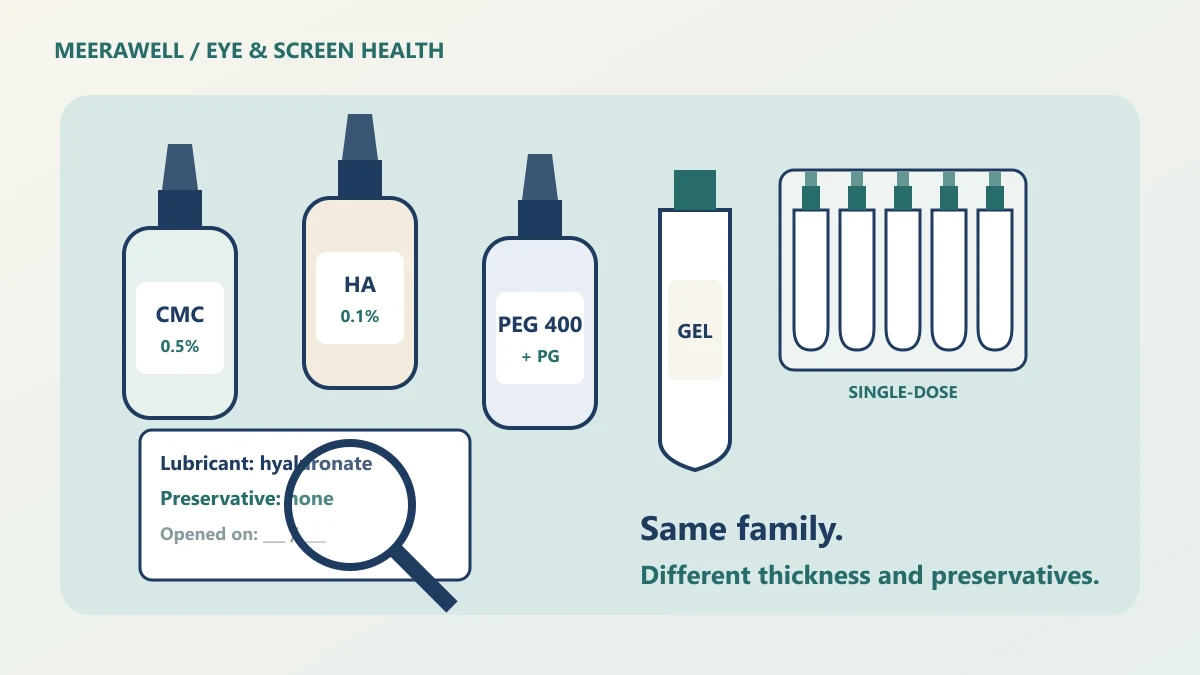
Hyaluronic acid now sits on the chemist’s counter, in a carton beside three others: carboxymethylcellulose 0.5%, polyethylene glycol 400 and propylene glycol, and a gel. The queue behind you is waiting.
Which one?
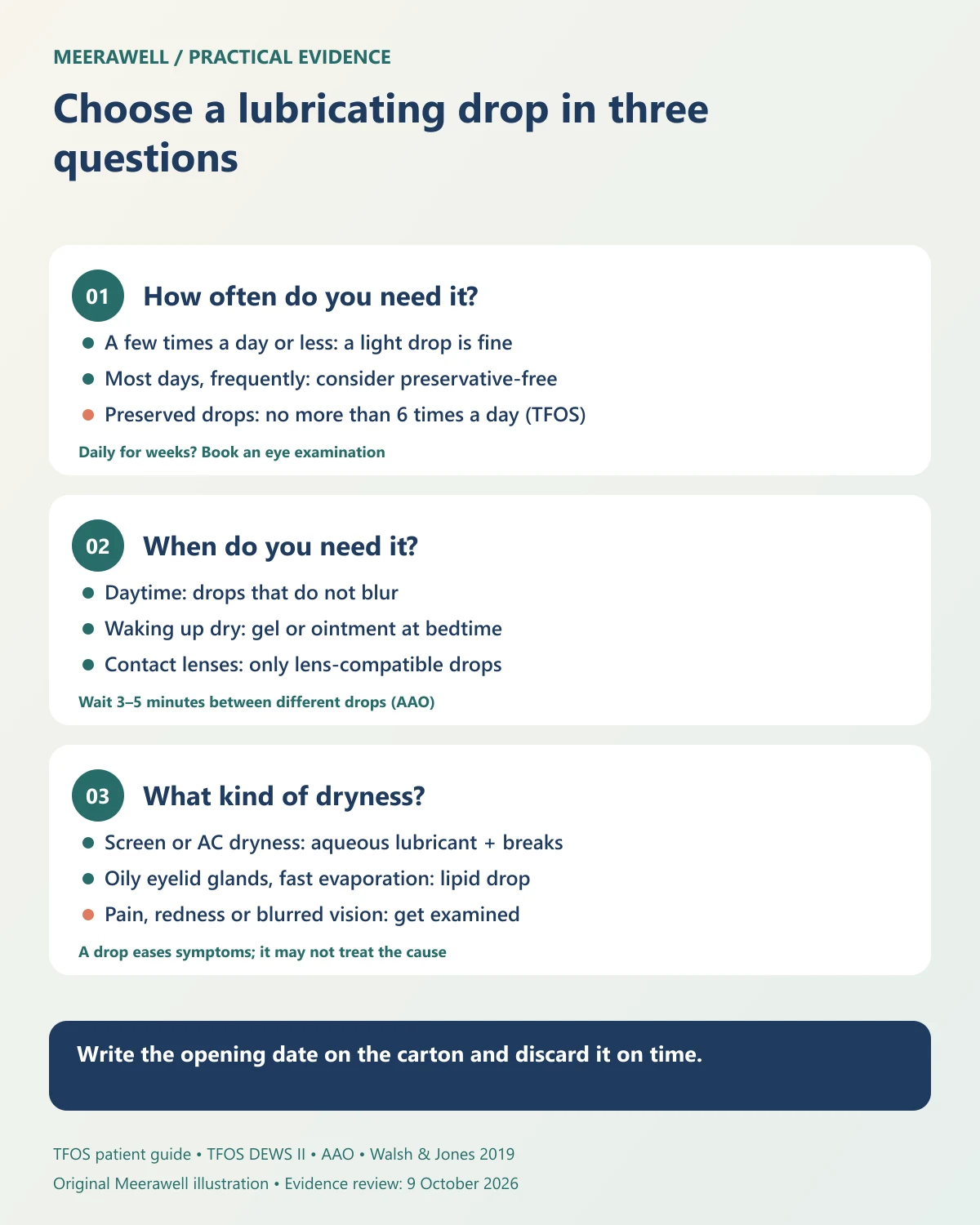
The short answer: most lubricating eye drops belong to one family and differ in two ways: thickness and preservative. Choose a light drop for occasional daytime use, a gel for night-time or longer-lasting dryness, and preservative-free drops whenever you use them often.
1. What Lubricating Eye Drops Actually Do
Tears are a layered film of oil, water and sticky mucins. When that film becomes unstable, eyes feel gritty, burning or tired, and vision blurs until you blink.
Drops add volume and a viscosity agent, a polymer that keeps the drop on the eye for longer. Dr Juan Ding explains this in a patient guide from the Tear Film & Ocular Surface Society (TFOS). It is why lubricants come first in the staged approach of the TFOS DEWS II report on dry eye treatment.
But a lubricant soothes. It does not unblock eyelid oil glands, calm inflammation or replace tears reduced by a medicine. That is why persistent dryness deserves an examination.
2. The Science: Thick When Still, Thin When You Blink
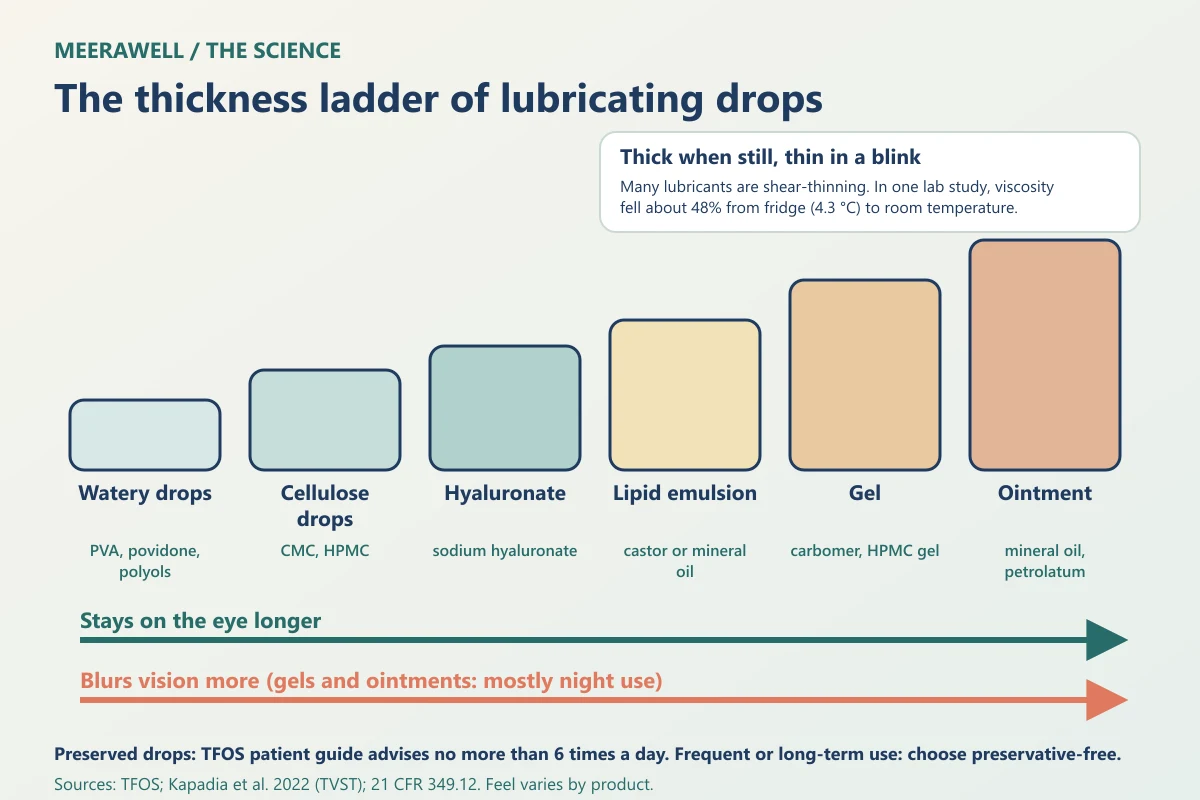
Your eyelid sweeps across the eye at speed. A drop that stayed thick would drag and smear. A drop that stayed thin would drain away almost at once.
Many lubricants solve this by being shear-thinning: thicker when the eye is still, thinner when the lid moves across them. A 2022 laboratory study of 12 ocular lubricants confirmed this. Temperature mattered too: on average, viscosity fell by about 48% from fridge to room temperature, and by about another 21% from room temperature to eye-surface temperature (34.5 °C).
The eye itself was not tested. Still, it explains why gels feel so different from drops.
3. Reading the Label
| On the label | How it tends to feel | Typical use |
|---|---|---|
| Carboxymethylcellulose (CMC, carmellose) or hypromellose (HPMC) | Light to medium | Daytime |
| Sodium hyaluronate (hyaluronic acid, HA) | Light to medium | Daytime |
| PEG 400, propylene glycol, glycerin | Light | Daytime |
| Milky lipid emulsion (castor oil, mineral oil or phospholipids) | May blur briefly | Evaporative dryness, eyelid oil-gland problems |
| Gel or ointment | Thick; blurs for a while | Night-time and morning dryness |
Is a higher percentage better? Not necessarily. The US rules for over-the-counter eye lubricants allow cellulose derivatives from 0.2% to 2.5%. A thicker product may last longer, but it can blur vision and crust on the lashes.
4. Preservatives: What Matters Most If You Use Drops Often
Multi-dose bottles need a preservative to stop germs growing inside. But a 2019 review describes the preservative as the ingredient with the greatest potential to harm the eye’s surface. The TFOS guide names benzalkonium chloride (BAK) as the most common one, and warns that it can damage the cells of the cornea and conjunctiva.
Three TFOS rules are worth remembering:
- Do not use preserved artificial tears more than six times a day.
- Discard an opened bottle after the period on the label, even if it is not empty.
- Discard an opened single-dose vial within 24 hours.
| How often you use drops | A sensible starting choice |
|---|---|
| Occasionally | Light lubricant; a gently preserved bottle is reasonable |
| Most days, up to about four times | Consider preservative-free |
| More than four to six times a day, or daily for weeks | Preservative-free, plus an eye examination |
| You also use glaucoma drops | Ask your eye doctor; preservatives add up |
5. How to Use Lubricating Eye Drops So They Work
The American Academy of Ophthalmology’s steps are simple:
- Wash your hands and tilt your head back slightly.
- Pull the lower eyelid down to make a small pocket.
- Squeeze one drop in, without letting the tip touch the eye or lashes.
- Close your eyes and press gently at the inner corner for a minute or two.
- Wait 3 to 5 minutes before using a different drop.
Write the opening date on the carton, and keep drops away from a hot dashboard or windowsill.
Did you know? The American Academy of Ophthalmology suggests asking your pharmacist whether your drops can be kept in the fridge. A cold drop is easier to feel, so you know it has gone in. Check the carton first, because storage advice differs between products.
The Verdict: the best lubricating eye drop is not the thickest or the most expensive. It is the one that suits how often, when and why your eyes are dry. If smog is part of the problem, read our guide to pollution eye irritation.
When drops are not enough
Arrange an eye examination if you notice:
- needing drops more than four to six times a day, or every day for weeks
- eye pain, light sensitivity or blurred vision that does not clear with blinking
- a red eye that is not improving, or discharge
- stinging every time you use a particular drop
Do not use steroid drops, or someone else’s prescription drops, for dryness without an examination.
Frequently asked questions
Can I use lubricating eye drops every day?
Many people do. For frequent or long-term use, preservative-free drops are the gentler choice. If you need them every day for weeks, an eye examination can look for a treatable cause.
Is CMC or hyaluronic acid better?
There is no single winner. Both are established lubricants. Comfort, how long the drop lasts for you, blur, preservative and price all matter. Try one for a couple of weeks before switching.
Are lubricating drops the same as redness-relief drops?
No. Redness-relief drops narrow blood vessels to make the eye look whiter and can cause rebound redness with regular use. Lubricating drops add moisture and do not work that way.
Next step
Drops help most when the reason for dryness is also fixed. Screens, airflow and sleep often matter as much as the bottle.
Sources and evidence
Evidence checked on 9 October 2026. General education, not a prescription or brand recommendation. Formulations vary; read the carton and follow your eye doctor’s advice.
- Laurent, Glycoforum 2002: hyaluronan research in the 20th century
- TFOS: a patient's guide to artificial tears
- Jones et al., 2017: TFOS DEWS II management and therapy report (Ocular Surface)
- Kapadia et al., 2022: shear-thinning and temperature-dependent viscosity of ocular lubricants (TVST)
- US Code of Federal Regulations, 21 CFR 349.12: ophthalmic demulcents
- Walsh and Jones, 2019: the use of preservatives in dry eye drops (Clinical Ophthalmology)
- American Academy of Ophthalmology: how to put in eye drops
- American Academy of Ophthalmology: redness-relieving eye drops