

Key takeaways
- Screen time myopia research shows a link, not proof: each extra daily hour of screens went with 21% higher odds of myopia.
- Time outdoors has the strongest evidence, from randomised trials.
- Daylight, breaks, distance, age limits and an early eye test all help.
In 1999, about 4 in 100 urban Indian children were short-sighted. By 2019 it was 21 in 100, one study found.
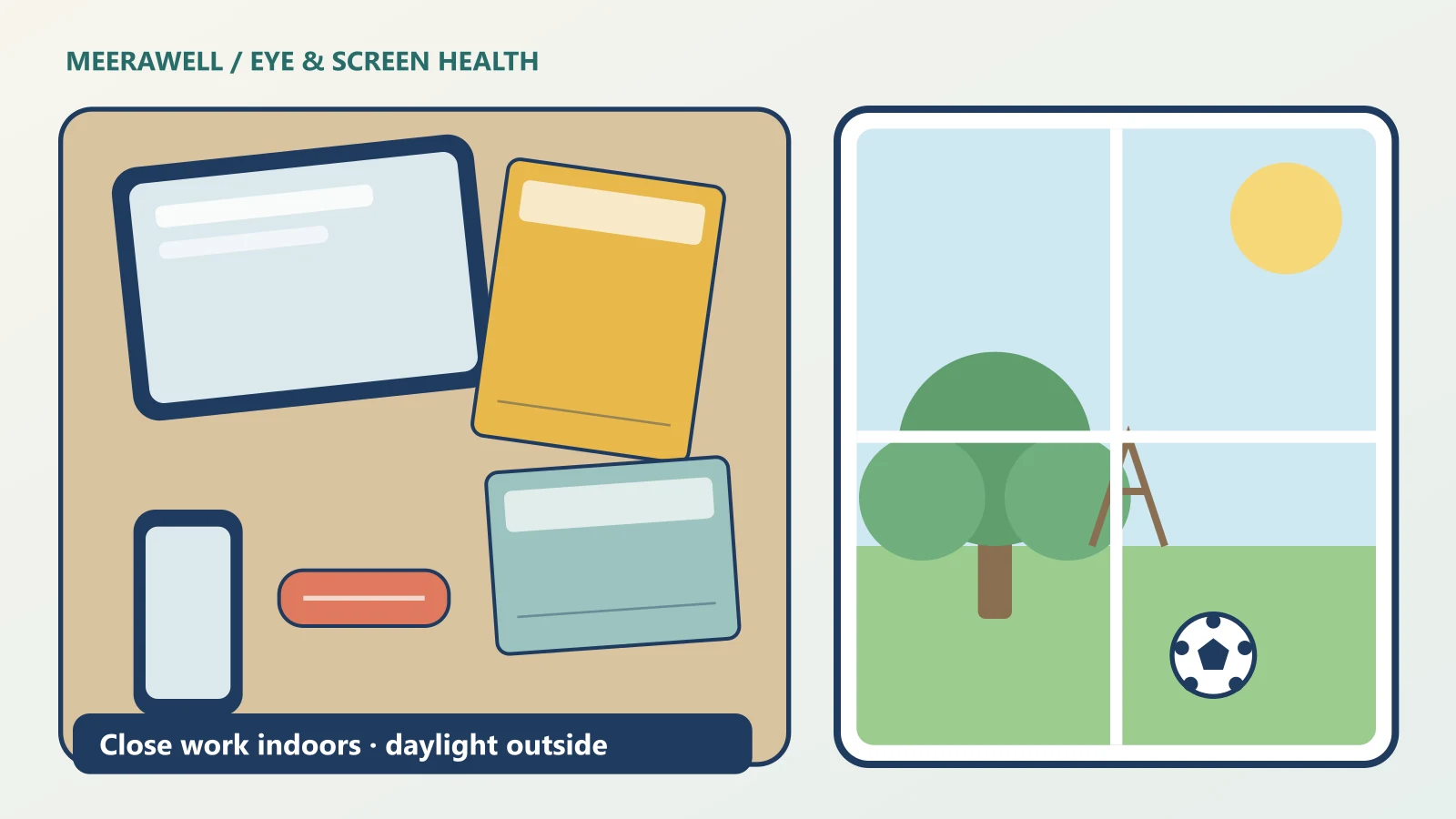
The short answer: more screen time is linked with more myopia, but studies can’t yet prove screens cause it. Screens may matter mainly because they keep children indoors and focused up close. Daily outdoor time is the best-proven protection.
1. Why Close Work and Indoor Days Lengthen the Eye
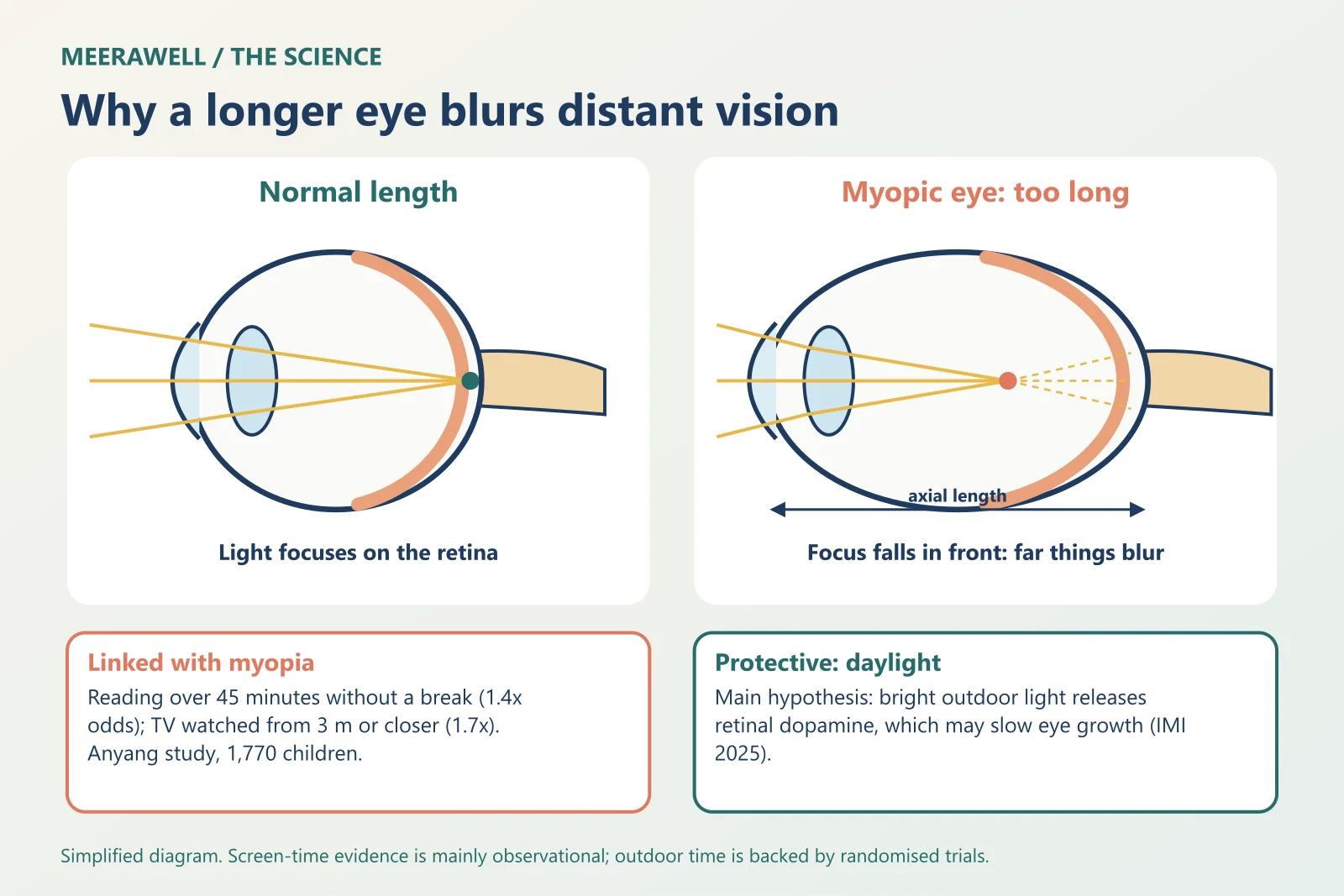
Most childhood myopia happens because the eyeball grows too long. Light from far objects then focuses in front of the retina, so distant things blur. A longer eye does not shrink back.
Two habits seem to push that growth. In the Anyang study of 1,770 children, reading for over 45 minutes without a break went with higher odds of myopia. So did watching TV from 3 metres or closer. And bright outdoor light may slow eye growth by releasing dopamine in the retina. That is the main idea in the International Myopia Institute’s 2025 digest.
Phones do both: they are held close and used mostly indoors.
2. What the Screen Time Myopia Research Shows
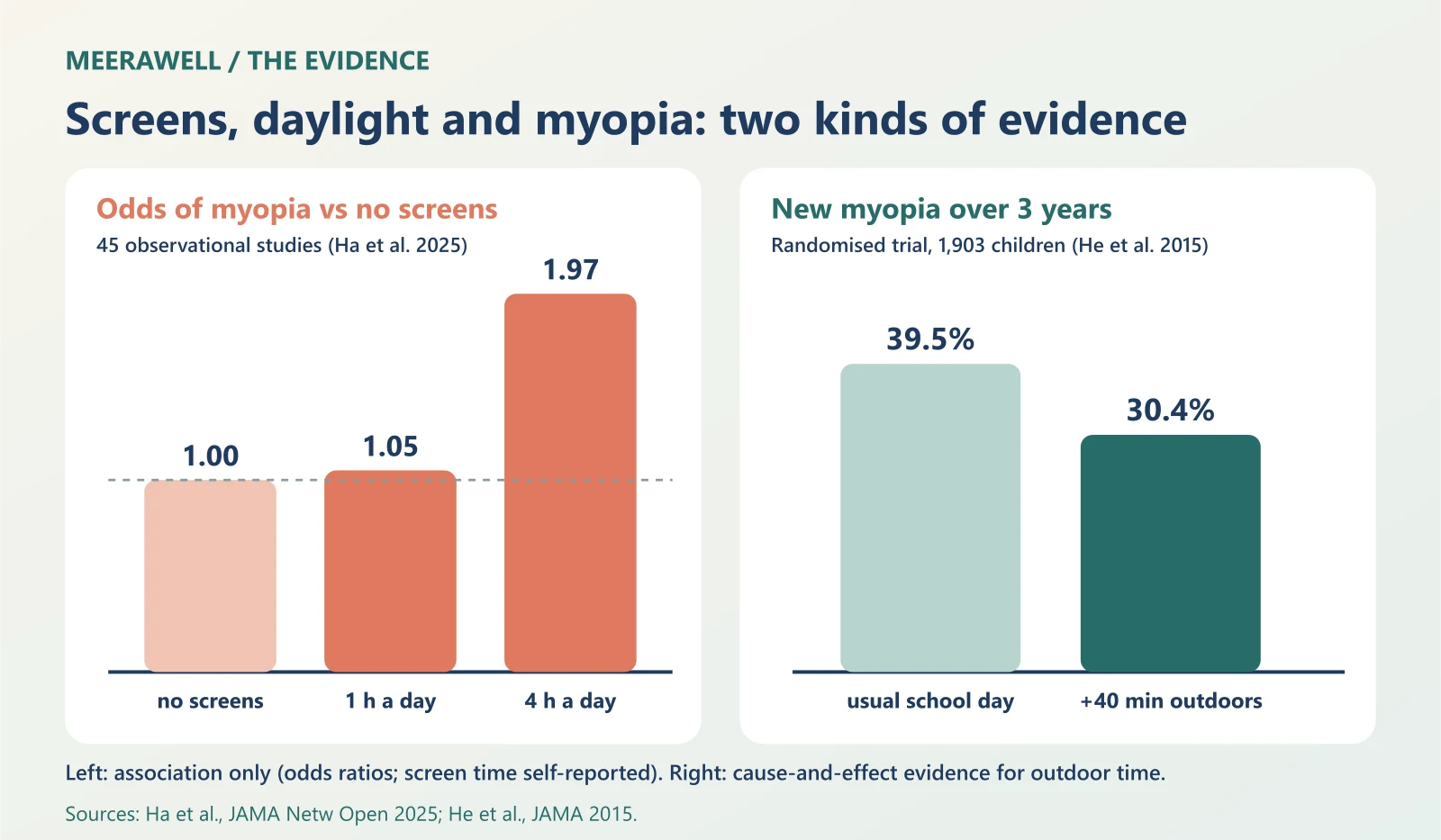
A 2025 review in JAMA Network Open pooled 45 studies with 335,524 people, mostly children. Each extra daily hour of screens went with 21% higher odds of myopia. Four hours a day roughly doubled the odds. But these studies only show a link, and most asked parents to estimate screen time.
The Institute calls the screen time myopia findings inconsistent. Cutting screens alone may not help much without more time outside.
Outdoor time is different. It was tested in randomised trials:
| Step | Evidence | Result |
|---|---|---|
| Extra 40-minute outdoor class daily | Trial, 1,903 children | New myopia 30.4% vs 39.5% over 3 years |
| Outdoor recess, up to 11 hours a week | Trial, 693 children | 54% lower odds of fast progression |
| Less screen time | Observational | Linked, not proven |
The trials come from Guangzhou and Taiwan. Shade still counted, which helps in an Indian summer.
Did you know? Myopia was rising in East Asia before smartphones existed. Phones only became common around 2008. So the long-term effect of phones from infancy is still unknown.
3. Cutting Screen Time Myopia Risk: What Parents Can Do
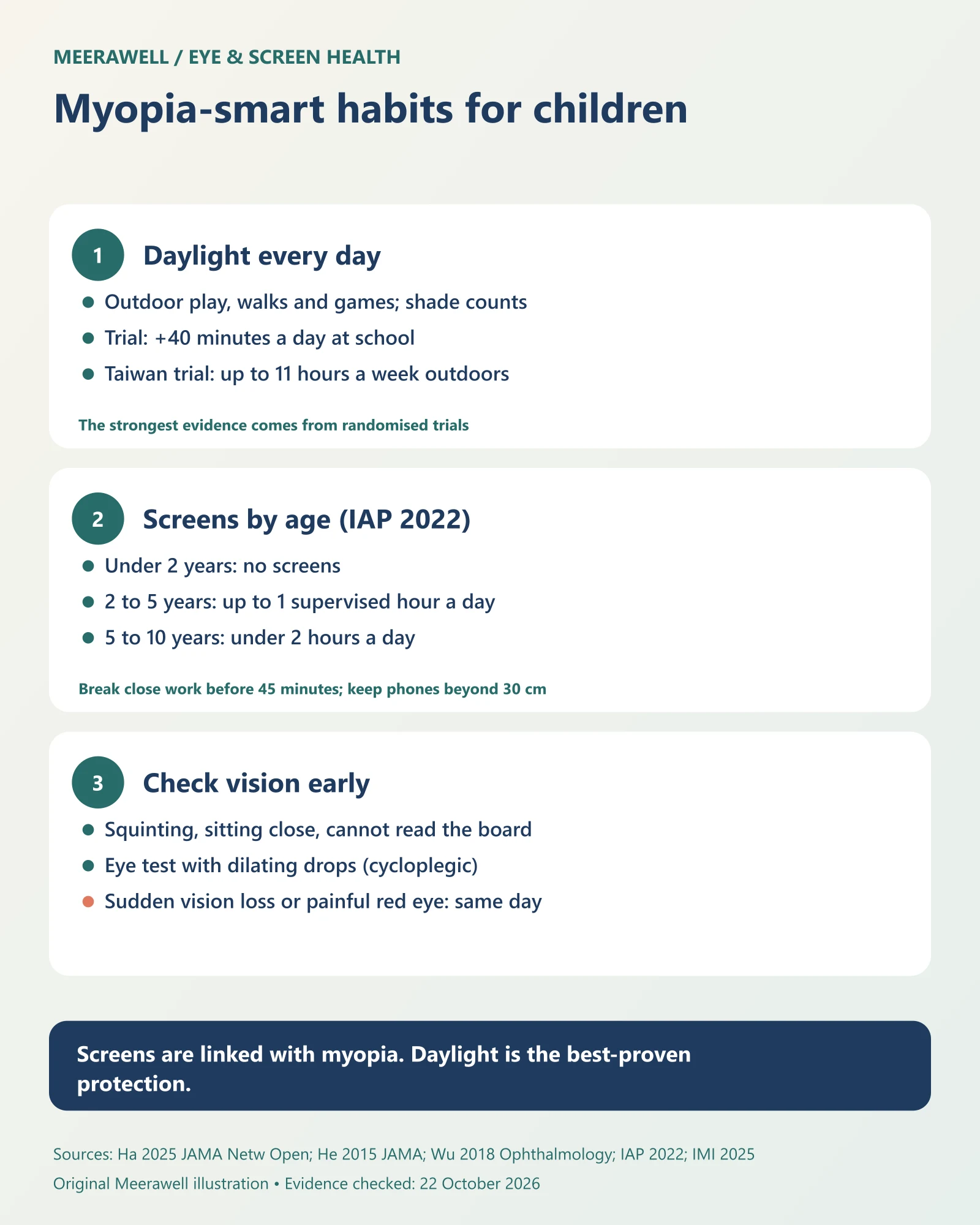
- Daylight every day. Play, walks and games all count.
- Age limits. The Indian Academy of Pediatrics advises no screens under 2, one supervised hour a day at 2 to 5, and under two hours at 5 to 10.
- Breaks. Stop close work before 45 minutes. Try the 20-20-20 rule.
- Distance. Keep phones beyond 30 cm. Apple’s Screen Distance warns when an iPhone is held closer. It is on by default for children under 13 in Family Sharing. Android’s Family Link sets time limits but has no distance alert. No trial has tested whether these alerts prevent myopia.
- Early eye test. Squinting or trouble reading the board needs a test with dilating drops. This “cycloplegic” test is the gold standard for measuring a child’s power.
When to see an eye doctor
Book an eye test if your child:
- squints, or cannot read the board
- gets headaches after close work
- has an eye that turns in or out
- has glasses power that keeps rising
A painful red eye or sudden vision loss needs same-day care.
Frequently asked questions
Can screen time myopia be reversed?
No. An eye that has grown too long does not shrink. Glasses correct the blur. An eye doctor can discuss treatments that slow further growth.
How much screen time is safe for kids’ eyes?
No limit is proven safe. Myopia odds rose from about one hour a day. The Indian Academy of Pediatrics advises under two hours a day for ages 5 to 10.
Does iPhone Screen Distance prevent myopia?
It has not been tested in trials. It is a useful reminder, but daily outdoor time and breaks matter more.
Next step
Children rarely complain about blurry distance vision. See what a full eye check includes.
Sources and evidence
Evidence checked on 22 October 2026. General education, not a diagnosis. Most screen time myopia studies show associations, not cause.
- Ha et al., 2025: screen time and myopia, dose-response meta-analysis (JAMA Netw Open)
- He et al., 2015: outdoor time at school and myopia, randomised trial (JAMA)
- Wu et al., 2018: outdoor recess and myopia, randomised trial (Ophthalmology)
- International Myopia Institute: IMI 2025 Digest (IOVS)
- Priscilla and Verkicharla, 2021: myopia trends in Indian children
- Li et al., 2015: near work and myopia, Anyang study (PLoS One)
- Indian Academy of Pediatrics, 2022: screen time guidelines
- Apple Support (India): What is Screen Distance?
- Google For Families Help: manage your child's screen time