You can read the smallest line on the chart and still have an eye-health question worth checking. A glasses test estimates the lens power that helps you see clearly. A broader eye examination also looks at the health of the eyes.
The useful question when booking is: “Is this a refraction appointment, or an eye-health examination too?” Ask what is included and whether dilation may be needed. A clinic's test list should depend on your age, symptoms, history and findings, rather than a fixed package for everyone.
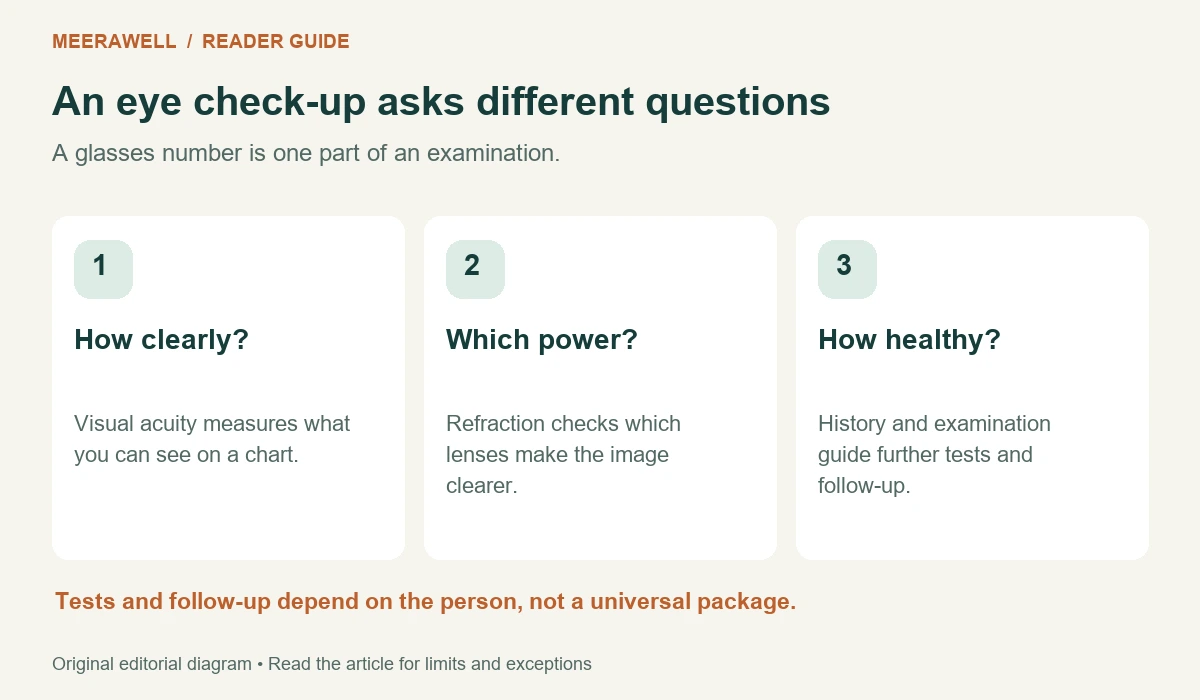
Three different questions
On a narrow screen, scroll the table sideways.| Part of the appointment | What it helps answer |
|---|---|
| Visual acuity | How clearly can each eye see the chart, with or without correction? |
| Refraction | Which lens power makes the image clearer? |
| Eye-health assessment | Are there findings in the eye that need monitoring, further tests or treatment? |
The first two do not, on their own, establish that every part of the eye is healthy. Optometrists and ophthalmologists may both contribute to care; ask about the scope of the appointment rather than judging it by the shop or clinic sign.
What may happen during the examination
The visit starts with questions: what has changed, whether one or both eyes are affected, your current glasses or contact lenses, medicines, previous surgery and family history. Diabetes and other health conditions can change what needs checking.
An examiner may check pupils, eye movements and side vision, measure eye pressure, and examine the front of the eye with a slit-lamp microscope. Looking at the retina and optic nerve addresses a different question from finding your glasses number.
The Indian-authored comprehensive examination guide distinguishes routine components from tests used when clinically indicated. A scan, detailed visual-field test or corneal mapping is not automatically needed at every visit. If an extra test is suggested, ask what question it will answer.
Why dilating drops may be offered
Dilation widens the pupil so the clinician can examine structures inside the eye more easily. It is not the same as the drops used to treat dryness, and it is not a change to your glasses prescription.
The National Eye Institute explains that near vision may blur and light may feel uncomfortable for a few hours afterwards. Bring sunglasses and arrange a lift home if dilation is planned. Do not assume you will be ready to drive or return immediately to detailed screen work.
Tell the clinic about previous reactions to eye drops. For contact lenses, ask beforehand whether and when to remove them; instructions vary with the examination being planned.
A small preparation checklist
- Bring your current glasses, previous prescriptions and relevant eye reports.
- Bring a medicine list, including eye drops, and mention allergies or earlier reactions.
- Note your main problem and when it occurs. For screen discomfort, record your usual monitor distance and whether blur changes after blinking or taking a break.
- Ask how much time to allow and whether dilation is likely. Confirm charges for the consultation and any additional tests directly with the clinic.
There is no universal price or test bundle in this guide. A routine eye check-up should leave you understanding the findings and the next step, not simply holding a new number.
How often should you return?
The AAO's examination guidance makes follow-up dependent on age and risk. Ask for your own next-review date and the reason for it. Diabetes, an existing eye condition, contact-lens use or a family history of eye disease can alter the plan.
Do not wait for a routine appointment if you develop sudden loss of vision or severe eye pain. This article concerns routine preparation, not emergency treatment.
If your main concern is desk-work discomfort, our computer vision syndrome guide explains why a prescription is only one part of the assessment. Read about Meerawell for the site's scope and authorship.
Before you leave: ask what was found, whether your prescription changed, and when to return. Keep a copy of the results.