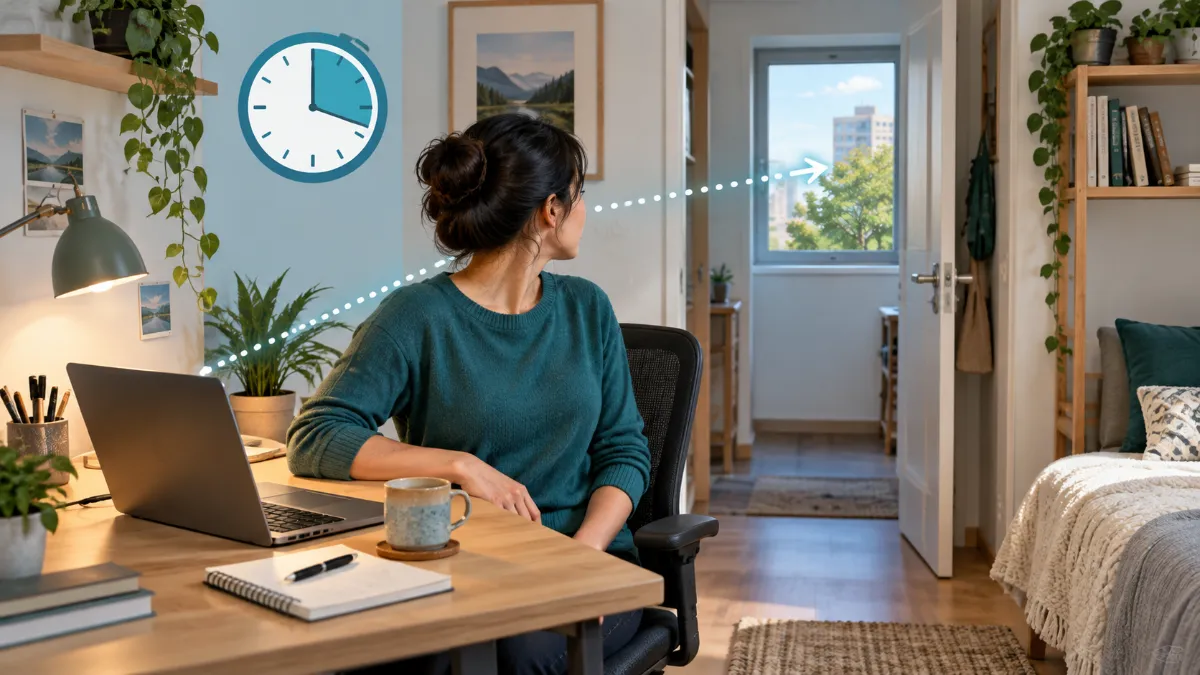
If your room is shorter than 20 feet, you can still interrupt prolonged near work. Look towards a genuinely distant object through a window or open doorway when available, or leave the desk for a brief change of task. These are practical adaptations; they have not all been proven equivalent to a specific 20-20-20 schedule.
The usual reminder is easy to remember: every 20 minutes, look about 20 feet away for 20 seconds. It sounds less useful when your workspace is a bedroom, shared flat or compact office with a wall directly behind the laptop.
What the rule is trying to change
The purpose is to interrupt continuous close visual attention. Twenty feet is approximately six metres. A timer can help establish the habit, but the numbers should not be treated as a guarantee that an eye problem will resolve.
In a study of 29 symptomatic computer users, reminders were associated with reduced symptoms after two weeks, but measured tear-film and ocular-surface signs did not improve. Benefits were not maintained after reminders stopped. This was a small study, not proof of a universally effective dose. Read the reminder study.
Choose a realistic route away from near work
| Your layout | Practical option | Keep the limitation clear |
|---|---|---|
| Desk beside a window | Look at a distant building or tree outside, rather than the nearby glass | Avoid looking at the sun or a glaring reflection. |
| Desk facing a wall; doorway nearby | Use a clear view into a corridor or another room | A short indoor distance is not identical to a six-metre target. |
| No distant view available | Leave the desk briefly when practical and change activity | Movement and task changes are useful habits, not a tested replacement dose. |
| Shared office with limited freedom | Pair breaks with routine transitions such as finishing a call | Do not replace every break with another close screen. |
Build a reminder you will actually use
- Choose a safe viewing option in advance. Do not wait until your eyes feel uncomfortable to decide where to look.
- Use a quiet reminder. A watch, calendar or ordinary timer can serve as a cue; no special subscription is necessary.
- Let the shoulders and hands pause too. Avoid treating an eye break as another task performed in a fixed posture.
- Return to readable text. A break will not correct a tiny font, strong reflection or unsuitable prescription.
- Adjust the routine to the work. Discuss persistent symptoms rather than assuming a more rigid timer will solve them.
What about newer research?
A 2025 experiment with 24 young adults compared different break schedules during a short reading task. Some symptom and focusing outcomes favoured more frequent or self-paced breaks. The study supports investigating practical break habits, but does not validate every adaptation in this guide. Read the break-schedule experiment.
Printable reminder card
Quick answers
Can I look through a window?
A distant object outside provides a different viewing distance from the nearby screen. Look at the object, not marks on the glass; choose a comfortable view without glare.
Is closing my eyes exactly equivalent?
A brief comfortable pause may feel restful, but do not assume it has been shown equivalent to every aspect of the rule.
Can I use the far wall if that is all I have?
It can interrupt fixation on the screen, but the focusing demand differs from a genuinely distant target. Combine practical changes with appropriate examination if symptoms continue.
When breaks are not enough
Persistent blur, repeated headaches or discomfort despite changes deserves assessment. New double vision, sudden visual loss or significant pain requires prompt medical attention. The rule is a work habit, not a diagnostic test or treatment for every eye condition.
For additional causes and workstation considerations, see our guide to computer vision syndrome.
This article provides general educational information and does not replace an individual examination. No product has been personally tested for this article. About Meerawell