

Key takeaways
- Myopia control treatments slow how fast a child’s eye grows. None of them reverses myopia, and results vary from child to child.
- The best-tested options are special spectacle lenses (DIMS and HAL designs), low-dose atropine eye drops and overnight orthokeratology (ortho-K) lenses. In two-year trials, the lenses and ortho-K each slowed eye growth by about 0.3 mm compared with ordinary glasses.
- In India, atropine 0.01% is approved for children aged 5 and above on an ophthalmologist’s prescription. On 22 October 2026, a 5 ml bottle was listed at ₹191 on Apollo Pharmacy. Lens prices vary, so ask for a written quote.
Glasses With Hundreds of Tiny Lenses
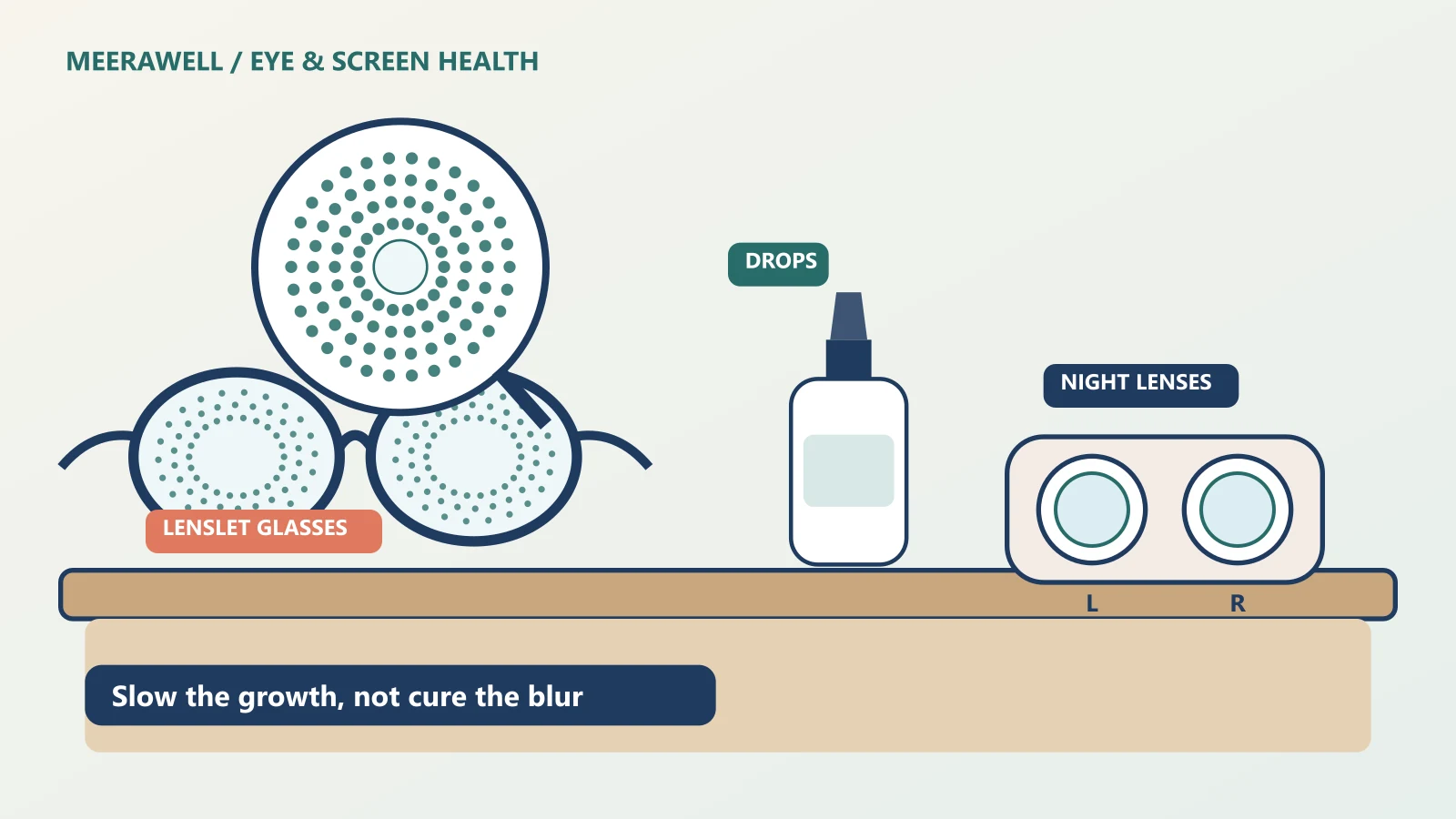
From across a room, the new myopia control glasses look ordinary. Up close, the outer part of the lens is covered in tiny lenslets. One design packs them into 11 rings around a clear 9 mm centre, according to the International Myopia Institute’s 2025 review.
The short answer: myopia control can slow a child’s myopia, but not stop or reverse it. Spectacle lenses, low-dose atropine and ortho-K all work in trials. The right choice depends on your child’s age, power, routine and budget, and every option needs regular follow-up.
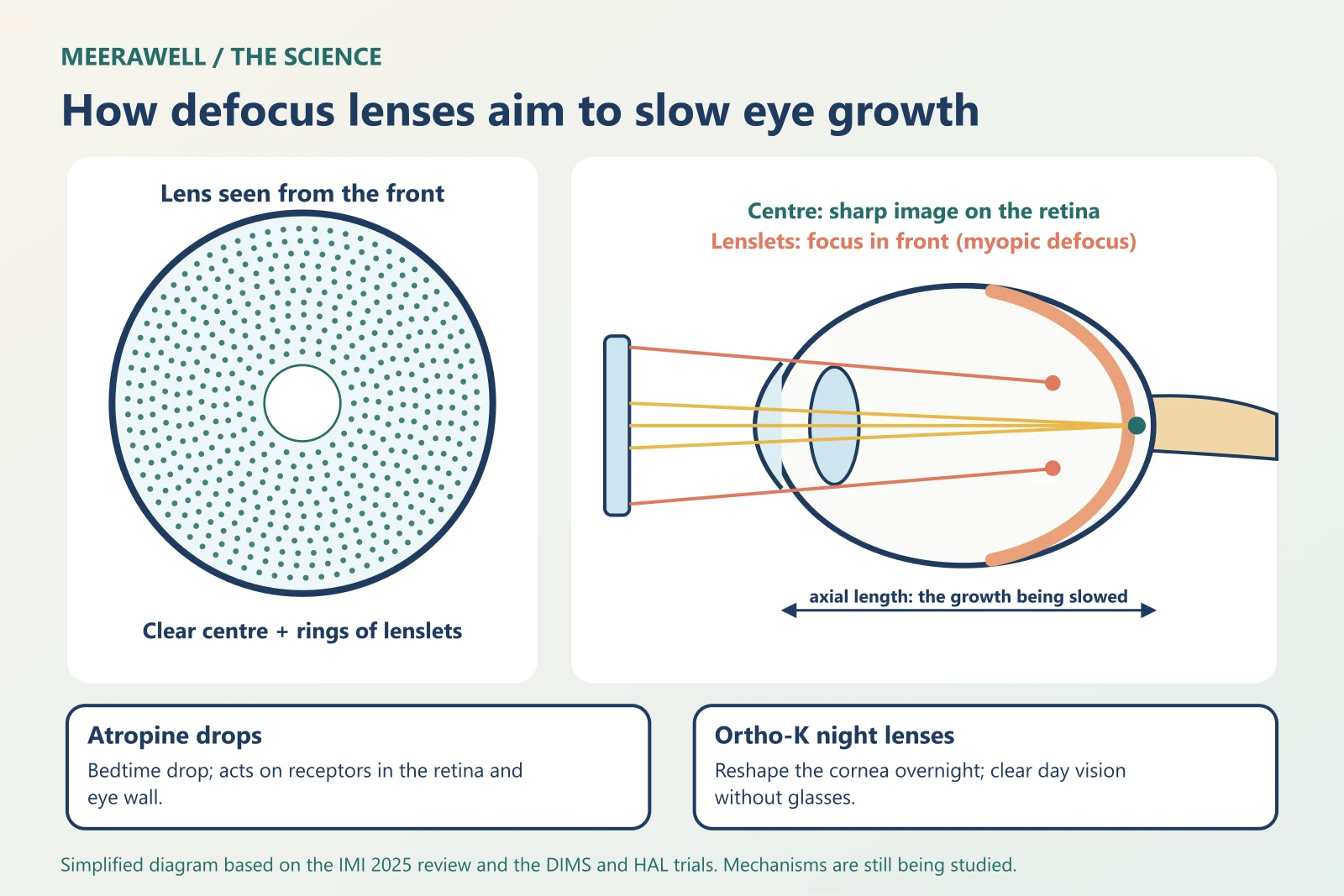
The centre gives sharp vision. The lenslets send a different focus signal to the edge of the retina, which seems to slow the eye’s growth.
If your child’s glasses power rises every year, you will hear about these lenses, atropine drops and night lenses. Each has real trial evidence. None of them is a cure.
1. How Myopia Control Works
Childhood myopia happens when the eyeball grows too long. Ordinary glasses sharpen vision but do nothing to slow that growth. Myopia control aims to put the brakes on it, because slowing progression can lower the later risk of myopia-related eye disease.
- Defocus spectacle lenses keep a clear centre for seeing, and add zones that create “myopic defocus” around it. The DIMS trial showed that clear vision plus constant defocus slowed progression.
- Low-dose atropine drops are used once at bedtime. They act on receptors in the retina and possibly the deeper layers of the eye wall.
- Ortho-K lenses are rigid contact lenses worn overnight. They temporarily reshape the front of the eye, so the child sees clearly in the day without glasses, and they also slow eye growth.
2. Myopia Control Options Compared
| Option | What trials found | Practical points |
|---|---|---|
| DIMS spectacle lenses | Over 2 years, myopia rose by 0.41 D vs 0.85 D with ordinary lenses | Worn all day; no drops or contact lenses |
| HAL spectacle lenses | Over 2 years, 0.80 D less progression and 0.35 mm less eye growth | Best results with at least 12 hours’ wear a day |
| Low-dose atropine (0.01% to 0.05%) | Higher strengths worked better in the LAMP trial | Prescription only; larger pupils, light sensitivity or near blur, more with higher strengths |
| Ortho-K night lenses | Median 0.30 mm less eye growth over 2 years | Strict lens hygiene; overnight wear raises infection risk |
| More time outdoors | Delays myopia starting | Free, and helps alongside any option |
The HAL results come from a two-year Chinese trial of 157 children. Children who wore the lenses at least 12 hours a day did better still.
3. What the Myopia Control Evidence Shows
The chart compares how much each option slowed eye growth over about two years, measured as axial length.
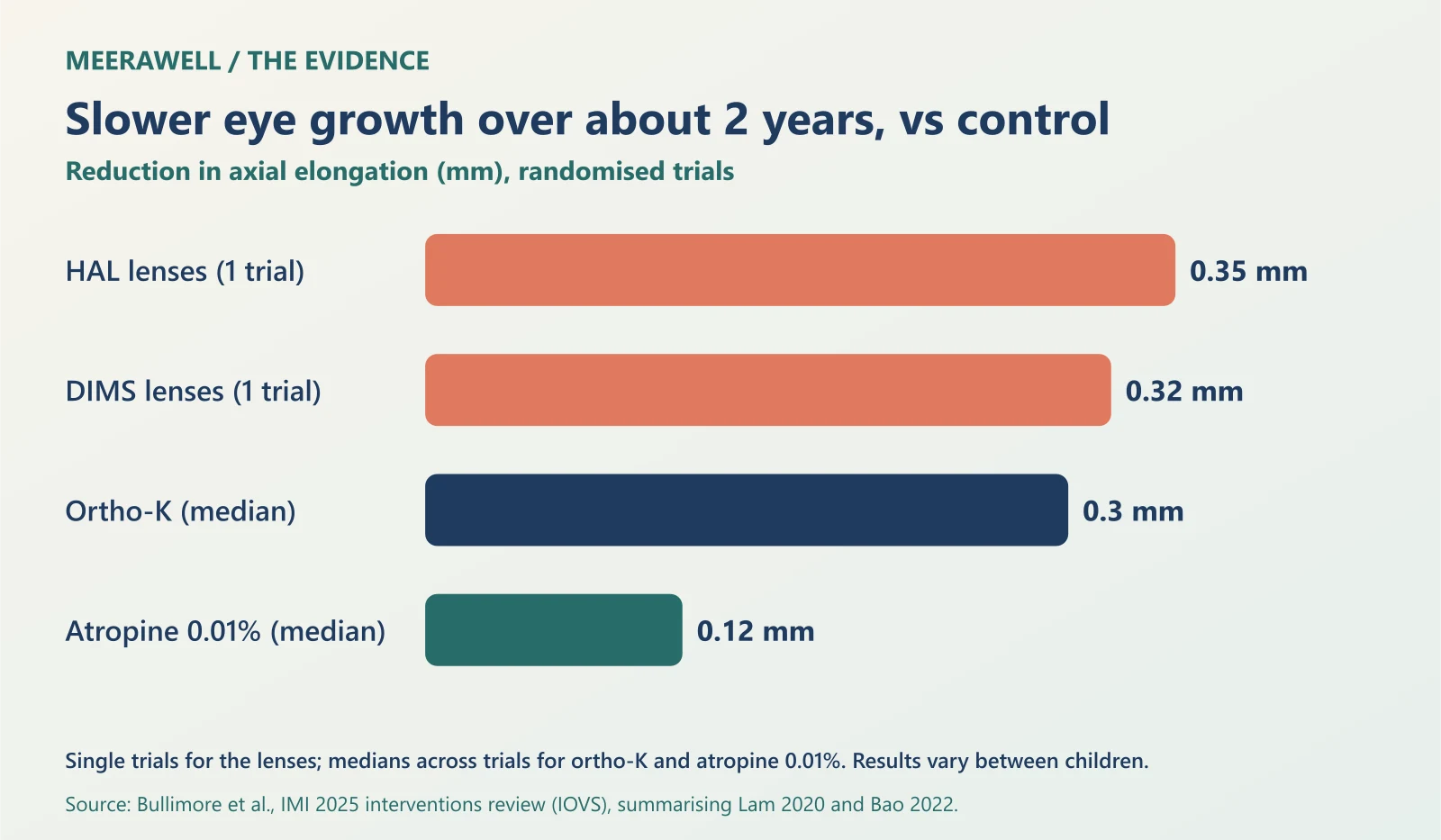
Atropine needs the most careful reading. In the LAMP trial of 438 children, myopia rose over one year by 0.27 D on 0.05%, 0.59 D on 0.01% and 0.81 D on placebo. Across trials, the International Myopia Institute found that the 0.01% strength slowed eye growth by a median of only 0.12 mm over two years. Its effect in year two was about half that of year one.
India has its own data. In a one-year randomised trial at AIIMS Bibinagar of 272 children, myopia rose by 0.26 D on 0.05% atropine, 0.32 D on 0.01% and 0.76 D on placebo. It was a single-centre study with short follow-up.
Stopping treatment can bring a rebound. In the five-year LAMP follow-up, 88% of children who stopped atropine after year three needed to restart it.
Be wary of percentages. The same atropine effect worked out to 40% in the youngest children and 130% in the oldest, simply because their untreated progression differed.
Did you know? Atropine has been tried for myopia for about two centuries. It was first used on the theory that over-focusing for near work drove myopia. Researchers now look instead at receptors in the retina and the deeper layers of the eye wall.
4. Myopia Control in India: Costs and How to Choose
Atropine. India’s drug regulator approved atropine 0.01% in 2021 to control myopia progression in children aged 5 and above. It must be sold only on an ophthalmologist’s prescription. On 22 October 2026, one brand, Atroped 0.01% (5 ml), was listed at ₹191 on Apollo Pharmacy. Other brands are priced differently.
Lenses. We could not verify current official prices for myopia control spectacle lenses or ortho-K in India, so we have not listed any. Prices vary with brand, power and store. Ask for a written quote that covers lens replacement if the power changes, frames, and follow-up visits.
Choosing. Talk through these with your child’s eye doctor:
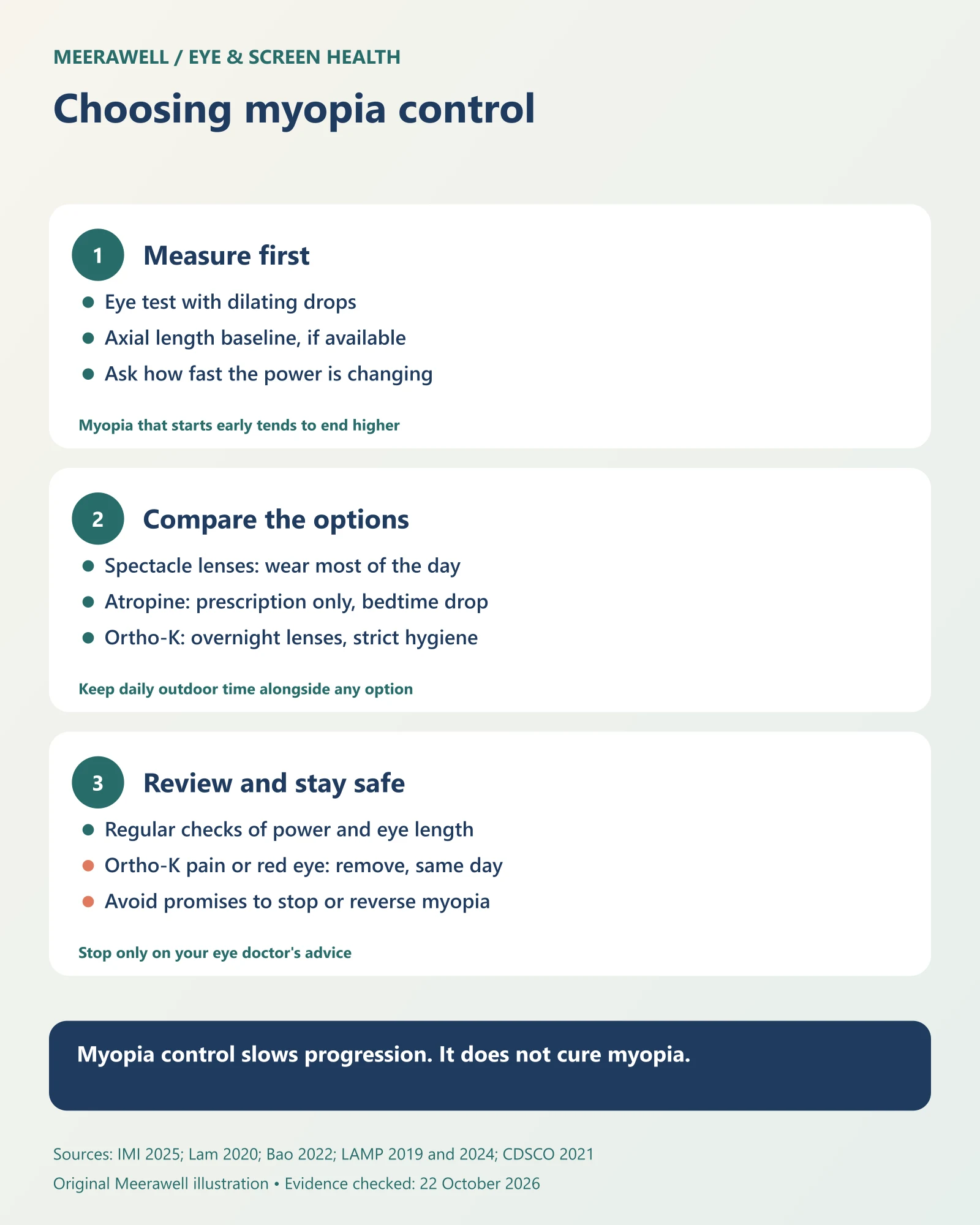
- Age. Early myopia tends to end higher. In one Chinese cohort, the risk of high adult myopia was under 5% when it began at 12 or older, but over 50% when present by age 7 or 8.
- Daily routine. Spectacle lenses only work if worn most of the day. Ortho-K suits a child who can handle careful lens hygiene.
- Astigmatism. Many lens trials included only small cylindrical power. Our guide to cylindrical power explains how to read that part of the prescription.
- Follow-up. Ask how progress will be checked. The International Myopia Institute recommends regular cycloplegic refraction and, where available, axial length measurement.
- Outdoor time. Keep it going alongside any treatment. Our screen time and myopia guide explains why.
Safety checks and buying traps
- Ortho-K: pain, redness, light sensitivity or sticky discharge means remove the lenses and see a doctor the same day.
- Atropine: use only the prescribed strength. Report allergy or marked light sensitivity.
- Claims: avoid promises to stop or reverse myopia.
- Warranty: ask what happens if the power changes.
Frequently asked questions
Is atropine 0.01% safe for children?
In trials, low-dose atropine was generally well tolerated. Short-term effects include larger pupils, light sensitivity, near blur and allergy, and these are more common at higher strengths. In India, it is sold only on an ophthalmologist’s prescription.
Do myopia control glasses really work?
Yes, in trials, if worn full time. HAL lenses slowed progression by 0.80 D over two years compared with ordinary lenses, and DIMS lenses showed a similar benefit. Results vary between children.
How long does myopia control treatment last?
Usually several years, while the eye is still growing. Stopping too early can bring a rebound, so your eye doctor will decide when and how to stop, based on regular measurements.
Next step
Myopia control starts with an accurate eye test using dilating drops. See what a full check-up includes.
Sources and evidence
Evidence checked on 22 October 2026. General education, not a diagnosis. Prices are as listed on the date shown and can change. Prescription decisions belong to your child’s eye doctor.
- Bullimore et al., 2025: IMI interventions for controlling myopia onset and progression (IOVS)
- Lam et al., 2020: DIMS spectacle lenses, 2-year randomised trial (Br J Ophthalmol)
- Bao et al., 2022: aspherical lenslet (HAL) spectacle lenses, randomised trial (JAMA Ophthalmol)
- Yam et al., 2019: Low-Concentration Atropine for Myopia Progression (LAMP) trial (Ophthalmology)
- Zhang et al., 2024: five-year LAMP study, phase 4 report (Ophthalmology)
- Atropine 0.05% vs 0.01% in Indian children, randomised trial, 2025 (Cureus)
- International Myopia Institute: IMI 2025 Digest (IOVS)
- CDSCO: new drug approvals list, 2021 (atropine sulfate 0.01%)
- Apollo Pharmacy: Atroped 0.01% paediatric eye drops listing