

Written by Dr. Samir Serasiya, Oculoplastic Surgeon, Meera Clinic & Eye Hospital, Vadodara
An eye prescription for glasses is a set of instructions for making lenses. It is not a score for how healthy your eyes are, and a larger number does not by itself tell you how well you will see with glasses.
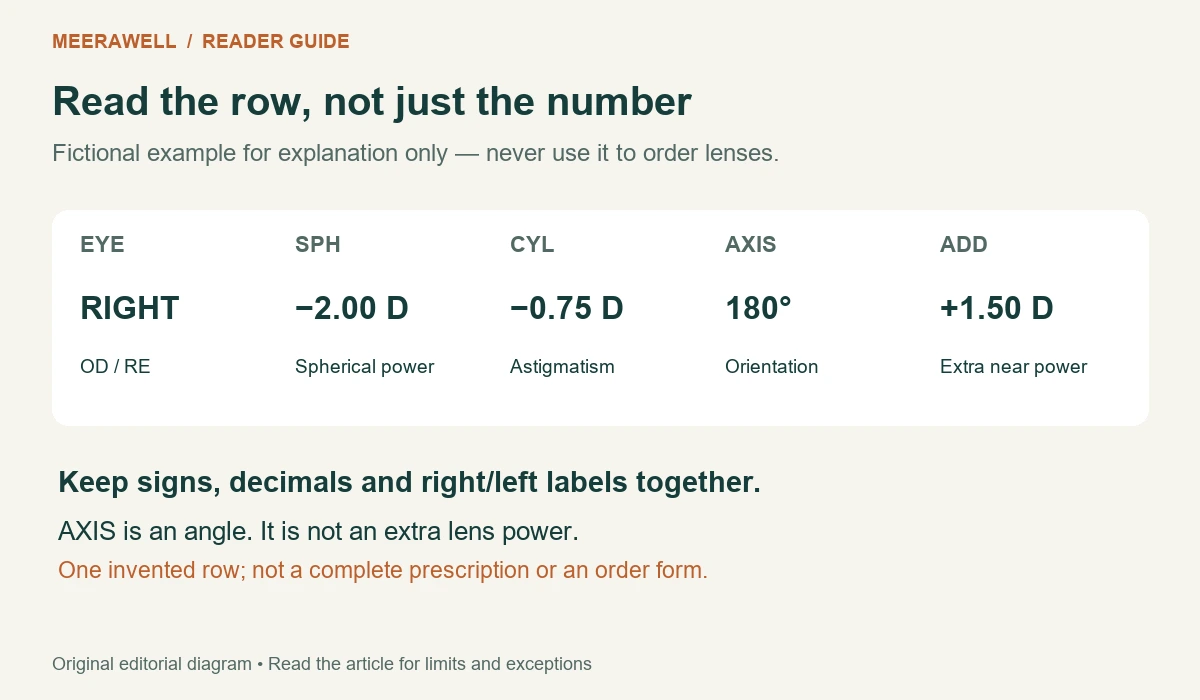
SPH describes spherical lens power; CYL describes astigmatism correction; AXIS gives that cylinder's orientation; ADD supplies extra power for near work. Keep the signs, decimal points and right/left labels with the numbers.
CYL on an eye prescription: the quick answer
- CYL (cylinder) on an eye prescription is the lens power that corrects astigmatism, measured in dioptres. It always comes with an AXIS from 1 to 180 degrees.
- CYL −1.00 means one dioptre of astigmatism correction, a common amount. The minus or plus sign is a writing convention, not a sign of worse eyes.
- A blank CYL box, or “DS” after the sphere, means no astigmatism correction was prescribed for that eye.
Read one eye at a time
OD means right eye and OS means left eye. Some prescriptions use RE and LE instead. Do not assume the first handwritten number belongs to a particular eye without checking the label.
The AAO's prescription guide explains the main fields. Your own form may also include visual acuity, prism or fitting measurements.
On a narrow screen, scroll the table sideways.| Field | Meaning | Common mistake |
|---|---|---|
| SPH | Spherical power, in dioptres (D) | Dropping the plus or minus sign |
| CYL | Cylinder power used to correct astigmatism, also in D | Treating it as a separate disease severity score |
| AXIS | Orientation associated with the cylinder, in degrees | Adding it to the lens power |
| ADD | Extra near power added to the distance prescription when prescribed | Ordering a reading pair using ADD alone |
| Prism / base | A different type of correction and its direction | Confusing prism with CYL or AXIS |
What “cylindrical power” means
With astigmatism, the eye's focusing power differs by direction. A cylinder correction addresses that difference. It is not a cylinder-shaped object placed inside the eye.
The CYL amount and its AXIS belong together. An axis of 180 is an orientation, not “more power” than an axis of 90. When no cylinder is prescribed, an axis may be left blank.
A prescription can be written in plus-cylinder or minus-cylinder form. Two forms can describe the same optical correction even though the printed numbers differ. Have an optometrist or ophthalmologist compare them; do not decide your eyes have changed simply because one sheet uses a different convention.
A fictional example
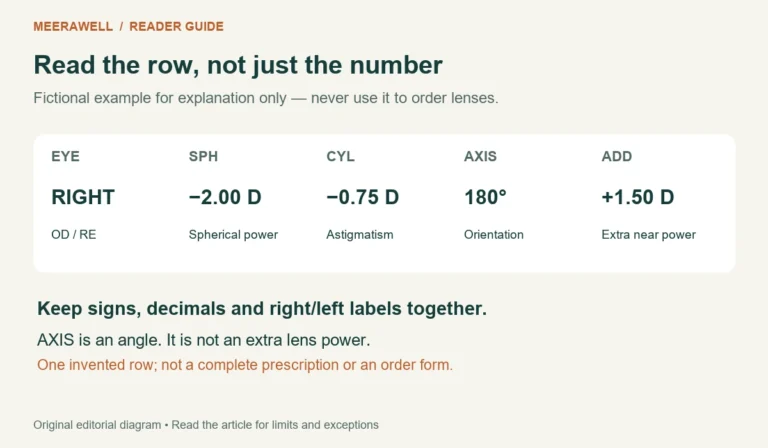
Suppose the right-eye row says SPH −2.00, CYL −0.75, AXIS 180, with ADD +1.50 elsewhere on the form. This shows minus spherical power, a cylinder correction and its orientation, plus an additional near power.
It does not tell you the patient's age, diagnosis, visual acuity or whether the eyes are healthy. This example is invented for explanation and must not be used to order lenses. The infographic deliberately shows just one fictional row so it cannot be mistaken for a complete prescription.
Is 1.75 cylinder “harmful”?
That number alone cannot answer a health question. The examination, how well you see with correction, previous results and whether the finding is stable all matter.
Ask the prescriber why the correction is recommended and what to expect when adapting. If new glasses remain uncomfortable, have the eye prescription, lens manufacture and fitting checked. Do not remove cylinder or change the axis yourself to make an online order easier.
For fluctuating blur after near work, our distance-blur guide discusses why one number is not the whole assessment. New or rapidly changing symptoms deserve a fresh examination.
Glasses and contact-lens prescriptions are different
Contact lenses sit on the eye and require fitting information that an ordinary glasses prescription does not provide. Do not transfer a glasses order directly into a contact-lens order, even if a website allows the same numbers to be entered.
Likewise, a reading ADD does not decide the best computer lens on its own. Working distance and lens design matter. Our progressive-glasses guide explains why a clear image and a comfortable head position need to work together.
Before ordering: confirm the eye labels, signs, decimals, cylinder/axis pairing and intended use. Ask the optical professional to resolve unclear handwriting rather than guessing.
Need your number checked? Dr. Samir Serasiya sees patients in Vadodara for a spectacle number check.