

Key takeaways
- In the jaggery vs sugar question, both are mostly sugar. Cane jaggery is about 84% sugars.
- Honey’s glycaemic index (61) is close to table sugar’s (65). “Sugar-free” mithai still carries carbohydrate and calories.
- This Diwali, plan the portion, not the swap. Never change diabetes medicines on your own.
India’s 1971 food tables listed cane jaggery at 11.4 mg of iron per 100 g. When the Indian Food Composition Tables 2017 re-tested it, the figure was 4.63 mg.
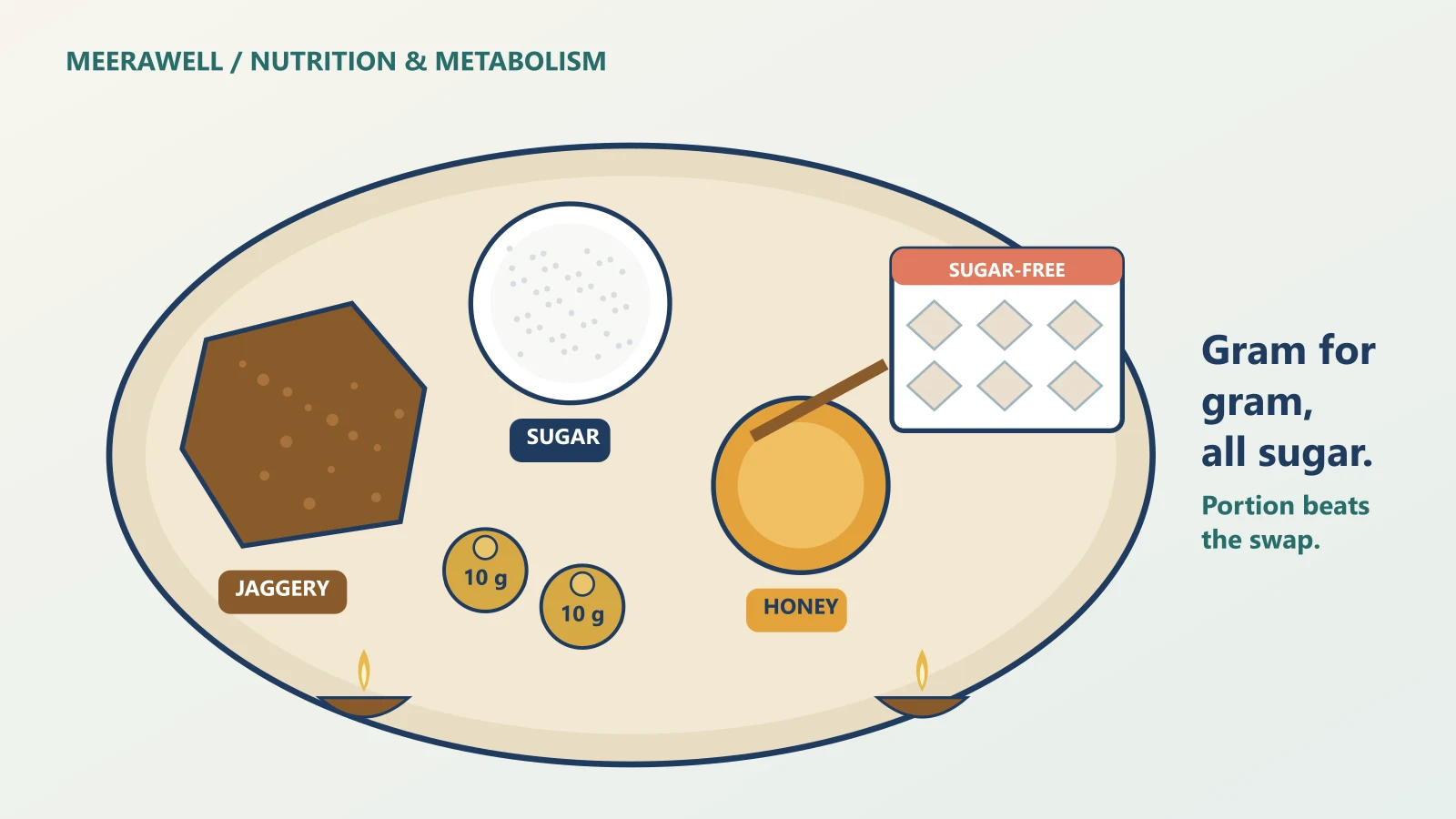
The short answer: in jaggery vs sugar, it is close to a tie for blood glucose. Gur, honey and white sugar act much the same, gram for gram. How much you eat matters most.
1. The Science: Why Jaggery vs Sugar Is Mostly a Tie
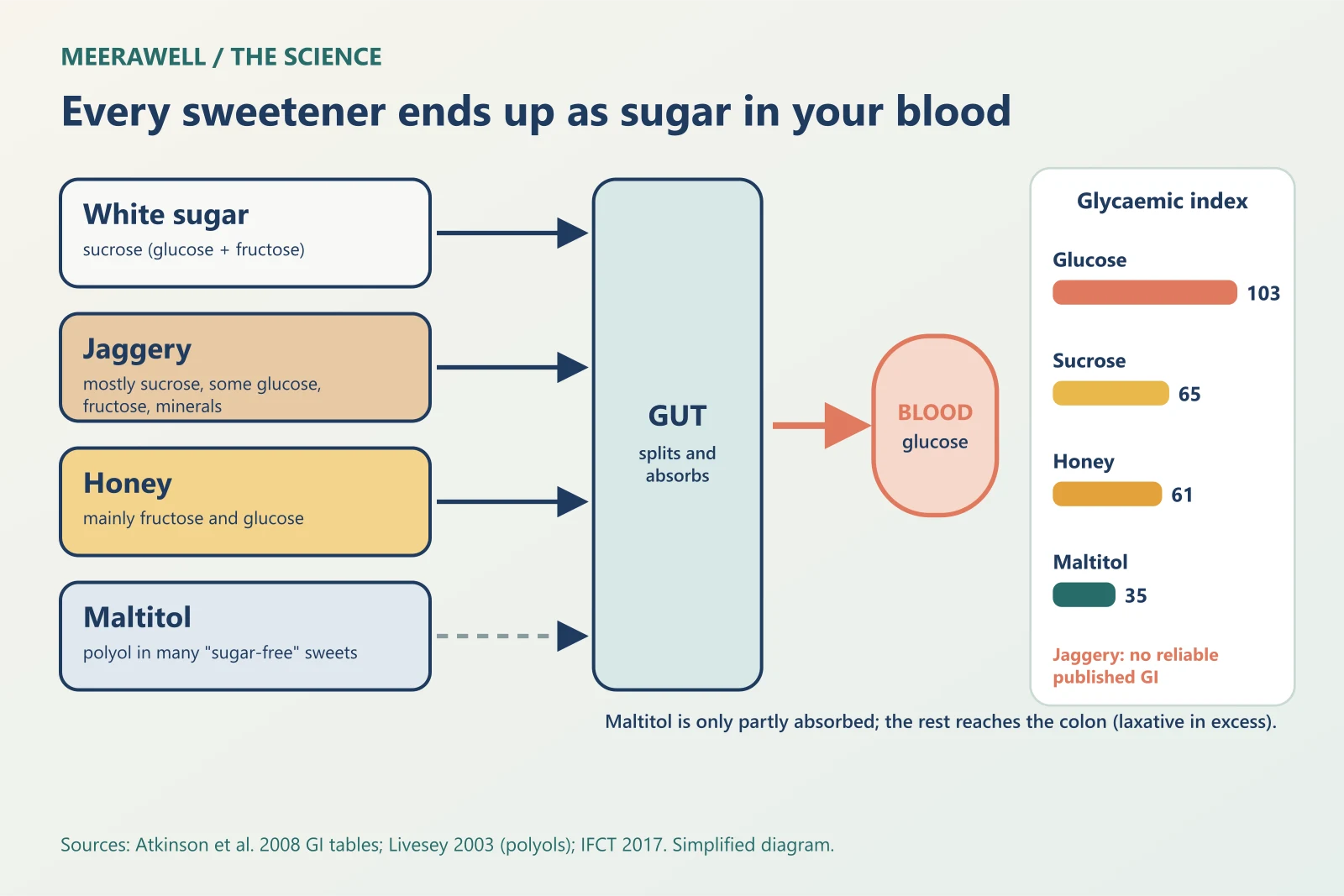
White sugar is sucrose. Your gut splits it into glucose and fructose. Jaggery is boiled-down cane juice: 84 g of sugars per 100 g, mostly sucrose. Honey is about 82% sugars, mainly fructose and glucose (USDA).
The glycaemic index (GI) compares how a food raises blood glucose with pure glucose. In the international GI tables, sucrose scored 65 and honey 61. Jaggery has no reliable published GI.
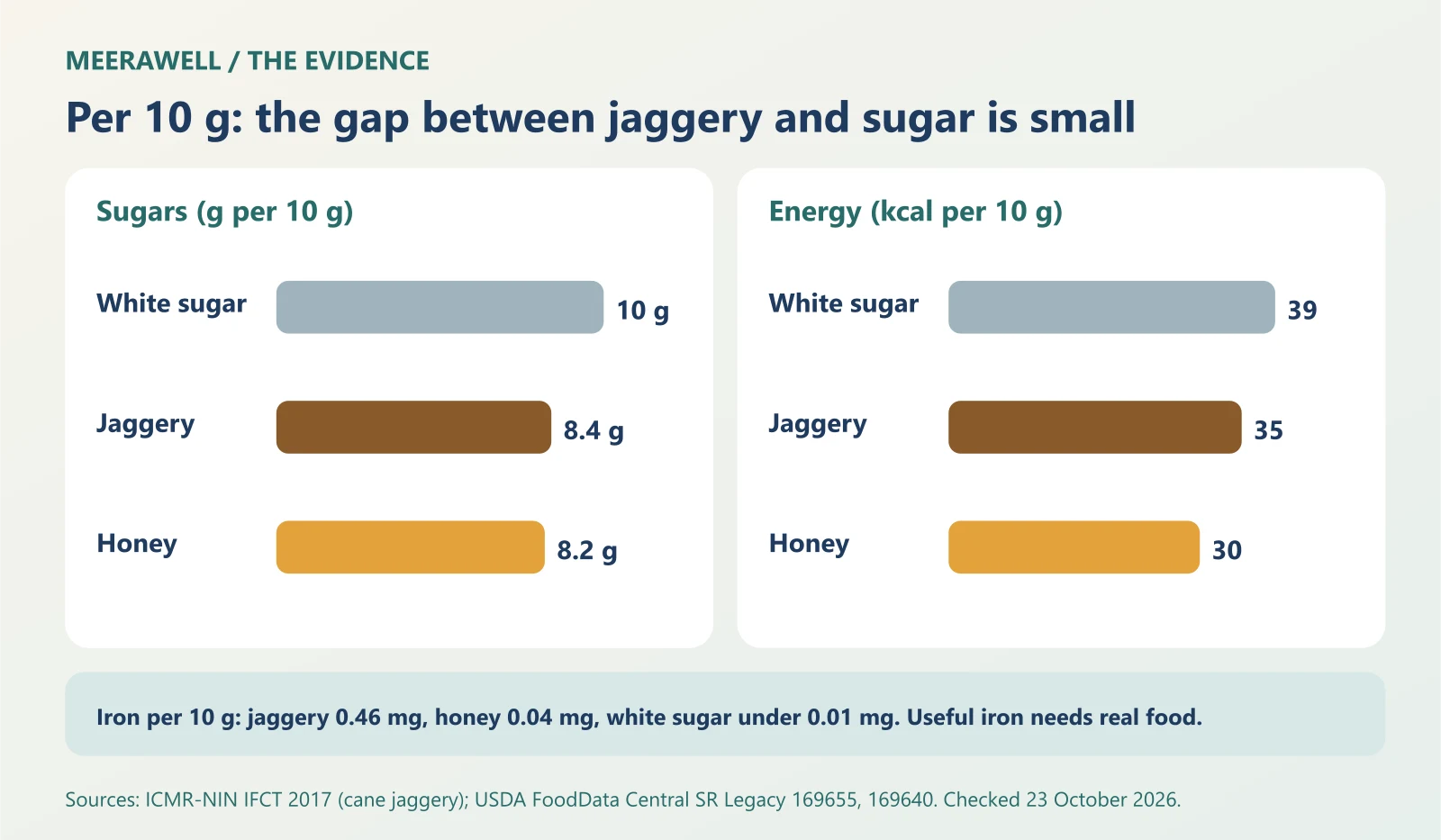
| Per 10 g | White sugar | Cane jaggery | Honey |
|---|---|---|---|
| Sugars | 10.0 g | 8.4 g | 8.2 g |
| Energy | 39 kcal | 35 kcal | 30 kcal |
| Iron | under 0.01 mg | 0.46 mg | 0.04 mg |
The jaggery vs sugar gap is 1.6 g of sugar per 10 g. That is smaller than the gap between one sweet and two. And 0.46 mg of iron is a small amount for that much sugar.
2. What the Evidence Shows on Honey, Gur and “Sugar-Free”
Honey. A 2023 meta-analysis of 18 small trials found honey lowered fasting glucose by 0.20 mmol/L. The certainty was low. The effect came mainly from certain raw honeys eaten within a healthy diet. The authors still call honey a free sugar.
Jaggery. On jaggery vs sugar specifically, we found no good trials showing jaggery helps glucose control.
Sweeteners. The WHO’s 2023 guideline against sweeteners for weight control does not apply to people with diabetes. The ADA says they can replace sugar in moderation, short term.
Labels. Under FSSAI rules, “sugar-free” means no more than 0.5 g of sugars per 100 g. Flour, khoya, ghee and nuts remain. Polyols such as maltitol have a GI of about 35, and too much can upset the stomach (review).
Did you know? When India’s 1951 food tables analysed honey, they found it was about 80% sugars, with no vitamins except vitamin C.
3. Jaggery vs Sugar This Diwali: A Simple Plan
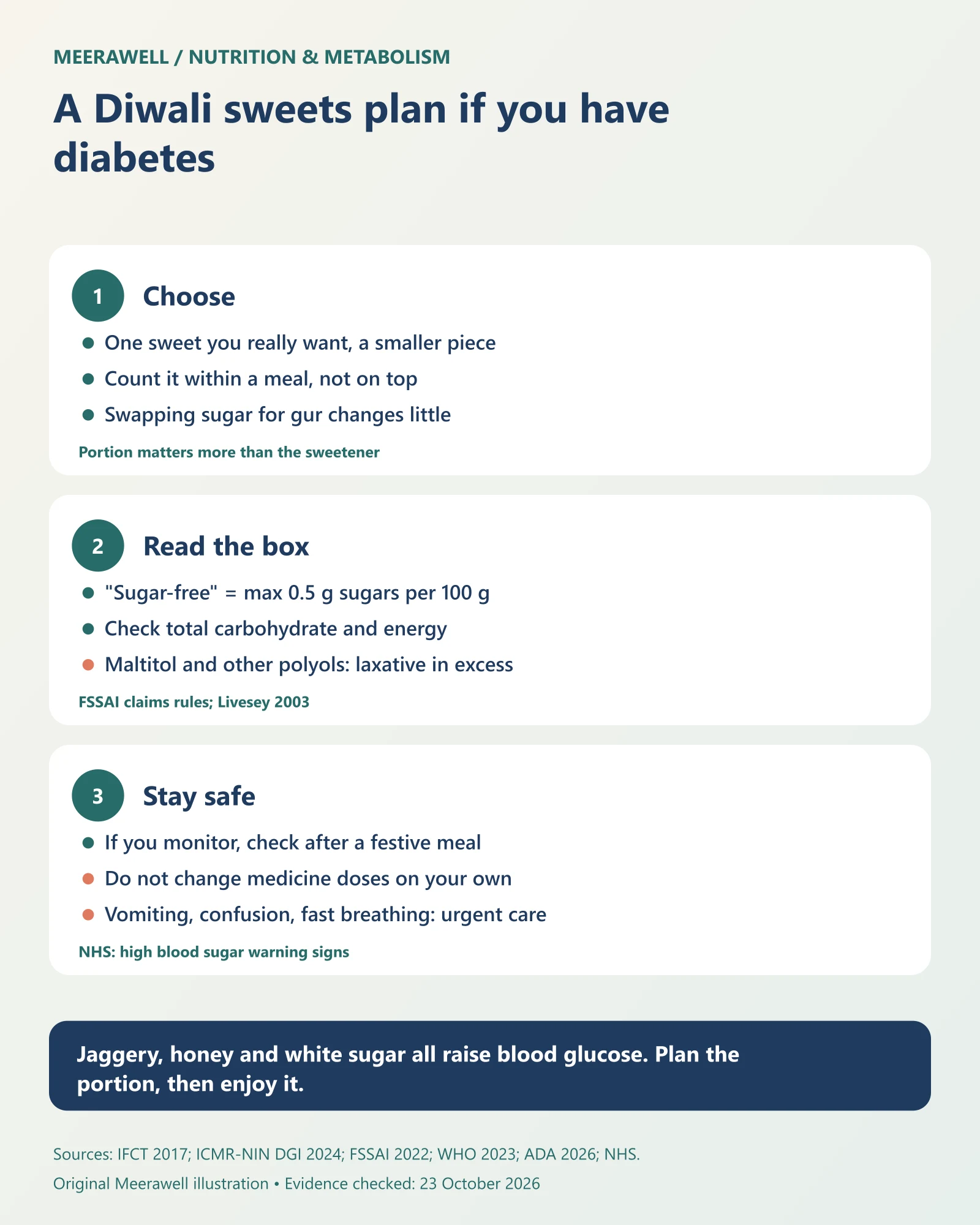
ICMR-NIN guidelines advise adults to keep sugar below 5% of daily energy. On 2,000 kcal, that is about 25 g, by our calculation.
- Pick one sweet you really want, and take a smaller piece.
- Eat it with a meal, and count it in that meal’s carbohydrate.
- Read the whole label. On “sugar-free” boxes, check carbohydrate and energy per 100 g.
- Skip the swap. In kheer, the jaggery vs sugar switch changes little. A smaller bowl changes more.
- Keep your medicines as prescribed. Discuss fasting or feasting plans with your doctor.
When to see a doctor
Get urgent help for vomiting, stomach pain, fast breathing, confusion or drowsiness with high sugar (NHS). See your doctor if readings stay high despite your efforts.
Frequently asked questions
Jaggery vs sugar: which is better for diabetes?
Neither, for blood glucose. Jaggery has slightly less sugar and a little more iron, but it is still about 84% sugars. The portion matters far more than the type.
Are sugar-free sweets safe for diabetics?
They contain much less sugar but still have carbohydrate from flour, milk solids or nuts, plus fat. Check the label. Polyols like maltitol can upset the stomach.
Which sugar is best for a diabetic patient?
None is clearly best: sugar, jaggery and honey all raise glucose. Sweeteners can replace sugar in moderation, says the ADA. Ask your doctor about your own targets.
Next step
The jaggery vs sugar lesson works all year: compare the portion, then read the label.
Sources and evidence
Evidence checked on 23 October 2026. General education, not a diagnosis or a diet prescription.
- ICMR-NIN: Indian Food Composition Tables 2017 (cane jaggery; 1971 iron value)
- ICMR-NIN: Dietary Guidelines for Indians 2024
- USDA FoodData Central: honey (169640)
- USDA FoodData Central: granulated sugar (169655)
- Atkinson et al., 2008: international tables of glycaemic index (Diabetes Care)
- Livesey, 2003: polyols and glycaemic index (Nutr Res Rev)
- Ahmed et al., 2023: honey and cardiometabolic risk, meta-analysis (Nutr Rev)
- WHO, 2023: guideline on non-sugar sweeteners
- ADA: Standards of Care in Diabetes 2026, section 5
- FSSAI: Advertising and Claims Regulations compendium, 2022
- NHS: high blood sugar