

Key takeaways
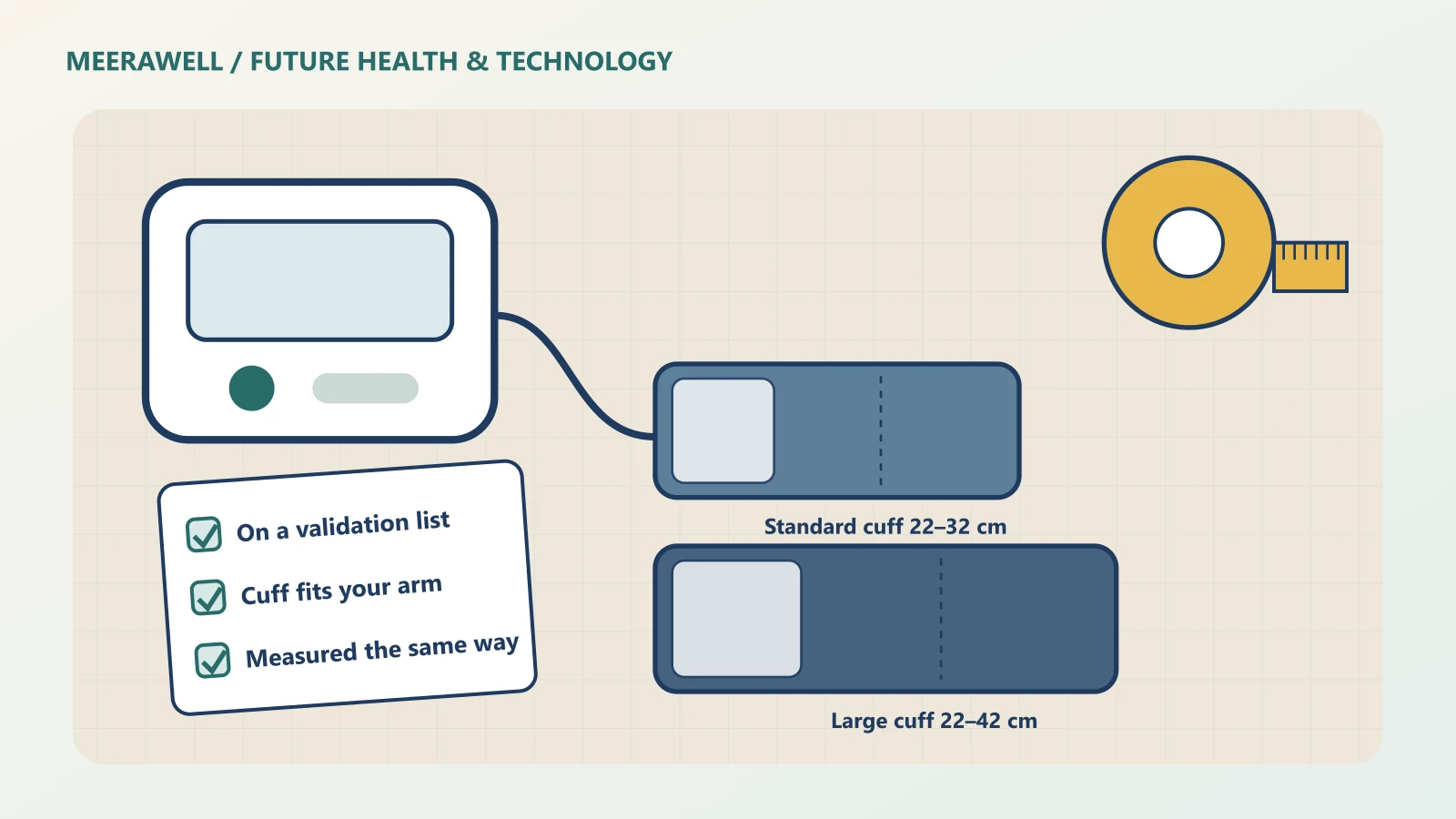
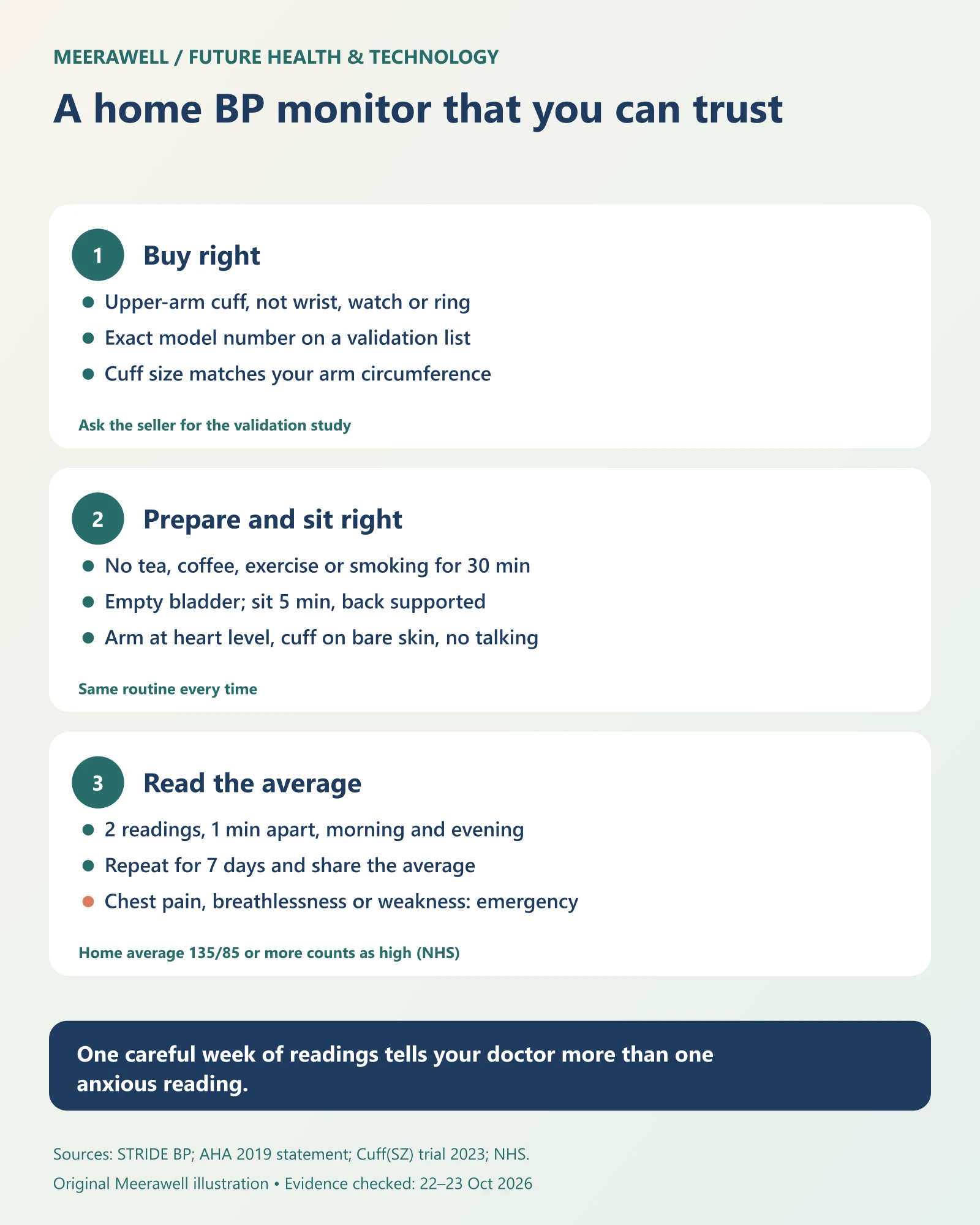
- Buy a BP monitor with an upper-arm cuff that fits your arm and that appears, under its exact model number, on an independent validation list such as STRIDE BP.
- Cuff size can matter as much as the brand. In a 2023 trial, a regular cuff on arms that needed an extra-large cuff read systolic pressure about 19.5 mmHg too high.
- Measure seated after five minutes of rest, twice in the morning and twice in the evening for a week, and share the average. A home average of 135/85 mmHg or more counts as high.
Star Ratings Cannot Tell You Which BP Monitor Is Accurate
Between 2020 and 2021, researchers tracked Amazon’s 100 best-selling blood pressure devices in 10 countries. In their JAMA report, India stood out: a median of 97% of the upper-arm monitors on the list did not appear on any validation listing. That was the highest share of any country studied.
The short answer: buy an upper-arm BP monitor whose exact model is listed by an independent validation registry, check that the cuff fits your arm, and measure the same way every time. Brand, price and a “clinically accurate” label come second.
Customer stars did not help. Validated and non-validated upper-arm monitors received the same median rating. Non-validated ones were simply cheaper.
That matters in a country where the ICMR-INDIAB survey00119-5) found hypertension in 35.5% of adults. A home BP monitor that reads high can lead to unnecessary worry. One that reads low can delay treatment.
1. What “Validated” Means for a BP Monitor
A validated BP monitor has been tested against careful reference measurements on a defined group of people, using a recognised protocol such as ISO 81060-2:2018. Registries such as STRIDE BP, run by hypertension experts, list devices whose studies they have reviewed.
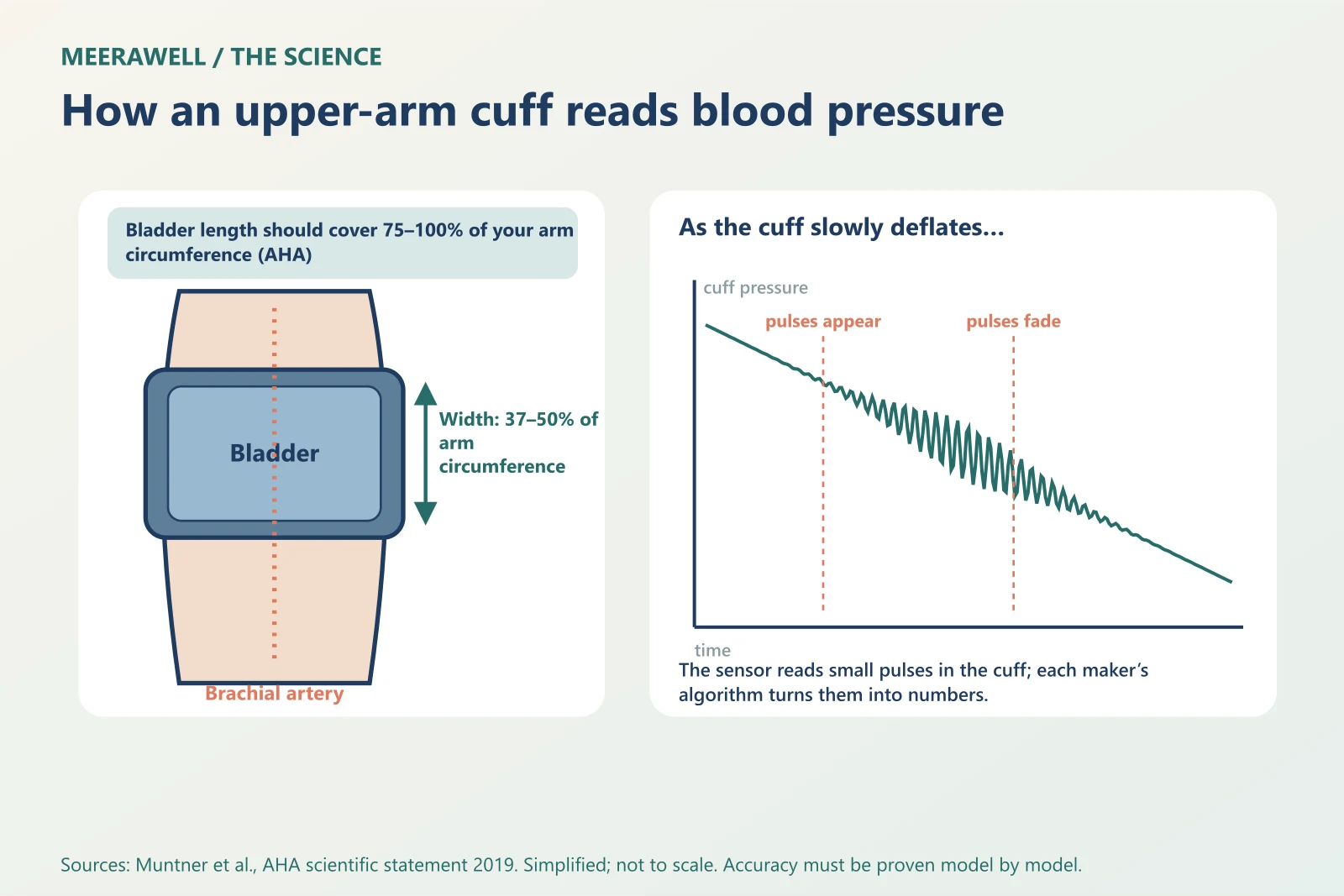
Most home monitors are oscillometric. The cuff inflates, then slowly deflates while a sensor feels tiny pressure pulses from the artery. A maker-specific algorithm turns that pulse pattern into systolic and diastolic numbers. Because every algorithm is different, accuracy has to be proven model by model.
Words on a BP monitor listing such as “clinically accurate”, “FDA” or “CE” are not the same as a published validation study.
2. Omron vs Dr Trust vs Dr Morepen: What the Registry Shows
We checked STRIDE BP’s full list of 619 devices on 22 October 2026, then each brand’s official Indian page for prices and cuffs.
| Model (official Indian page) | Price shown, checked 22–23 Oct 2026 | Cuff in the box | STRIDE BP entry for this exact model code? |
|---|---|---|---|
| Omron HEM-7120 | ₹2,334 (Omron RRP) | 22–32 cm | Yes, though STRIDE marks it “not available”; check stock |
| Omron HEM-7090 / HEM-7090-L | ₹1,990 / ₹2,490 | 22–32 / 22–42 cm | No; European versions (HEM-7090-E, -LE) are listed |
| Omron HEM-7124, HEM-7181, HEM-7183T1, HEM-7194T1 | ₹2,166–₹4,490 | 22–32 or 22–42 cm | No entry found |
| Dr Trust 101, 103, 118, 120, 131 | ₹1,099–₹2,250 (Dr Trust store) | 22–42 cm (120: 22–33 cm) | No Dr Trust model found |
| Dr Morepen BP-02, BP-09, BP-14, BP-15 | ₹1,400–₹1,565, all out of stock | Not stated | No Dr Morepen model found |
“No entry found” does not prove a BP monitor is inaccurate. It means the accuracy is unproven in a registry you can check. Several Dr Trust pages say “clinically validated” or “validated by FDA and CE”, but no study is named. Ask the seller for the published validation study and its model number before you pay.
3. Cuff Size: The Error You Can Measure at Home
Wrap a tape measure around your bare upper arm, halfway between the shoulder tip and the elbow. That is your arm circumference. The American Heart Association’s measurement statement says the cuff’s inflatable bladder should cover 75–100% of it.
Most cuffs boxed with a BP monitor fit 22–32 cm or 22–42 cm. Under 22 cm, you need a small cuff. Omron India lists a 17–22 cm cuff for the HEM-7120. Above 32 cm, a standard cuff is too small.
How big is the error? The Cuff(SZ) randomised crossover trial measured 195 adults in Baltimore with both a regular cuff and their correct size.
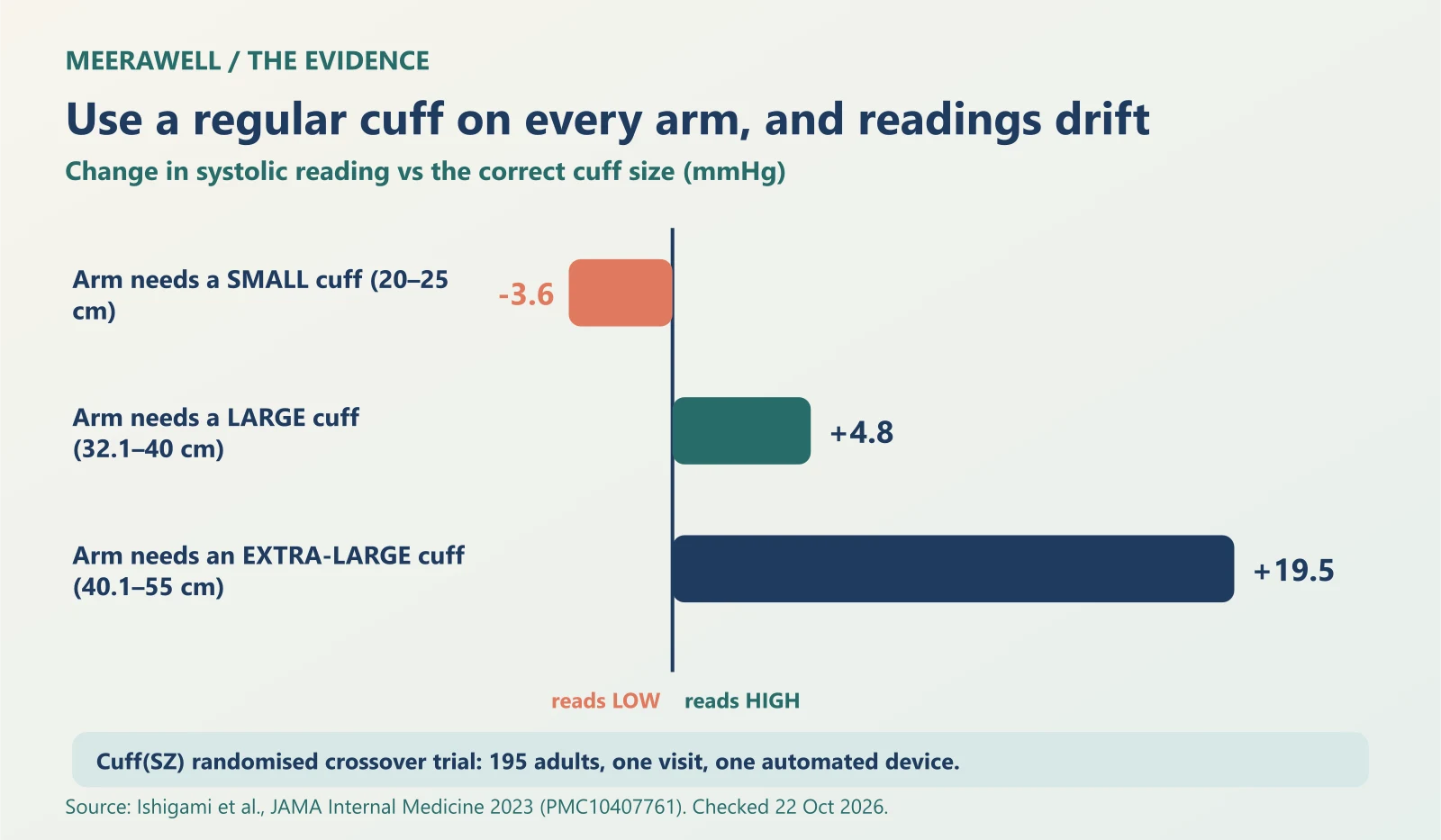
It was one visit with one automated device, so it shows short-term reading error, not long-term outcomes. The direction is clear, though. On larger arms, a cuff that is too small adds pressure that is not really there.
Did you know? In 1901, the German physician Heinrich von Recklinghausen noticed that Riva-Rocci’s original arm cuff, only 4.5 cm wide, overestimated blood pressure. The cuff-size problem is more than 120 years old.
4. How to Use a BP Monitor Correctly at Home
The AHA statement lists the steps that matter most:
- Before: no tea, coffee, exercise or smoking for 30 minutes. Empty your bladder.
- Posture: sit on a chair, back supported, feet flat, legs uncrossed. Rest for five minutes without talking.
- Arm: rest it on a table at heart level. Put the cuff on bare skin, not over a rolled-up sleeve.
- Schedule: take two readings one minute apart, morning and evening, for seven days. Some experts discard the first day.
- Interpret: the NHS treats a home average of 135/85 mmHg or more as high. Clinic readings use 140/90.
Take your BP monitor to your next clinic visit so the doctor can compare it with theirs.
5. Wrist Cuffs, Smartwatches and Rings
A wrist BP monitor reads correctly only when the wrist is held at heart level, and they slip easily. The AHA statement explains why upper-arm devices are preferred.
Cuffless watches and rings are a separate problem. The European Society of Hypertension says its guidelines do not recommend cuffless devices for diagnosing or managing hypertension. The Apple Watch’s hypertension alert works differently again. Our guide to Apple Watch hypertension notifications in India explains what an alert means. Either way, confirm with a validated cuff.
The Verdict: choose the BP monitor whose exact model you can find on a registry, in the cuff size your arm needs. A ₹2,000 device used correctly beats a ₹4,000 device used carelessly.
Safety, warranty and when to get help
- Chest pain, breathlessness, sudden weakness, confusion or vision loss: call emergency services, whatever the BP monitor says.
- Repeated high readings, headaches or blurred vision: see a doctor soon.
- Check that a spare cuff in your size is sold, and whether the warranty covers it.
- Keep the invoice until you have compared readings with your doctor.
Frequently asked questions
Which BP monitor is best for home use in India?
There is no single best brand. Choose an upper-arm BP monitor whose exact model number appears on an independent registry such as STRIDE BP, with a cuff that fits your arm circumference. Then compare it with your doctor’s reading once.
Omron vs Dr Trust: which is more accurate?
We found an exact STRIDE BP entry for one Omron model sold in India, the HEM-7120, and for no Dr Trust or Dr Morepen model. That is a difference in published evidence, not proof that any individual unit is inaccurate.
Are smartwatch blood pressure readings accurate?
Cuffless readings have not met the validation standards that cuff devices meet, and the European Society of Hypertension does not recommend them for diagnosis. Use an upper-arm cuff for numbers you plan to act on.
Next step
Already wear a smartwatch? Learn what its blood pressure alert can and cannot tell you, then confirm with your cuff.
Sources and evidence
Evidence checked on 22–23 October 2026. Prices, stock and registry entries change; confirm before buying. No monitor was tested for this article, and no brand paid for inclusion. General education, not a diagnosis.
- Picone et al., 2023: non-validated vs validated BP devices sold online in 10 countries (JAMA)
- STRIDE BP: validated blood pressure monitors list
- Ishigami et al., 2023: the Cuff(SZ) randomised crossover trial (JAMA Internal Medicine)
- Muntner et al., 2019: AHA scientific statement on measuring blood pressure (Hypertension)
- NHS: blood pressure test and home readings
- Stergiou et al., 2022: ESH statement on cuffless BP devices (J Hypertens)
- Anjana et al., 2023: ICMR-INDIAB national survey (Lancet Diabetes Endocrinol)00119-5)
- Omron Healthcare India: HEM-7120 product page
- Dr Morepen devices store: blood pressure monitors
- Silva et al., 2014: cuff size history and adolescent hypertension (Rev Lat Am Enfermagem)