Key takeaways
- Pollution eye irritation happens when fine particles and gases such as ozone unsettle the tear film, the thin layer that keeps the eye’s surface smooth.
- The usual pattern: both eyes burn, water and look pink, then settle indoors. Pain, light sensitivity, blurred vision or one very red eye need an eye examination.
- What helps: wraparound glasses outside, no rubbing, a gentle eyelid rinse indoors, a cold compress and preservative-free lubricating drops. Never start steroid drops without an examination.
A Particle 30 Times Thinner Than a Hair
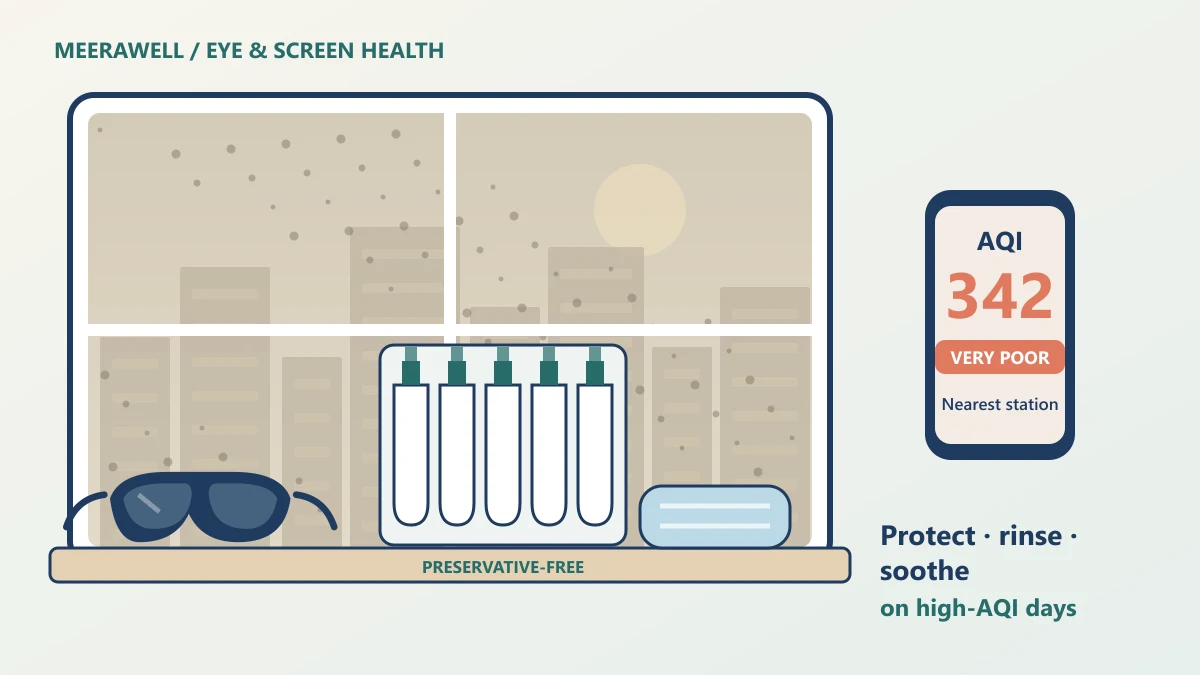
The finest particles in smog, called PM2.5, are almost unimaginably small. The US Environmental Protection Agency notes that an average human hair, about 70 micrometres across, is roughly 30 times wider than the largest of them.
You breathe them in. But they also land somewhere few people think about: the open, wet surface of your eye.
That is why ten minutes at a red light behind an idling bus can leave your eyes stinging, then watering, then pink. A colleague asks whether it is conjunctivitis. Usually, it is not.
The short answer: most pollution eye irritation is the eye’s surface reacting to particles and gases. It affects both eyes, burns more than it itches, and settles once you are away from the smoke. Shield your eyes outside, rinse and soothe them indoors, and know the warning signs.
1. The Science: A Film Thinner Than Paper
Your cornea is never truly dry. It is covered by a tear film with three layers: an oily top layer that slows evaporation, a watery middle layer, and a sticky mucin layer that holds the tears to the eye. Every blink rebuilds it.
A 2020 review of air pollution and dry eye found that tear break-up time, how quickly that film starts to break apart after a blink, was the eye sign most consistently linked to particle exposure. Ozone has been linked to lower tear secretion in observational research, and to inflammation in laboratory and animal work.
When the film becomes unstable, the surface is exposed and the eye fires off reflex tears. Those tears are watery and drain quickly. That is why irritated eyes can stream and still feel dry.
2. What a Delhi Commuter Study Found
In a study in New Delhi, researchers compared 441 people who had commuted through polluted areas daily for at least two years with 79 people who travelled much less.
| Measure | Daily commuters | Comparison group |
|---|---|---|
| Any eye symptom | 78% | 45% |
| Watering | 49% | 22% |
| Redness | 38% | 14% |
| Tear production (Schirmer test, mm) | 22.75 | 30.30 |
There is an honest caveat. Tear measurements in both groups were still within normal limits, so the authors called the changes subclinical. The study shows an association, not proof that pollution caused every difference.
If you already have dry eye, a 2022 study of 387 dry-eye patients linked higher PM2.5 exposure with worse eyelid-gland function and more inflammatory markers in tears. Smog days may hit you harder.
Did you know? In the early 1950s, the Caltech chemist Arie Haagen-Smit showed that Los Angeles smog was largely ozone, formed when sunlight acts on exhaust gases. One of his team’s tests was memorably simple: volunteers sat in a chamber of smoggy air while researchers timed how long it took for tears to run down their faces.
3. What Helps Pollution Eye Irritation on a High-AQI Day
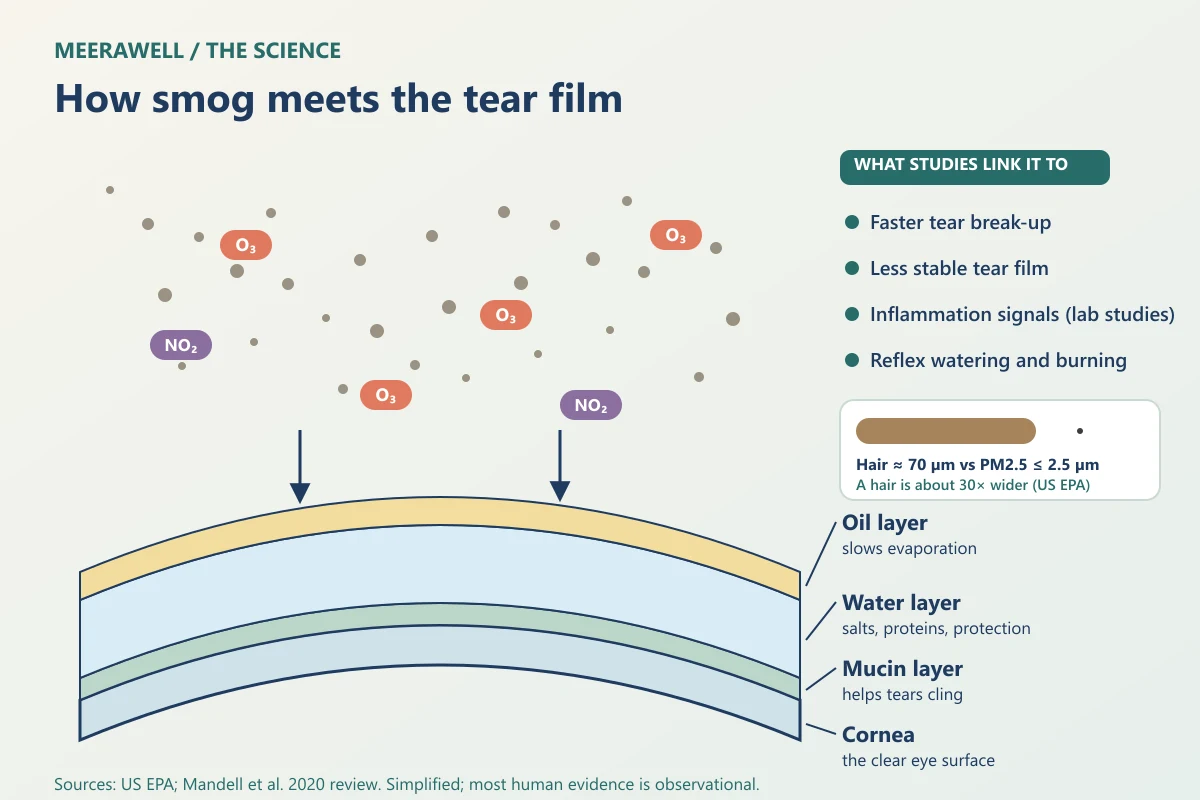
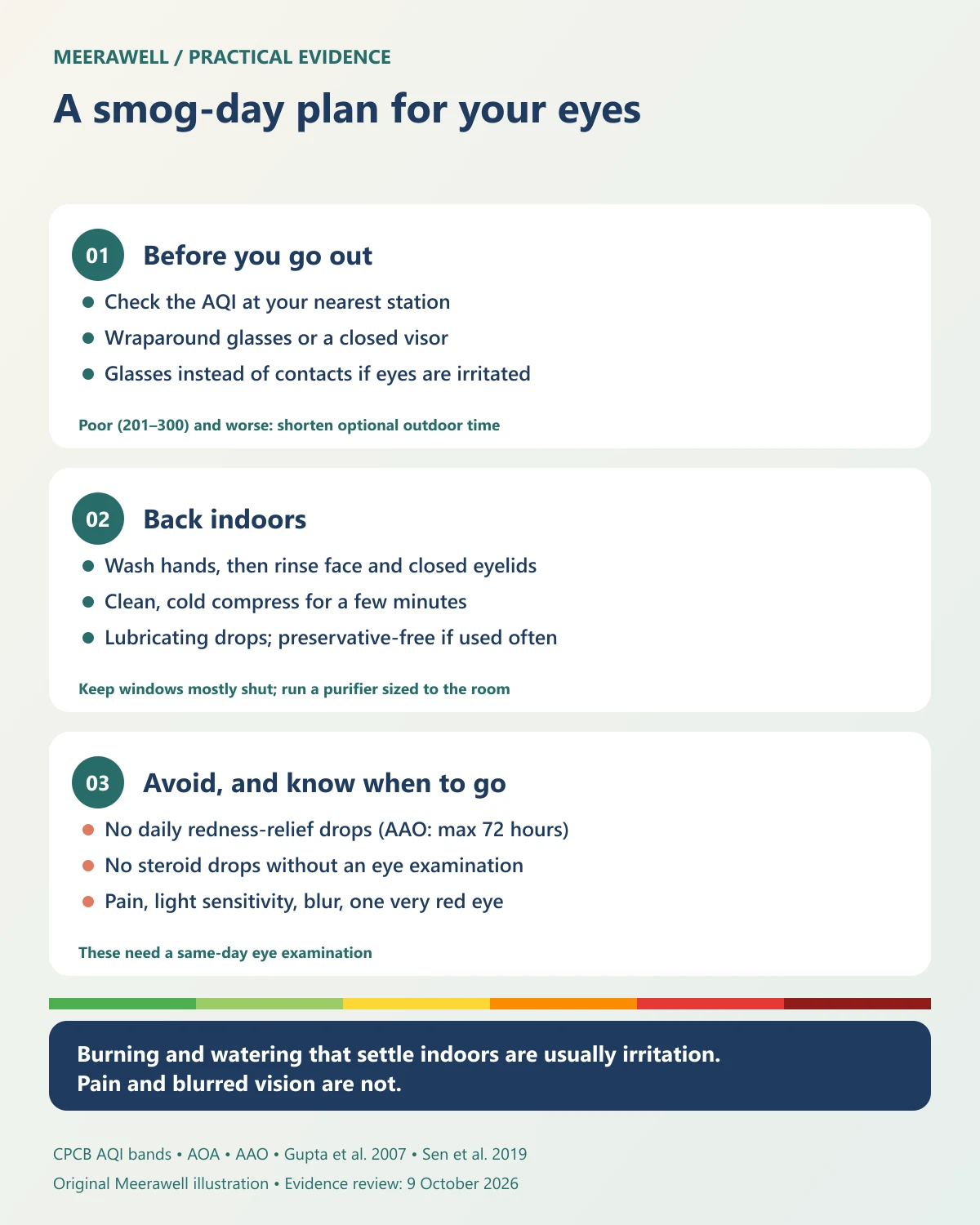
Check the National Air Quality Index for the station nearest you. On Poor (201–300), Very Poor (301–400) or Severe (401–500) days:
- Outside: wear wraparound glasses, or keep the helmet visor down on a two-wheeler. The American Optometric Association recommends eye protection on poor-air days. If your eyes already feel irritated, switch from contact lenses to glasses.
- Do not rub. Rubbing makes burning and watering worse.
- Back indoors: wash your hands, then gently rinse your face and closed eyelids with clean water. A cold compress for a few minutes calms the burning.
- Drops: use lubricating drops (artificial tears) if your eyes feel gritty. Preservative-free drops are gentler if you need them often.
- At home: keep windows mostly shut during peak hours and run a purifier sized for the room. Our guide to air purifiers and ventilation explains when to open up again.
4. What Not to Put in Your Eyes
- Redness-relief drops. They whiten the eye by narrowing blood vessels. The American Academy of Ophthalmology warns that eyes can become redder when they wear off, and advises using them for no more than 72 hours.
- Steroid drops without an examination. Steroids can raise eye pressure without any warning symptoms. In a study from rural India of 1,423 young people with a severe eye allergy, 240 were using steroid drops without a prescription, and 47 had developed steroid-induced glaucoma. If a label says dexamethasone, betamethasone, prednisolone, fluorometholone or loteprednol, do not use it without seeing an eye doctor.
- Home remedies. Rose water, honey and herbal liquids are not sterile eye medicines.
The Verdict: with pollution eye irritation, comfort comes from protecting the tear film, not from making the eye look whiter.
When to see an eye doctor
Smog irritation should ease within hours of coming indoors. Arrange a prompt eye examination for:
- eye pain rather than burning or grittiness
- light sensitivity, or blurred vision that does not clear with blinking
- one eye much redder than the other, or thick discharge
- a red eye while wearing contact lenses
For a chemical splash, rinse the eye with plenty of room-temperature running water for 15–20 minutes and seek urgent care. Poison Control describes the method.
Frequently asked questions
Can air pollution damage your eyes permanently?
For most people, pollution irritation is temporary and settles when exposure falls. Long-term exposure has been linked to dry eye symptoms, but most of that evidence is observational. Persistent symptoms deserve an eye examination.
Which eye drops help with pollution irritation?
Lubricating eye drops (artificial tears) are the usual first choice. If you need them more than a few times a day, preservative-free versions are gentler. Avoid relying on redness-relief drops, and never start steroid drops without an examination.
Is it conjunctivitis or pollution?
Pollution irritation usually affects both eyes, burns or stings, and improves indoors. Infective conjunctivitis more often brings sticky discharge and eyelids stuck together in the morning. If you are unsure, or there is pain or blurred vision, get examined.
Next step
Smog rarely acts alone. Dry office air and long screen sessions strain the same tear film. Fix the indoor side too.
Sources and evidence
Evidence checked on 9 October 2026. General education, not a diagnosis. Observational studies show associations, not proof of cause.
- US EPA: particulate matter basics and PM2.5 size
- Mandell et al., 2020: impact of air pollution and weather on dry eye (J Clin Med)
- Gupta et al., 2007: air pollution and the eyes of Delhi commuters (Indian J Occup Environ Med)
- Hao et al., 2022: air pollution, the ocular surface and tear cytokines (Front Med)
- South Coast AQMD: 50 years of progress (1943 smog and Haagen-Smit)
- Central Pollution Control Board: National Air Quality Index
- American Optometric Association: consumer alert on air pollutants and eyes
- American Academy of Ophthalmology: redness-relieving eye drops
- Sen et al., 2019: steroid misuse and glaucoma in vernal keratoconjunctivitis in rural India (Indian J Ophthalmol)
- Poison Control: first aid for eye exposures