Key takeaways
- Walking pad vs treadmill comes down to use: a walking pad is a compact walking machine. A treadmill is a larger machine built for a wider range of speeds and training. Compare the actual model, not the category name.
- Read the spec sheet carefully. “Peak HP” is a marketing number; ask for the continuous motor rating, the walking-belt length and width, and the user-weight limit.
- Measure your step before you buy. A belt that is barely longer than your step will keep you watching your feet.
- Footfall noise travels through floors, a safety key protects children and pets, and local service decides how your purchase feels after month three.
The Sofa-Gap Problem
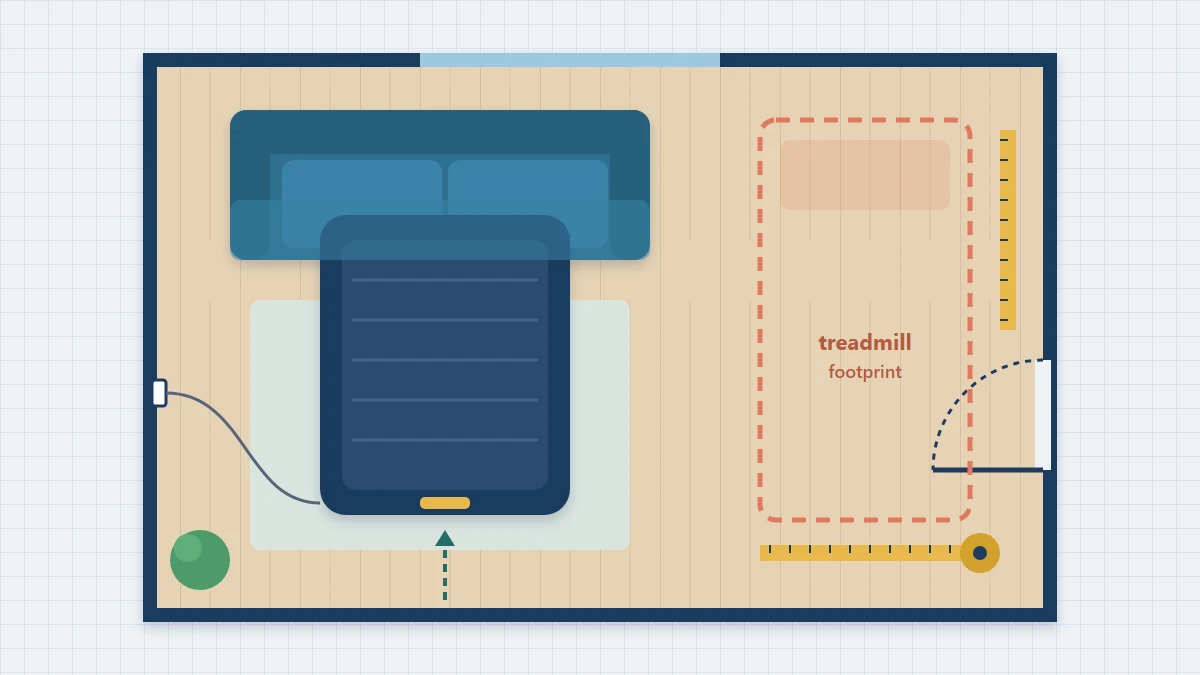
In the product video, the walking pad slides neatly under a sofa.
In your flat, the sofa clears the floor by nine centimetres. The machine is twelve.
The spare socket is across the room. Your downstairs neighbour goes to bed at ten.
That is where this buying decision really begins: not with the motor, but with your home.
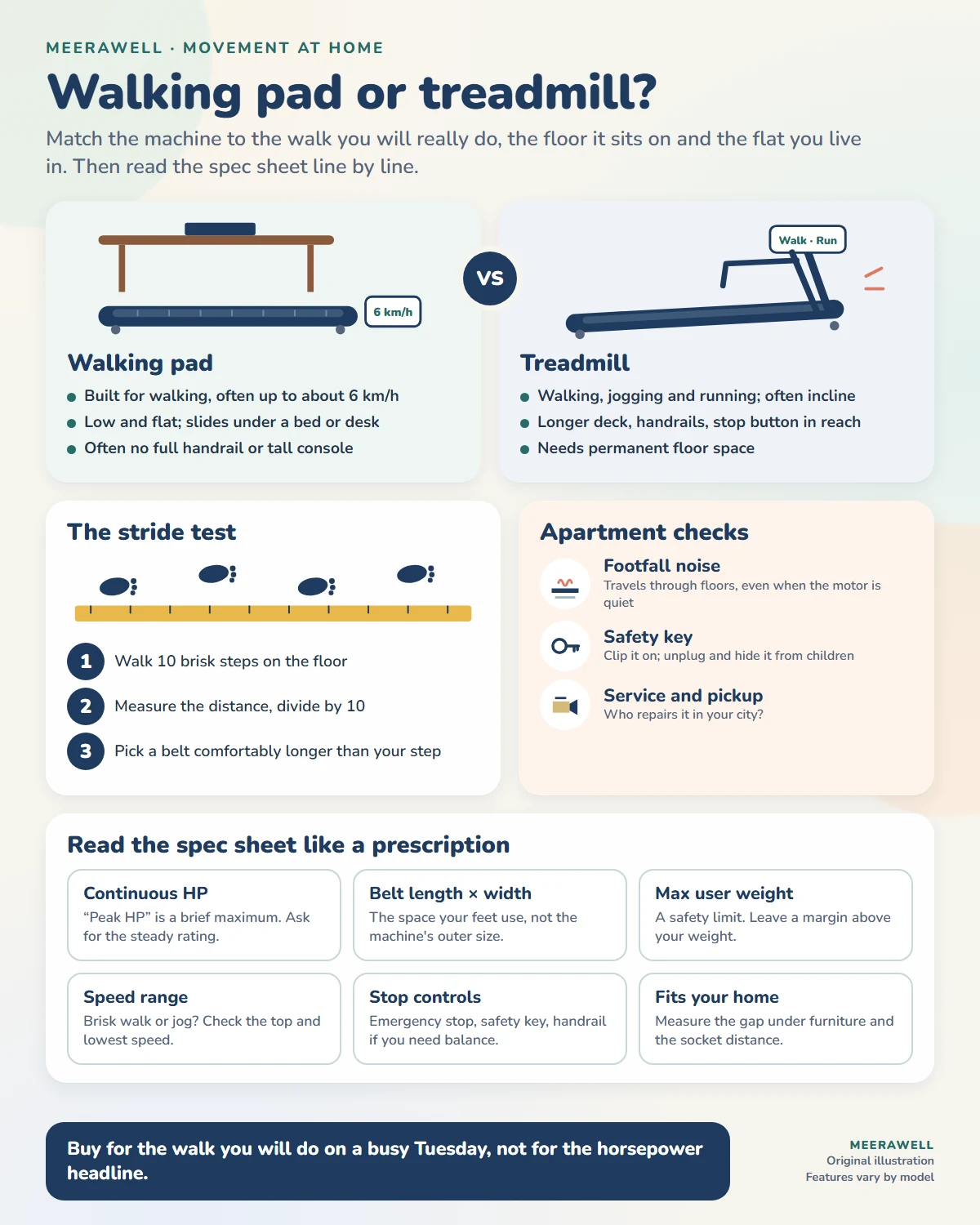
Here is the short answer to walking pad vs treadmill: choose a walking pad if you want easy indoor walking and compact storage. Choose a treadmill if you need higher speeds, incline, a longer deck or full handrails. In both cases, the model’s real specifications, your stride, your floor and local service matter more than the label.
1. Walking Pad vs Treadmill: Two Machines, Two Jobs
The words overlap online, so start with what each machine is built to do.
The Walking Pad
- Built for: walking. Many pads top out at around 6 km/h, which is a brisk walk.
- Shape: a low, flat deck, often without a tall console or full handrails. Some fold or have a pop-up bar.
- Lives: under a bed, a sofa or a standing desk.
The Treadmill
- Built for: walking, jogging and running, often with incline.
- Shape: a longer, wider deck with handrails, a console and an emergency stop within reach.
- Lives: permanently in a room, or folded upright against a wall.
At 6 km/h you cover 100 metres a minute. Thirty minutes is three kilometres. Five such walks a week reaches the WHO adult guideline of at least 150 minutes of moderate activity. A walking pad can be enough for that goal.
If your plan includes running intervals, a walking pad is the wrong tool, whatever the listing calls it.
2. Read the Spec Sheet Like a Prescription
A prescription lists the drug, the dose and how often to take it. A good spec sheet should be just as specific.
Here is a real example. On 1 October 2026 we read the listing for one popular Indian walking pad, the Lifelong LLTM179. The product title says “6HP”. The specification line beneath it says “4 HP Peak Motor”. The page gives a 120 kg capacity, a 6 km/h top speed and an overall folded size of 104 × 53 × 8.5 cm. We could not find the walking-belt dimensions anywhere on the page.
This is not a criticism of one brand. Peak-horsepower headlines are common across this category. The lesson is to look past the headline number.
| Specification | Why it matters | What to ask |
|---|---|---|
| Continuous motor rating | “Peak HP” describes a brief maximum. Continuous rating better reflects steady walking. | “What is the continuous (CHP) rating?” |
| Walking-belt length × width | The space your feet actually use. It is smaller than the machine’s outer size. | “What are the belt dimensions, not the product dimensions?” |
| Maximum user weight | A safety and durability limit. | Leave a margin above your weight. |
| Speed range | Decides whether you can walk briskly or jog. | “What is the top speed, and what is the lowest?” |
| Stopping and safety | Emergency stop, safety key or clip, and handrail. | “How do I stop it instantly if I stumble?” |
| Height and weight of the machine | Decides whether it fits under furniture and whether you can move it. | Measure the gap; check the wheels. |
| Service and returns | Returning a heavy boxed machine needs a pickup, not a courier drop. | “Who repairs it in my city?” |
Save the manual, the model number and a screenshot of the listing on the day you buy.
3. The Stride Test: Will the Belt Fit Your Walk?
Product photos rarely show a person walking at full pace.
Do this instead:
- Mark a starting line on the floor.
- Walk ten steps at the brisk pace you plan to use on the machine.
- Measure the distance and divide by ten. That is your step length.
When you walk, one foot lands at the front of the belt while the other pushes off behind you. A belt that is only a little longer than your step leaves no room to drift forward or back. You end up watching your feet instead of walking.
Width works the same way. A narrow belt leaves little margin if you drift sideways while looking at a screen.
Taller users, and anyone who wants to walk fast, should pay most attention to belt length. If you can, stand on the machine in a store and walk at your real pace.
4. Your Downstairs Neighbour Is Part of the Comparison
“Quiet motor” and “quiet flat” are different promises.
Your footsteps hitting the belt send impact through the deck into the floor. In a concrete building, that thud can travel to the flat below even when the motor sounds soft beside you.
What helps:
- a dense mat designed for exercise machines, if the manual allows one
- walking rather than jogging late at night
- placing the machine away from shared walls
- checking your society’s rules before you buy
What does not help: a noise rating measured from the motor alone.
5. Safety Is a Feature, Not an Accessory
Treadmills and walking pads are moving belts with motors. Treat them the way you would treat any powerful appliance.
In April 2026, the US Consumer Product Safety Commission warned consumers to stop using several Sperax walking-pad and treadmill models. It cited 201 reports of uncontrollable speed or abrupt stops, with at least 66 falls or injuries, and 573 reports of overheating. Those specific models were sold online in the US. The general lesson travels well: buy from a seller you can trace, keep the receipt, and register the product.
In a separate 2023 recall, the CPSC described adults, children, pets and objects being pulled under a treadmill’s rear roller. Sensible precautions at home follow from that:
- clip the safety key to your clothing while walking
- unplug the machine and keep the key out of children’s reach when you finish
- keep children and pets away from the belt while it is running
- follow the manual’s instructions for power supply and clearance behind the deck
6. Walking While Working: Set Realistic Expectations
An under-desk walking pad is appealing for long workdays. It works best when the walking is slow and the task is light: reading, listening, joining a call without typing.
Precise mouse work and long documents are harder while moving. Many people walk between focus blocks rather than through them.
Your desk has to fit the walking height too. Raising a laptop for walking brings the same problems as raising it for standing. Our guide on using a laptop stand without an external keyboard explains the trade-off. When you sit back down, a well-fitted chair still matters; see our guide to the best ergonomic chair in India.
7. The ₹5,000 Question
Many people search for a walking pad under ₹5,000.
At that price, check what the listing actually is. It may be a manual (non-motorised) treadmill, a stepper, a mat or an accessory. The motorised pad in our example above was listed at ₹12,999 on the day we checked.
Manual treadmills can suit some people. But a manual belt that you push with your own legs feels very different from a motorised one. Compare like with like.
Add delivery, installation, a mat, and the cost of a service visit to the price on the screen.
Walking Pad vs Treadmill: Which One Belongs in Your Apartment?
- Choose a walking pad if: you mainly want to walk, you need to store it, and the exact model’s belt, weight limit and stopping features fit you.
- Choose a treadmill if: you want to jog or run, use incline, or need full handrails for balance, and you have the floor space.
- Choose neither, for now, if: you cannot measure the gap, test the noise or find local service. Brisk walks outdoors on cleaner days, or indoor movement without equipment, still count.
The best machine is the one you will step onto on a busy Tuesday, not the one with the biggest horsepower headline.
Stop and get checked
Stop the belt and seek medical help for chest pain or pressure, fainting or near-fainting, unusual breathlessness or palpitations.
If you have heart disease, a recent injury, balance problems or joint pain that worsens with walking, discuss a safe starting plan with your doctor or physiotherapist before buying.
Frequently asked questions
Can you run on a walking pad?
Most walking pads are designed for walking, often up to about 6 km/h. Some two-in-one models reach jogging speeds with a fold-up handrail. Check the exact model’s speed range, belt length and the manufacturer’s stated use before you run on one.
Is a walking pad enough exercise?
It can be. A brisk 30-minute walk on five days reaches the WHO guideline of at least 150 minutes of moderate activity a week. Muscle-strengthening work is a separate part of the guidelines.
Will a walking pad disturb my neighbours?
It might. Footfall impact travels through floors even when the motor is quiet. An appropriate mat, slower speeds at night and placement away from shared walls can help.
What does “peak HP” mean on a treadmill listing?
It describes a short maximum output, not the steady output during a long walk. Ask for the continuous (CHP) rating when you compare motors.
Next step
Buying a machine because of winter smog? Read how to decide between an outdoor walk and an indoor session when the AQI climbs.
Sources and evidence
Sources checked on 1 October 2026. Product information changes; confirm the exact model, manual and warranty on the day you buy. This article involved no hands-on product testing.