Key takeaways
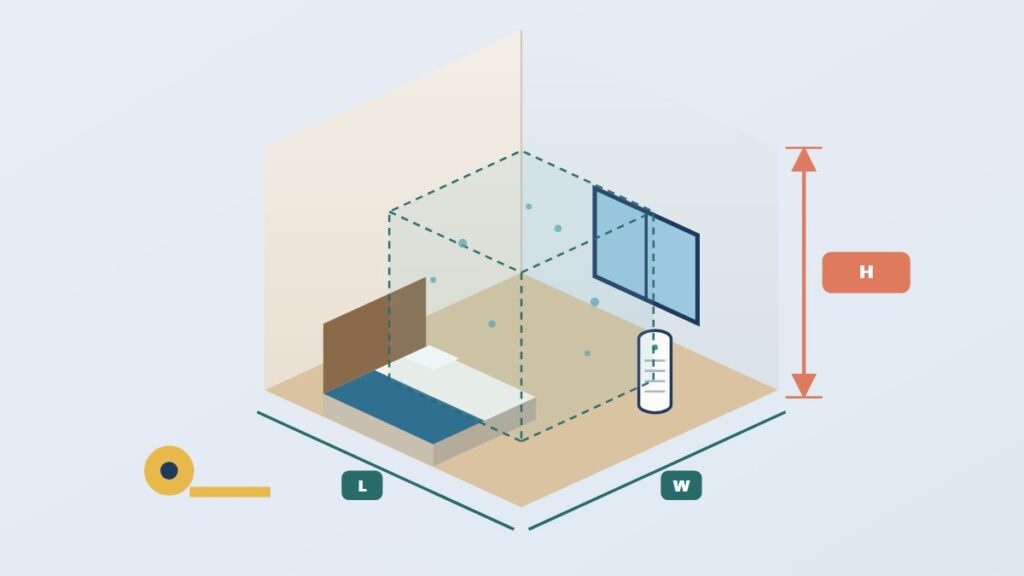
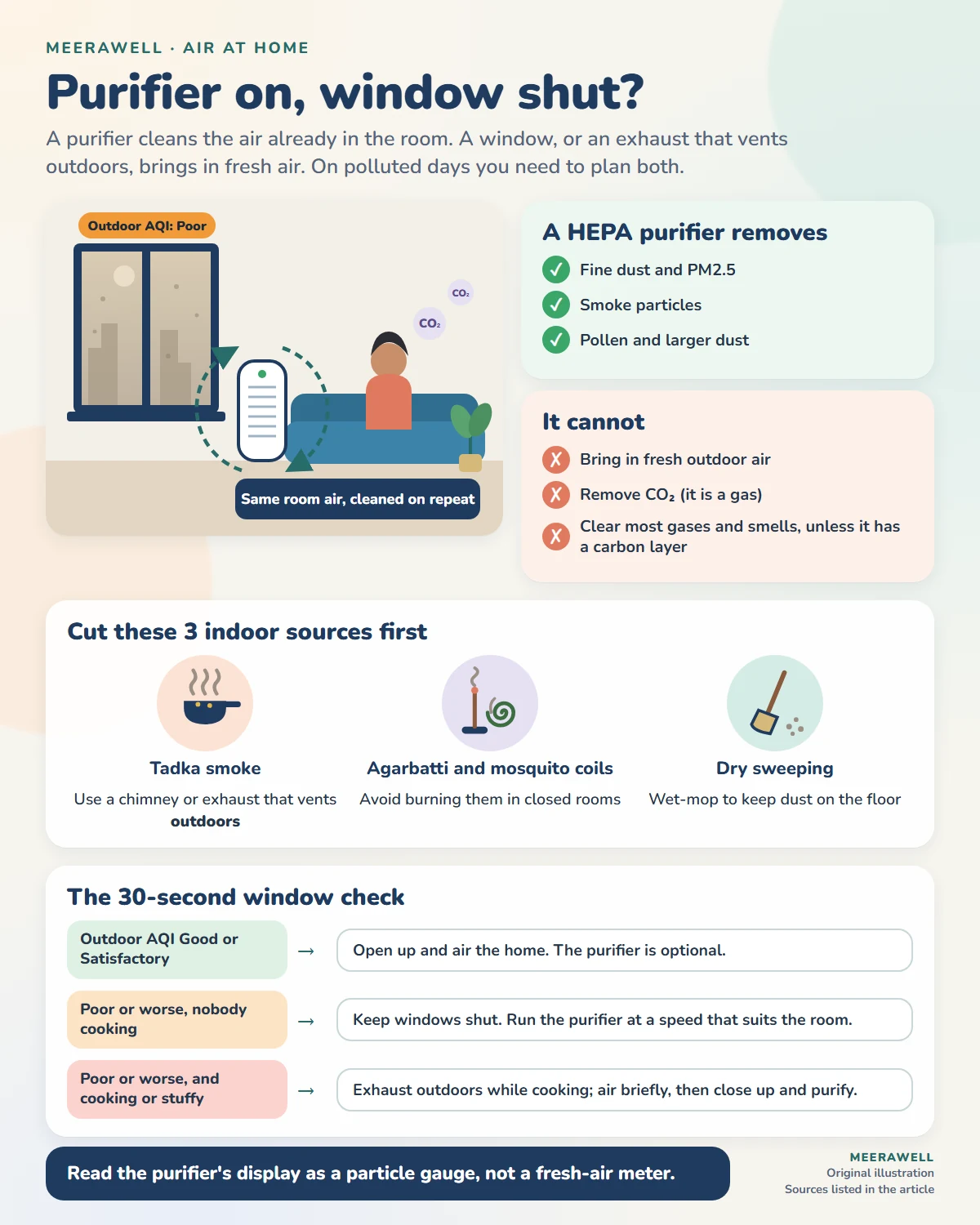
- A HEPA air purifier cleans particles out of the air already in the room. It does not bring in fresh air, and it does not remove carbon dioxide or most gases.
- On a high-AQI day, closing the windows cuts the outdoor particle load. Indoor sources then matter more: tadka smoke, agarbatti, mosquito coils and dry sweeping.
- Ventilate when outdoor air is cleaner, and whenever you cook, crowd a room or the air feels stale. Check your nearest station’s latest PM2.5 reading, not a fixed clock time.
- A low number on the purifier’s display describes particles only. It cannot tell you whether the room needs fresh air.
The 8 PM Window Argument
It is a November evening. The air purifier in the corner glows green.
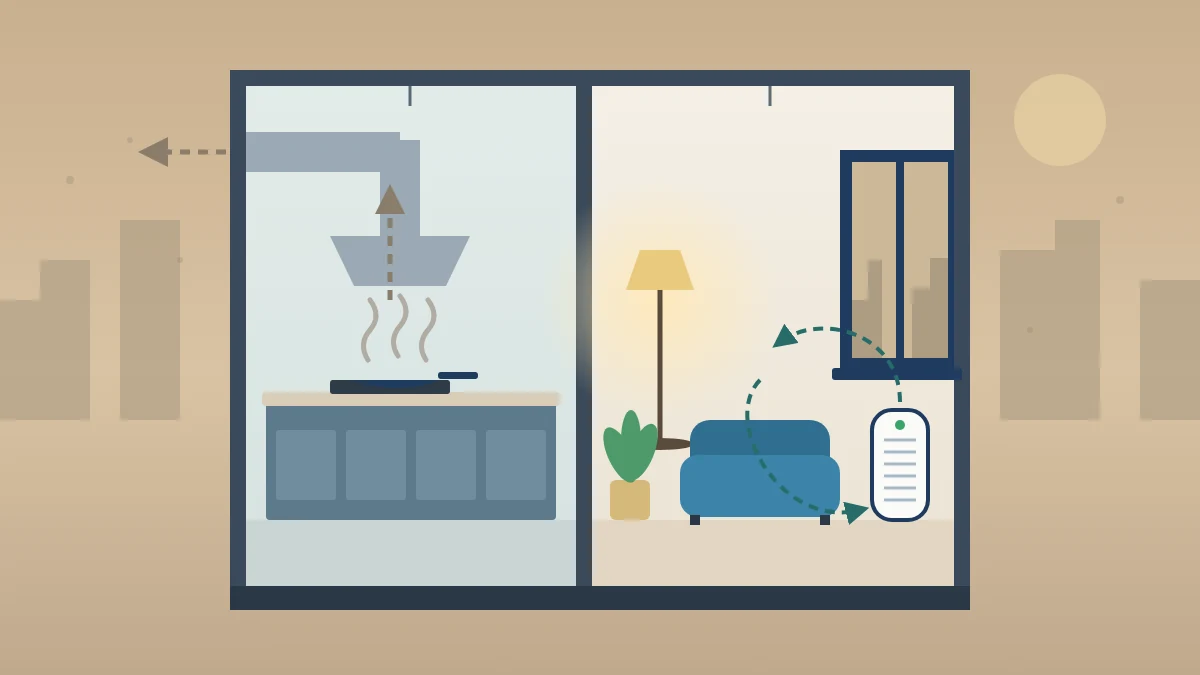
Dinner is on the stove. The jeera has just hit hot oil, and the kitchen is filling with smoke.
Someone says, “Open the window.”
Someone else checks their phone. “The AQI outside is 280. Keep it shut.”
Both of them are partly right.
Here is the short answer: an air purifier and a window do different jobs. An air purifier removes particles from the air already in the room. A window, or an exhaust fan that vents outdoors, replaces stale indoor air with outdoor air. On a polluted day, the skill lies in deciding which air is worse right now, and in cutting the indoor sources you have just shut in.
1. What an Air Purifier Does—and the Two Jobs It Cannot Do
Think of a portable air purifier as a sieve in a circulating stream.
Room air goes in. A HEPA filter traps fine particles—dust, smoke particles, pollen. Cleaner air comes out.
But the sieve never adds new water to the stream. The air keeps going round the same room.
That leaves two jobs undone.
Job 1: Bringing in fresh air
Every person in a closed room breathes out carbon dioxide and moisture. A particle filter lets both straight through, because they are gases, not particles.
The US Environmental Protection Agency puts it plainly: “Filtration does not replace the need to control pollutants and ventilate.” Its guidance treats an air cleaner as an addition to source control and fresh air, not a substitute for them.
Job 2: Removing gases and smells
Cooking fumes, a gas stove and cleaning sprays all release gases as well as particles. Some purifiers add an activated-carbon layer for odours. Even so, a particle rating such as CADR says nothing about gas removal.
What about the AC? Most home split ACs mainly recirculate and cool the room’s own air. Unless yours has a fresh-air function, running it does not mean you are ventilating.
2. The Pollution You Close the Window On
Shutting the windows on a smoggy evening makes sense. It reduces the outdoor particles drifting in.
But a closed room also traps whatever you create inside it.
In many Indian homes, everyday habits add pollution indoors:
- The tadka. Hot oil and spices release smoke and fumes. A ducted chimney or exhaust fan that vents outdoors removes them at the source. A filter-only chimney that blows air back into the kitchen does not take it outside.
- Agarbatti, dhoop and mosquito coils. Delhi’s Directorate of Health Services advises against burning mosquito coils and incense sticks in closed rooms.
- Dry sweeping. A jhaadu throws settled dust back into the air. The same advisory recommends wet mopping instead of sweeping.
- Smoking indoors. No home air purifier makes this safe for the people sharing the room.
The EPA calls source control “usually the most effective way” to improve indoor air. An air purifier works much harder against a source you could have switched off.
3. Air Purifier On: A 30-Second Window Check
You do not need a timetable. You need three quick questions.
First: is the outdoor air better or worse than the air you want to replace?
Use the station nearest you, through CPCB’s website or its SAMEER app, rather than a city-wide headline number. One catch: CPCB’s AQI is a running 24-hour average, so it changes slowly. To spot a cleaner hour, look at the station’s latest PM2.5 concentration instead. Do not assume dawn or midnight is always “clean”.
Second: what is happening inside?
Cooking, a full room and a damp bathroom each call for fresh air or exhaust, even on a poor day.
Third: can you limit what comes in?
Use the exhaust fan while you cook. Open one window briefly instead of every window for hours. Then let the purifier clear the room again with the window shut.
| Situation | What to do |
|---|---|
| Outdoor AQI Good or Satisfactory | Open up and air the home properly. The purifier is optional. |
| Outdoor AQI Poor or worse, nobody cooking | Keep windows shut. Run the purifier at a speed suited to the room. |
| Outdoor AQI Poor or worse, cooking | Run a ducted exhaust that vents outdoors. Keep the kitchen door closed if you can, then purify the room afterwards. |
| Room feels stuffy or smells stale | Exchange the air briefly, during a cleaner hour if possible, then close up and purify. |
| Smoke, fire or a gas smell | Leave the room and ventilate. Treat it as a safety problem, not an air-quality setting. |
The table is a set of household decisions, not a medical threshold. People with asthma or heart and lung disease may need to stay more cautious; see the section on symptoms below.
4. Stuffy Is Not the Same as Polluted
Here is the confusing part.
A bedroom can show a beautiful particle reading on the air purifier and still feel heavy by morning. Two people have been breathing in a closed room for eight hours.
That stale feeling is mostly about air exchange, not particles. Carbon dioxide and humidity rise when nobody lets air in or out.
Some households use a separate carbon-dioxide monitor as a rough guide to whether a room is getting enough fresh air. It measures something different from the purifier’s particle sensor, so neither reading replaces the other.
The Verdict: read the purifier’s display as a particle gauge. Treat it like a car’s fuel gauge, which tells you nothing about the tyres.
5. A Workable Night-Time Setup
For a bedroom on a high-pollution night:
- Size the air purifier to the room you sleep in. A unit that is too small for the room, or set to whisper-quiet, may not keep up. Our companion guide on choosing the right size of air purifier covers the calculation.
- Give it space. Keep the inlet and outlet clear of curtains and furniture. Follow the manual’s clearances.
- Air the room before bed. If outdoor air is cleaner at that hour, open up for a short while, then close and purify.
- Leave the door ajar if the rest of the home is clean. This shares air with a larger space, but it also gives the purifier more volume to clean.
- Change filters on schedule. A clogged filter moves less air.
- Skip ozone-generating “purifiers”. The EPA notes that no US federal agency has approved them for occupied spaces.
Which Approach Fits Your Home?
- If outdoor air is clean: open the windows. Fresh air beats recirculation.
- If outdoor air is polluted: keep windows mostly shut, remove indoor sources and let the purifier work. Ventilate in short, planned bursts.
- If you cook daily without outdoor exhaust: that is likely your biggest fix. It may matter more than a second air purifier.
When to get checked
An air purifier and a closed window cannot cure breathing symptoms. Seek medical advice if, on polluted days or indoors, you notice:
- breathlessness, wheezing or a persistent cough
- chest discomfort, palpitations or giddiness
- asthma symptoms that are not settling with your usual action plan
- red, watering, irritated eyes that persist after you are out of the smoke
Children, older adults, pregnant women and people with heart or lung disease deserve extra caution. Seek emergency care for severe breathlessness or chest pain.
Frequently asked questions
Should I keep windows closed when the air purifier is on?
On a high-AQI day, mostly yes, because an open window keeps letting outdoor particles in. Still air the room briefly when you cook, when the room feels stale, or when outdoor readings improve.
Does an air purifier remove carbon dioxide?
No. HEPA filters trap particles; carbon dioxide is a gas and passes through. Only fresh-air exchange lowers it, through a window, a door to a well-ventilated space or a mechanical ventilation system.
Is it okay to open the window for ten minutes every morning?
There is no universal right time or duration. Look at the latest PM2.5 reading for your nearest monitoring station; the AQI itself is a 24-hour average and moves slowly. Air the home when outdoor air is cleaner, and when you need to after cooking or sleeping.
Does a kitchen chimney help on polluted days?
Yes, if it vents outdoors. It removes cooking smoke at the source before it spreads through the home. A filter-only model that recirculates air back into the kitchen does much less.
Next step
Wondering whether your air purifier is big enough for the room? Measure the room and check the CADR at the speed you will actually use.
Sources and evidence
Sources checked on 1 October 2026. Indoor-air guidance is general; follow your local advisory and your doctor’s advice for any medical condition.