Key takeaways
- Smartwatch sleep score accuracy depends on the device and its algorithm. A score is an interpretation of sensor data, not a clinical sleep study.
- A low HRV reading can be worth noticing, but it does not diagnose a disease or prove you failed to recover.
- Compare trends from the same device under similar conditions. Another person’s number, or another brand’s score, is a poor target.
- Persistent sleepiness, loud snoring or witnessed breathing pauses deserve assessment even when the watch shows a good night.
The Red Number at Breakfast
You wake before the alarm. You feel reasonably rested. Breakfast is ready.
Then the watch syncs: poor sleep, low recovery, HRV below your usual range.
Within seconds, a perfectly ordinary morning feels like a health problem.
Here is the short answer: put the number beside your symptoms, recent routine and longer trend. Smartwatch sleep score accuracy is limited by what the device measures and how it interprets those measurements. One bad score is a prompt to look for context, not an instruction to cancel your day or buy a supplement.
1. Smartwatch Sleep Score Accuracy Starts with an Estimate
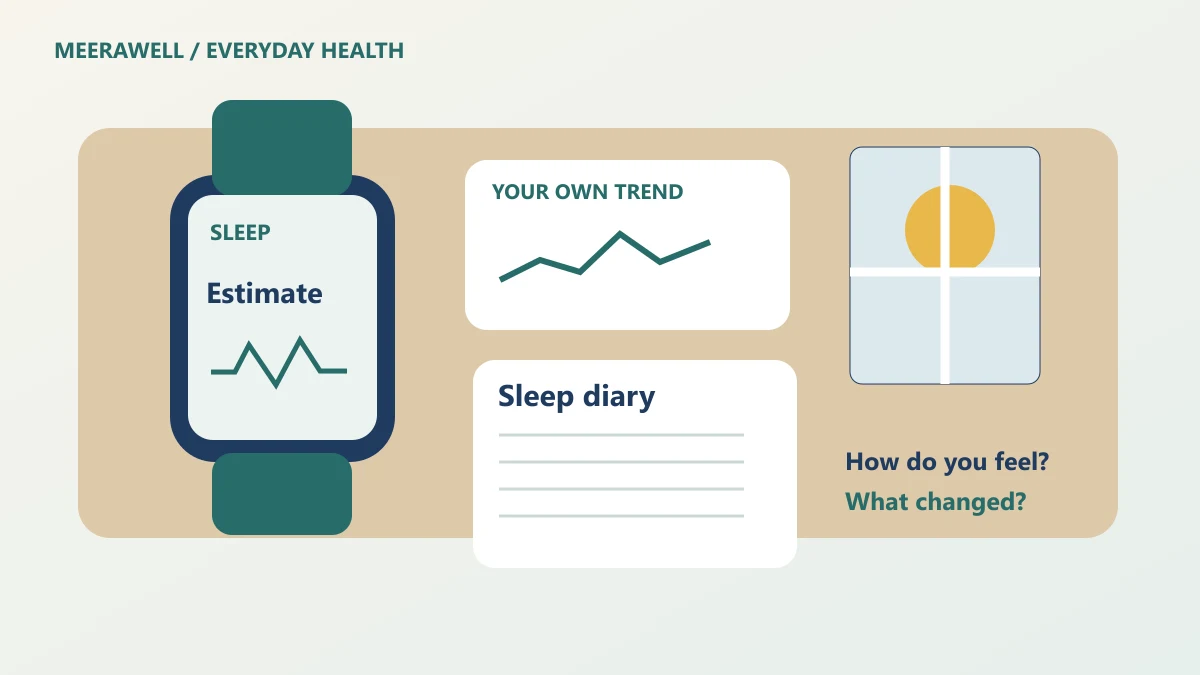
A watch may combine estimated sleep duration, movement, pulse patterns and proprietary rules into a score. Which inputs it uses, and how heavily it weights them, varies by model.
The score can be convenient. It makes a complicated graph easy to glance at. That convenience also hides uncertainty: an apparently precise 67 may be built from several imperfect estimates.
Johns Hopkins explains that trackers estimate sleep indirectly, while a medical sleep study measures signals including brain waves. A consumer tracker can help reveal habits, but does not provide the same information as that study.
That distinction is especially useful when the app reports exact minutes of deep sleep. Treat the staging as an estimate, rather than a nightly examination mark.
2. HRV Measures Timing, Not How Strongly the Heart Beats
Heart rate is the number of beats per minute. Heart-rate variability, or HRV, describes variation in the time between beats.
Two people can share the same average heart rate while having different beat-to-beat patterns. HRV is therefore a different measurement, not another way of displaying pulse.
Cleveland Clinic’s HRV guidance describes influences including age, stress and sleep, and notes that electrocardiography is more accurate than typical wrist tracking.
There is another trap: different HRV measurements are not interchangeable. A short overnight estimate and a 24-hour ECG statistic are different observations. Do not apply a numerical threshold from one method to the number on your watch.
The most useful first comparison is usually your own pattern from the same device, measured in similar circumstances. Even that pattern needs context.
3. Run a Context Check Before Changing the Day
| What you notice | First check | Sensible response |
|---|---|---|
| One poor score; you feel well | Wear time, fit, recent routine and missing data | Keep an ordinary day; watch the pattern |
| Several poorer nights; you also feel tired | Sleep opportunity, late caffeine, stress or illness | Adjust the likely contributor and reassess |
| The score changed after an update or new device | Measurement method and app explanation | Avoid treating old and new values as equivalent |
| Good scores but regular daytime sleepiness | Symptoms and actual sleep schedule | Seek assessment rather than reassurance from the score |
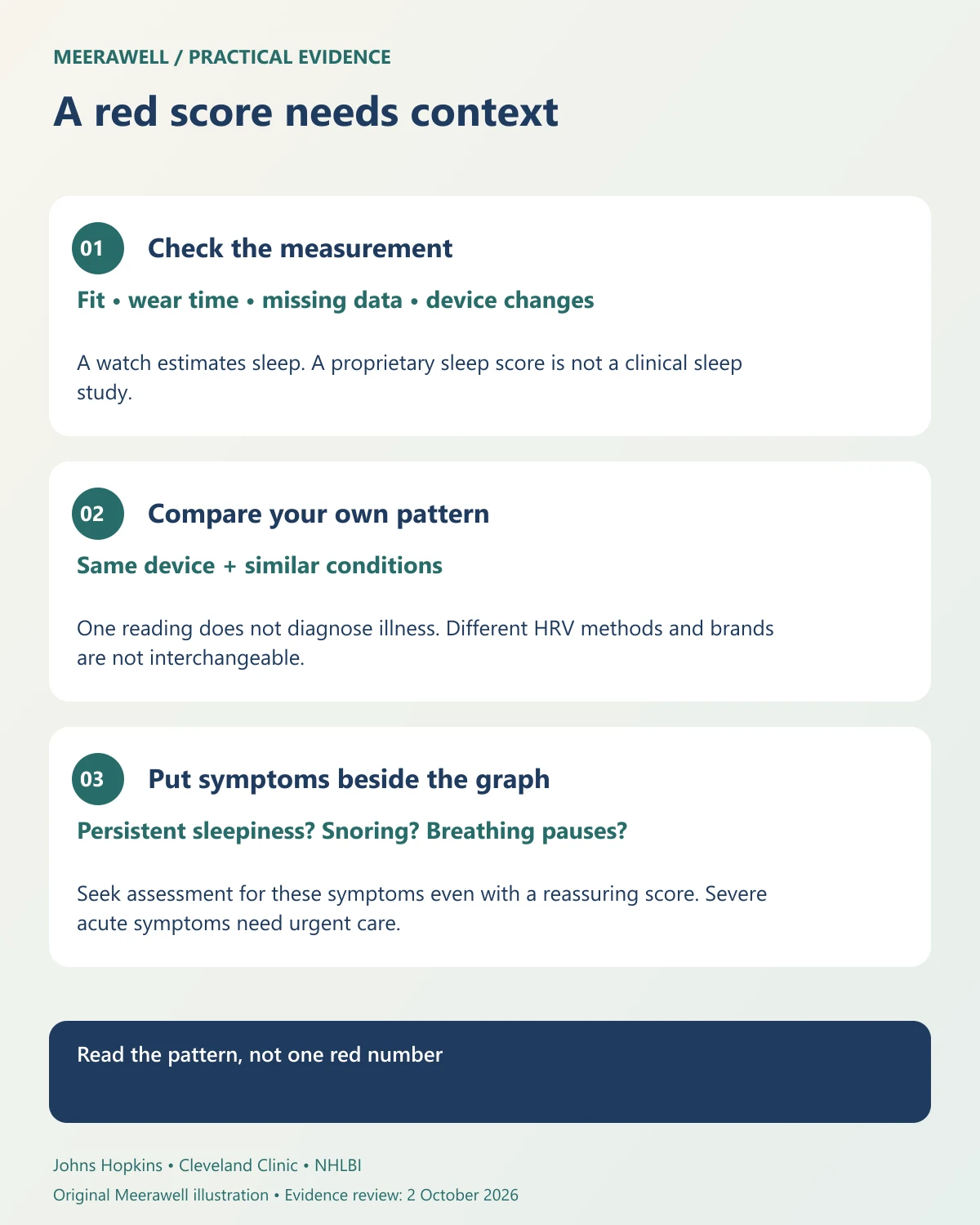
Check the simple things first. Did the watch charge during part of the night? Was the strap fitted as instructed? Did you sleep at an unusual time? Has the app explained a change in how it calculates the score?
These questions do not prove the result is wrong. They stop you assigning a biological explanation before checking the measurement.
4. Keep a Small Diary, Not a Second Job
For one or two weeks, write down bedtime, wake time, how you felt on waking, daytime sleepiness and anything unusual. Add the watch’s broad trend if you find it useful.
You do not need to transcribe every graph. The diary is meant to answer a practical question: does the pattern match anything you can change or anything a clinician should assess?
For example, several late work nights may explain a shorter sleep opportunity. A regular evening coffee may suggest a timing experiment. A low score after one unsettled night may need no intervention at all.
Pick one change at a time. Keep the wake time more consistent, protect time for sleep, or move the last caffeinated drink earlier. Changing bedtime, exercise, food and three supplements together makes the result hard to interpret.
If repeated checking leaves you more anxious without changing a useful decision, reduce how often you open the score. Tracking should help you understand your routine, not dominate it.
5. Symptoms Can Outvote a Green Dashboard
A good score does not rule out a sleep disorder.
NHLBI lists frequent loud snoring, breathing that stops and starts, gasping, and daytime sleepiness among symptoms of sleep apnea. A bed partner’s observation may be more useful than a reassuring app colour.
Our guide to sleeping but still feeling tired explains why persistent tiredness needs a wider view. A wearable cannot settle that question by itself.
Arrange assessment if excessive sleepiness persists, sleep repeatedly interferes with daily life, or someone notices breathing pauses. Do not drive when you are struggling to stay awake. Chest pain, fainting or severe breathlessness need urgent attention, regardless of the HRV reading.
6. Decide What You Want the Watch to Do
Before enabling another metric, choose its job.
If you want a reminder to keep regular sleep hours, a broad duration trend may be enough. If you want to understand persistent symptoms, the next step may be clinical assessment rather than a more expensive tracker.
For training, consider the device’s recovery suggestion alongside how you feel and your established plan. A single consumer score should not become your sole exercise decision rule.
Smartwatch sleep score accuracy matters most when you ask the score to make a decision it cannot reliably make. “My nights are getting shorter” is a useful pattern. “This number proves my nervous system is damaged” goes far beyond the measurement.
Frequently asked questions
Is a sleep score of 70 bad?
There is no universal clinical meaning for 70. Scores are defined by each manufacturer. Look at the device’s explanation, your own trend and your symptoms rather than applying another brand’s scale.
My HRV is low but I feel fine. Should I worry?
One reading needs context. Check your usual pattern and the measurement conditions. A sustained change with symptoms deserves discussion with a clinician; the number alone does not identify a diagnosis.
Can a smartwatch diagnose sleep apnea?
Some models offer specific regulated features, depending on region and model. That is different from an ordinary sleep score. Follow the feature’s actual instructions, and seek assessment for symptoms even without an alert.
Should I buy supplements to improve my score?
A score alone does not establish a deficiency or treatment need. Start with sleep opportunity, routine and symptoms. Discuss persistent problems before treating a graph.
Next step
Put tomorrow’s score beside how you slept and how you function. If those disagree repeatedly, investigate the disagreement rather than chasing a higher number.
Sources and evidence
Evidence checked on 2 October 2026. No particular device was tested; feature availability and validation depend on the exact model. This article does not provide HRV diagnostic thresholds.