
Key takeaways
- Check which scale your app uses. India’s National AQI and the US AQI use different bands, so “150” means Moderate on one and Unhealthy for Sensitive Groups on the other.
- During exercise you breathe far more air each minute, so polluted air delivers a bigger dose. Intensity and duration matter as much as the number.
- Use CPCB’s category, your own health and the route to decide: carry on, go shorter and easier, or move indoors.
- A well-fitted N95 reduces particle exposure, but it does not filter gases. Hard exercise in one is uncomfortable. On the worst days, an indoor session is usually the better choice.
The 6 AM Shoelace Moment
It is a winter morning. Your walking group is already at the park gate.
You bend down to tie your shoes. The sky is the colour of weak tea.
Your phone says the AQI is 186. A friend’s app says 290.
Do you go?
Here is the short answer: before exercising in polluted air, first make sure you are reading the Indian AQI scale for a station near you. Then match the session to the category and to your health. Moderate air may mean a normal walk for you, but a shorter, easier one for a friend with asthma. Very Poor or Severe air usually means an indoor session.
1. First, Which AQI Are You Reading?
Here is a surprise for many people: the same AQI number can mean different things.
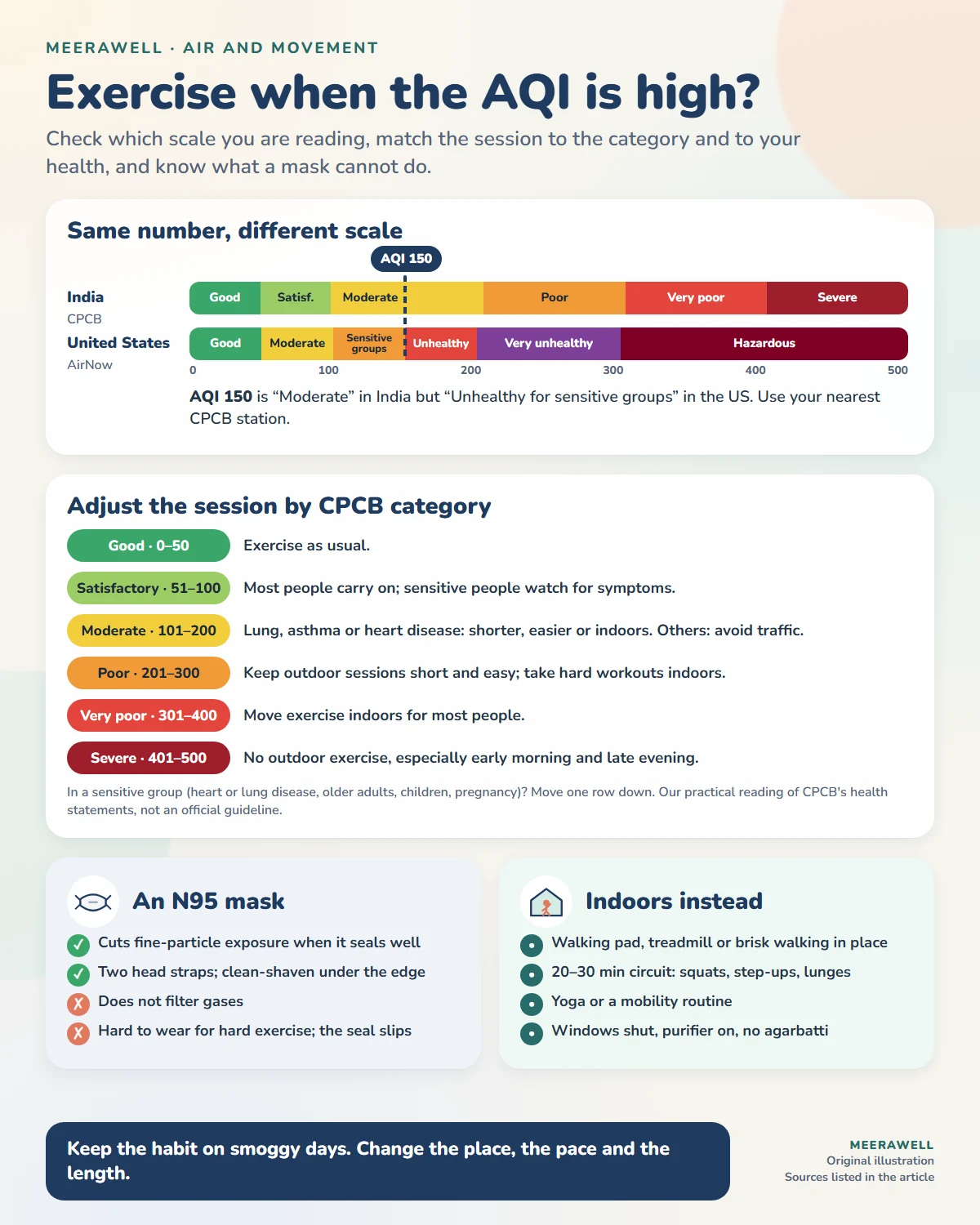
India’s National Air Quality Index (NAQI), published by the Central Pollution Control Board, has six bands. Many international apps and some purifier displays show the US AQI instead, which uses different bands for the same numbers.
| AQI number | India (CPCB) | United States (AirNow) |
|---|---|---|
| 0–50 | Good | Good |
| 51–100 | Satisfactory | Moderate |
| 101–150 | Moderate | Unhealthy for Sensitive Groups |
| 151–200 | Moderate | Unhealthy |
| 201–300 | Poor | Very Unhealthy |
| 301–400 | Very Poor | Hazardous |
| 401–500 | Severe | Hazardous |
So your friend’s 290 may be a US reading, or a different station, or both.
Location matters too. CPCB’s own city bulletin notes that averaging stations across a city “is not a scientifically sound approach”, even though it is used for simplicity. Use the nearest station’s reading, through the CPCB website or its SAMEER app.
2. Why Exercise in Polluted Air Changes the Equation
At rest, you breathe a modest volume of air each minute. During a brisk walk, that rises. During a run, it rises much further, and more of it comes through your mouth, bypassing some of your nose’s filtering.
More air per minute means more particles per minute. That is why the same smog matters more on a run than on a stroll.
But exercise is also one of the most powerful things you can do for your health. So the question is not “Is polluted air harmful?” It is “When does the dose outweigh the benefit?”
A 2016 modelling study by Tainio and colleagues estimated exactly that for long-term mortality. At typical urban pollution levels, the benefits of walking and cycling far outweighed the harm from air pollution. Even at a background PM2.5 level of 100 µg/m³, harms only exceeded benefits after about 90 minutes of cycling a day, or more than 10 hours of walking.
Two cautions keep that finding honest:
- It is a population model of long-term outcomes. It does not predict an asthma attack or chest symptoms on a given morning.
- PM2.5 in µg/m³ is a concentration, not an AQI number. Do not read “100” on your app as the same thing.
The Verdict: for most healthy adults, a daily walk is still worthwhile on many polluted days. The real decisions are intensity, duration, route and who you are.
3. A Decision Guide by Indian AQI Category
CPCB attaches a health statement to each category. The right-hand column is our practical reading of that wording. It is not an official activity guideline.
| CPCB category | CPCB health note | What to do |
|---|---|---|
| Good (0–50) | Minimal impact | Exercise as usual. |
| Satisfactory (51–100) | Minor breathing discomfort to sensitive people | Most people carry on. If you are sensitive, watch for symptoms. |
| Moderate (101–200) | Breathing discomfort to people with lung, asthma and heart diseases | If that describes you, go shorter and easier, or move indoors. Others: choose routes away from traffic. |
| Poor (201–300) | Breathing discomfort to most people on prolonged exposure | Keep outdoor sessions short and easy. Move hard workouts indoors. |
| Very Poor (301–400) | Respiratory illness on prolonged exposure | Move exercise indoors for most people. |
| Severe (401–500) | Affects healthy people; seriously impacts those with existing diseases | Avoid outdoor exercise. Delhi’s health directorate specifically advises against outdoor morning and late-evening walks, jogs and runs on severe-AQI days. |
Who counts as sensitive? People with asthma, COPD or other lung disease, heart disease, older adults, children and teenagers, pregnant women and outdoor workers are commonly listed. If you are in one of these groups, move one row down the table.
4. Where You Exercise Matters as Much as When
Pollution is not spread evenly across a city.
The Delhi advisory recommends avoiding slow, heavy-traffic roads, areas near polluting industries, and construction or demolition sites. A park in the middle of a residential area is usually a better choice than a walk along a busy arterial road.
Timing helps too, but use real data, not folklore. The Delhi advisory specifically names early-morning and late-evening sessions for severe-AQI days. On other days, remember that CPCB’s AQI is a running 24-hour average, so it barely changes from hour to hour. To compare times of day, watch your nearest station’s PM2.5 concentration over a few days. Your own station’s pattern is the best guide.
5. Masks: What an N95 Can and Cannot Do
A good respirator can help when you have to be outside. It is not a licence to run a half-marathon through smog.
According to US EPA guidance on smoke:
- A well-fitted N95 significantly reduces exposure to fine particles. Leaks around the edges let unfiltered air in.
- Choose two head straps. Masks with ear loops are not designed to seal tightly to the face.
- Facial hair breaks the seal. The skin under the edge should be clean-shaven.
- It filters particles, not gases. It does not protect against gases such as carbon monoxide.
- Young children are hard to fit. Approved respirators are not made in small children’s sizes.
Cloth masks and loose surgical masks do not seal the way a fitted respirator does.
Exercising hard in an N95 is also uncomfortable. The mask resists breathing, gets damp and may slip, and a mask that has slipped no longer seals. For a commute or an unavoidable errand, wear a fitted respirator. For a workout, an indoor session is usually the simpler answer.
6. A Good Indoor Session When the Air Outside Is Polluted
Skipping exercise for weeks of winter smog has its own cost. The WHO notes that any amount of physical activity is better than none.
Indoor options that work in most homes:
- brisk walking in place, or on a walking pad or treadmill
- a 20–30 minute circuit of squats, step-ups, wall push-ups and lunges
- skipping, if your floor and neighbours allow
- yoga or a mobility routine
Close the windows, run a purifier sized for the room (our guide on choosing the right purifier size explains how), and skip agarbatti or dry sweeping before your session.
Building stairwells and basement gyms may not have cleaner air than outdoors. Indoor air is only better when it is actually being filtered or is well away from the source.
Which Choice Fits Today?
- Good to Moderate, and you feel well: go out. Pick a quieter route.
- Poor: keep it short and easy outdoors, or bring the session indoors. Sensitive groups should choose indoors.
- Very Poor or Severe: indoors, almost always.
- Any day you feel unwell: rest or go gentle, whatever the number says.
When to stop and get checked
Stop exercising and seek medical advice if you notice:
- chest pain or pressure, or palpitations
- breathlessness or wheezing that is unusual for you
- giddiness, or a cough that keeps coming back after exercise
- red, watering eyes that stay irritated after you come indoors
If you have asthma, follow your asthma action plan and keep your reliever inhaler with you. People with heart disease who develop palpitations, breathlessness or unusual tiredness should contact their doctor. Seek emergency care for severe breathlessness or chest pain.
Frequently asked questions
Is it safe to go for a morning walk when the AQI is high?
It depends on the category and on you. On Moderate days most healthy adults can walk, preferably away from traffic. On Poor days, keep it short and easy. On Very Poor or Severe days, move the session indoors; Delhi’s health advisory specifically advises against outdoor morning walks on severe-AQI days.
Which AQI should I follow: the CPCB app or an international app?
For decisions in India, use CPCB’s National AQI for the station nearest you. International apps often show the US AQI, which uses different category bands for the same numbers.
Can I run outside if I wear an N95?
A well-fitted N95 reduces particle exposure, but hard running in one is uncomfortable, and the seal often slips. It also does not filter gases. On poor-air days, an indoor workout is usually the more practical choice.
Is indoor exercise really better on a polluted day?
Usually, if the room is closed and filtered and has no indoor sources such as smoke. An unfiltered stairwell or a basement next to a parking area may not be cleaner.
Next step
Thinking of a machine for smoggy months? Compare walking pads and treadmills for an Indian apartment before you buy.
Sources and evidence
Sources checked on 1 October 2026. The activity column in our table is a practical interpretation of CPCB’s health statements, not an official guideline.
- CPCB: About the National Air Quality Index (categories and breakpoints)
- CPCB: AQI bulletin with possible health impacts (7 November 2022)
- AirNow (US EPA): AQI basics
- AirNow: Air quality guide for particle pollution
- Directorate of Health Services, Delhi: public health advisory on air pollution
- US EPA: Protect your lungs from smoke (respirator fit and limits)
- Tainio et al. (2016): Can air pollution negate the health benefits of cycling and walking?
- WHO: physical activity fact sheet