Key takeaways
- Air purifier CADR (clean air delivery rate) tells you how much particle-free air a purifier delivers, usually at its highest fan speed. It is a better sizing number than “HEPA” or “covers 600 sq ft”.
- AHAM’s two-thirds rule (smoke CADR in cfm ≥ ⅔ of floor area in sq ft) assumes an 8-foot ceiling. It works out to about five clean-air changes an hour.
- Many Indian rooms are taller than 8 ft. Size by volume: room volume (m³) × 5 = the CADR you need in m³/h.
- Check the CADR at the speed you will actually sleep with. If the brand does not publish it, treat it as unknown and size up.
Two Bedrooms, One Box
Picture two bedrooms. Both measure 10 × 15 feet, or 150 square feet.
One is in a new tower with an 8-foot ceiling. The other is in an older home with a 10-foot ceiling.
The same purifier box says it “covers up to 300 sq ft”. It must be fine for both, surely?
Not quite. The second room holds 25% more air.
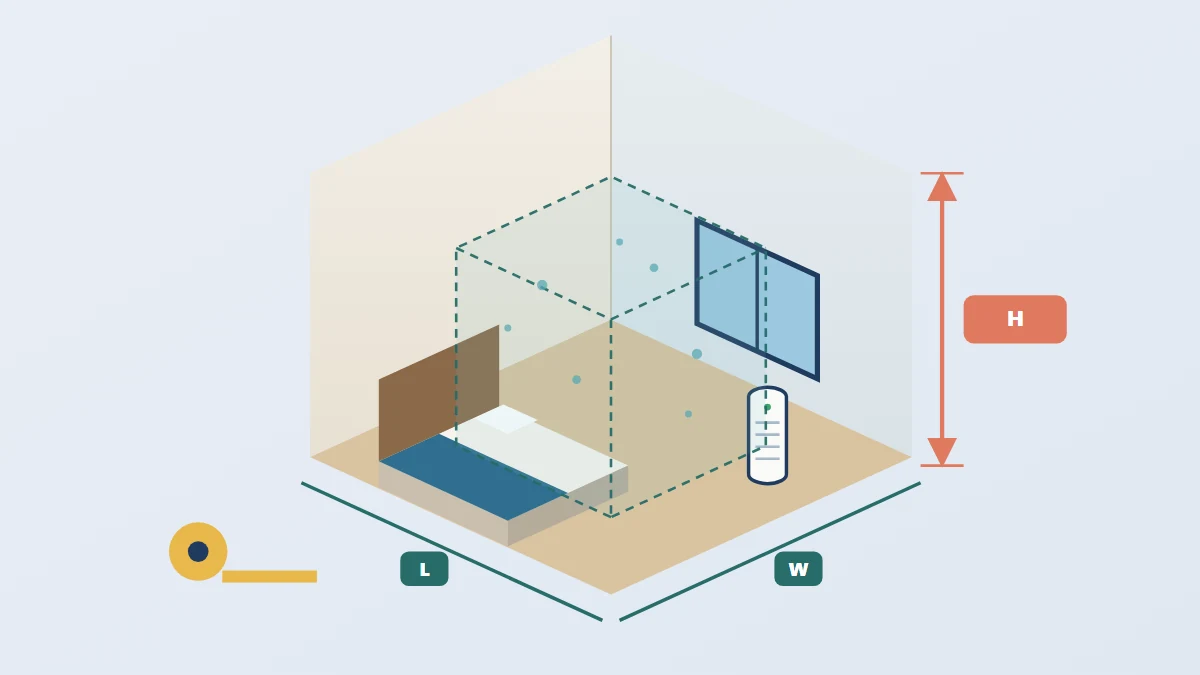
A purifier does not clean a floor. It cleans a box of air. And the box on the label is usually smaller than the one you live in.
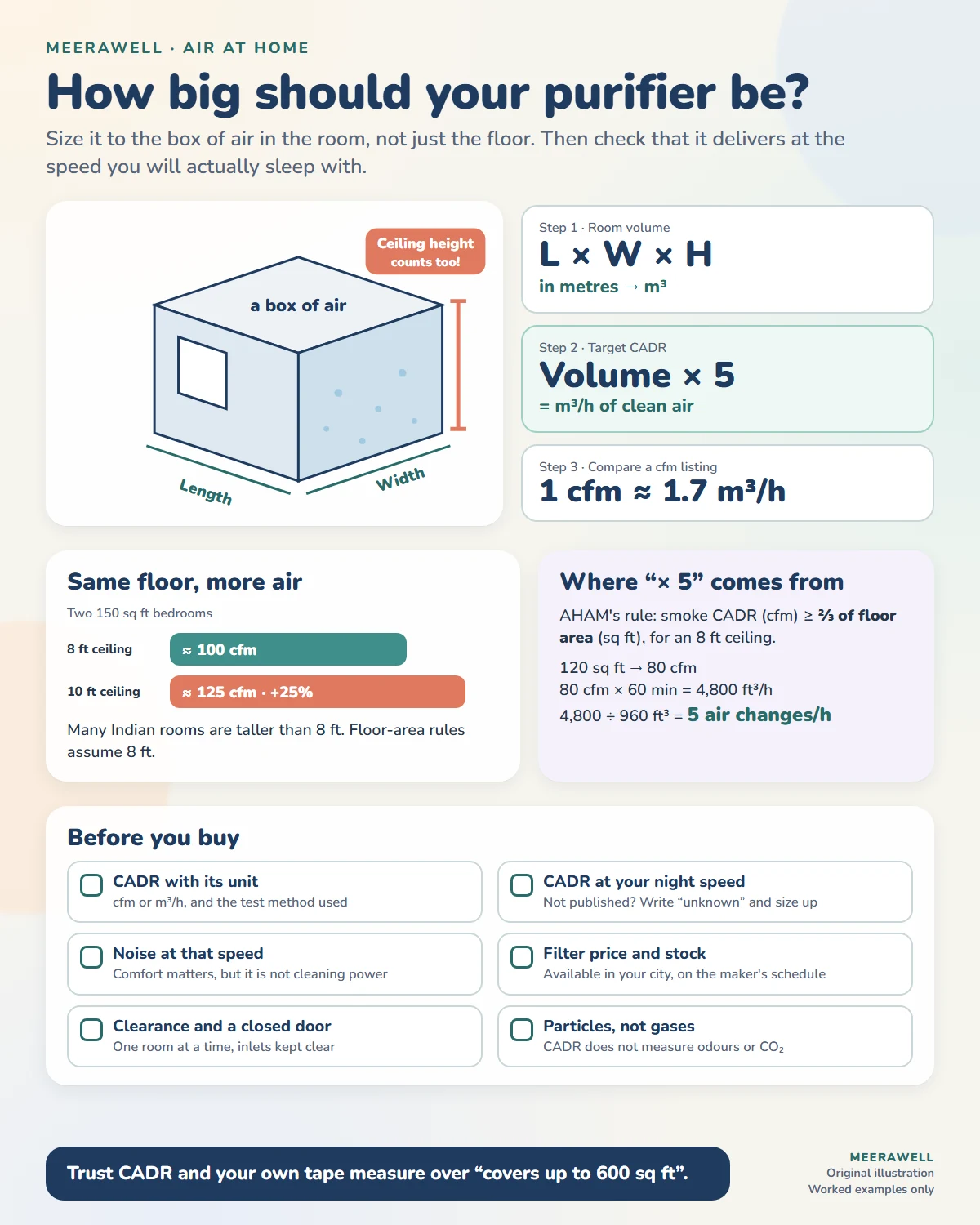
Here is the short answer: to choose the right air purifier CADR, measure length, width and height. Multiply the volume by five to get a sensible CADR target in m³/h. Then check that the purifier delivers it at a speed you can live with at night.
1. What Air Purifier CADR Actually Measures
Think of a tea strainer.
A very fine mesh catches more leaves. But if you pour slowly, you still wait a long time for a full cup.
“HEPA” describes the mesh. CADR describes the pour: how much cleaned air the machine delivers in a given time.
A few things to know about the number:
- It is measured for particles. AHAM, the US appliance association behind the CADR test, scores smoke, pollen and dust separately. Smoke is the most useful for fine particles such as PM2.5.
- It is usually measured at the highest fan speed. The EPA notes this; the quiet night mode delivers less.
- It comes in two units. US-style listings use cubic feet per minute (cfm). Many Indian listings use cubic metres per hour (m³/h). 1 cfm ≈ 1.7 m³/h. A CADR of 250 cfm is about 425 m³/h, so check which unit the box uses before comparing.
- It says nothing about gases. Odours and gases depend on a carbon layer, which CADR does not measure.
India has its own standard for these machines, IS 17531:2021, published by the Bureau of Indian Standards. Ask the brand which test method produced its CADR figure.
2. The Two-Thirds Rule—and Where It Comes From
AHAM gives a simple rule of thumb: a purifier’s smoke CADR, in cfm, should be at least two-thirds of the room’s area in square feet.
A 10 × 12 ft room is 120 sq ft. Two-thirds of 120 is 80. So you would look for a smoke CADR of at least 80 cfm.
AHAM adds an important condition: the rule assumes an 8-foot ceiling. With higher ceilings, it says, you need a purifier rated for a larger room.
That matters in India. The National Building Code sets a minimum height of 2.75 m, about 9 feet, for most habitable rooms (2.4 m for air-conditioned rooms). A room built to the 2.75 m minimum already holds about 13% more air than an 8-foot room with the same floor.
Here is why the rule works. 80 cfm delivers 4,800 cubic feet of clean air an hour. A 120 sq ft room with an 8 ft ceiling holds 960 cubic feet. 4,800 ÷ 960 = 5.
In other words, the two-thirds rule quietly aims for about five clean-air changes per hour. Once you know that, you can apply it to any ceiling height.
For smoke-heavy conditions, AHAM goes further and suggests a smoke CADR equal to the full room area. That works out to about seven and a half clean-air changes an hour.
3. Air Purifier CADR: Do the Maths for Your Room
You need a measuring tape and two minutes.
- Measure length, width and ceiling height, in feet or metres.
- Multiply them to get the room’s volume. To convert cubic feet to cubic metres, divide by 35.3.
- Volume (m³) × 5 = target CADR in m³/h.
- To compare with a cfm listing, divide by 1.7.
| Room (L × W × ceiling) | Volume | Target CADR (volume × 5) | Two-thirds rule (assumes 8 ft) |
|---|---|---|---|
| 10 × 12 ft × 8 ft | 27 m³ | ~136 m³/h (~80 cfm) | 80 cfm, a match |
| 10 × 10 ft × 9 ft | 25.5 m³ | ~127 m³/h (~75 cfm) | 67 cfm |
| 10 × 12 ft × 10 ft | 34 m³ | ~170 m³/h (~100 cfm) | 80 cfm |
| 12 × 14 ft × 10 ft | 47.6 m³ | ~238 m³/h (~140 cfm) | 112 cfm |
| 14 × 18 ft × 10 ft (living room) | 71.4 m³ | ~357 m³/h (~210 cfm) | 168 cfm |
Notice the pattern. At 10-foot ceilings, the floor-area rule undershoots by about a quarter.
These are worked arithmetic examples, not test results for any product. “Clean-air changes” means room air passed through the filter. It is not fresh outdoor air; for that, see our guide on when to open the windows.
4. The Speed You Will Actually Use
Now the awkward bit.
Suppose your bedroom needs 170 m³/h. You find a purifier rated at 180 m³/h. Perfect?
Only at full speed. And full speed can be noticeably loud in a quiet bedroom. At 2 AM, many people switch to “sleep mode”.
The EPA notes that air-cleaning performance improves at higher fan speeds, and that noise rises too. So you need a second number: CADR, or at least airflow, at the speed you will sleep with.
- If the brand publishes CADR for each speed, use the night-time figure for your calculation.
- If it publishes only noise levels per speed, that tells you comfort, not cleaning.
- If it publishes neither, write “unknown” on your list. Then choose a model with headroom, so a middle setting has a better chance of doing the job.
Do not invent a percentage for sleep mode. An honest “unknown” is better than a precise-looking guess.
5. Reading the Box: Reverse the Claim
Coverage claims such as “up to 600 sq ft” rarely say what they assume.
You can check them yourself. Take a purifier with a CADR of 300 m³/h and a claim of 600 sq ft:
- 600 sq ft at an 8 ft ceiling is about 136 m³ of air.
- 300 ÷ 136 ≈ 2.2 clean-air changes per hour.
That is less than half the five-per-hour pace behind the two-thirds rule. The claim is not necessarily false. It simply assumes a slower cleaning rate than you may want on a polluted day.
The Verdict: trust CADR and your own tape measure over coverage claims.
6. Placement, Filters and Running Cost
A correctly sized purifier still needs a fair chance:
- Put it in the room you spend most time in. For most people, that is the bedroom at night.
- Close the door. One purifier cannot keep an open-plan flat at the same level as one closed room.
- Leave clearance. Keep the inlet and outlet clear of curtains, beds and walls, as the manual specifies.
- Budget for filters. Check the replacement filter’s price and local availability before buying. Replace it on the maker’s schedule; a clogged filter moves less air.
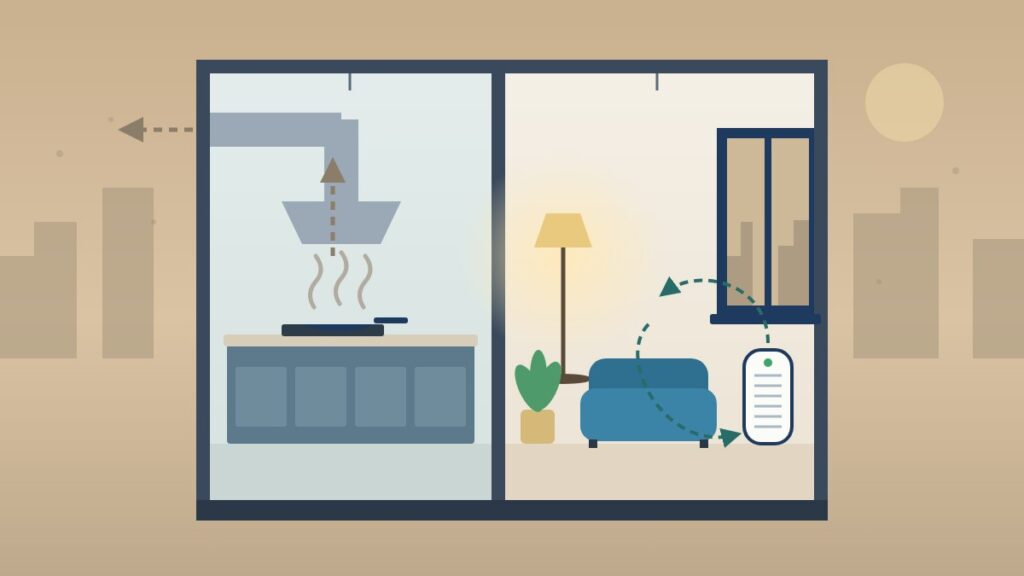
- Cut the sources. Cooking smoke, agarbatti and dry sweeping add particles faster than a small unit can remove them.
- Avoid ozone generators. The EPA notes that no US federal agency has approved them for use in occupied spaces.
Your Buying Checklist
- Room volume, measured with the real ceiling height, to set your air purifier CADR target
- Target CADR = volume × 5 (m³/h)
- Smoke CADR from the brand, with its unit (cfm or m³/h) and test method
- CADR or airflow at your night-time speed, or “unknown”
- Noise at that speed
- Replacement filter price and availability in your city
- Space for clearance around the unit
If two purifiers meet the target, choose the one that meets it more quietly.
Frequently asked questions
What CADR do I need for a 150 sq ft room?
With an 8-foot ceiling, AHAM’s two-thirds rule suggests a smoke CADR of at least 100 cfm (about 170 m³/h). With a 10-foot ceiling, the room holds 25% more air, so aim for about 125 cfm (about 212 m³/h).
Is a higher CADR always better?
For cleaning speed, yes. But a bigger machine costs more to buy and to refit with filters, and it can be louder. The best fit meets your target at a speed you will actually use.
Can one purifier clean the whole flat?
Not reliably. Purifiers are sized for a room. Put one in the room you use most, close the door, and add units only if you need several protected rooms.
Is HEPA grade more important than CADR?
Both matter, for different reasons. The filter grade describes what it can catch; CADR describes how much clean air reaches the room. A fine filter with weak airflow can still be undersized.
Next step
A purifier recirculates the same air. Read when to ventilate on polluted days, and which indoor sources to cut first.
Sources and evidence
Sources checked on 1 October 2026. Worked examples are arithmetic, not product tests. Confirm each model’s CADR, unit and test method with the manufacturer.