🔹 The “Miracle” Claim and the Timing Question
Wondering when to take ashwagandha? First check what the evidence supports and whether it is appropriate for you. A precise time of day is not a proven shortcut to better sleep or testosterone.
The world is stressed, and many people are looking for a biological exit strategy. That makes adaptogens for stress and anxiety an appealing phrase—but popularity is not a measure of benefit.
The market has responded by handing you a bottle of Ashwagandha (Withania somnifera). But here is the problem: Most people treat this powerful herb like a multivitamin—they pop it randomly and hope for the best. This is a mistake.
Some ashwagandha preparations have short-term evidence for stress or insomnia. NIH guidance describes the evidence for anxiety as unclear; the name adaptogen does not make it a general treatment.
- Drowsiness can occur, so be cautious with driving or activities that need alertness.
- Extracts and doses vary, and health conditions or medicines may make supplementation inappropriate.
🔹 The Science: What Human Trials Can Tell Us
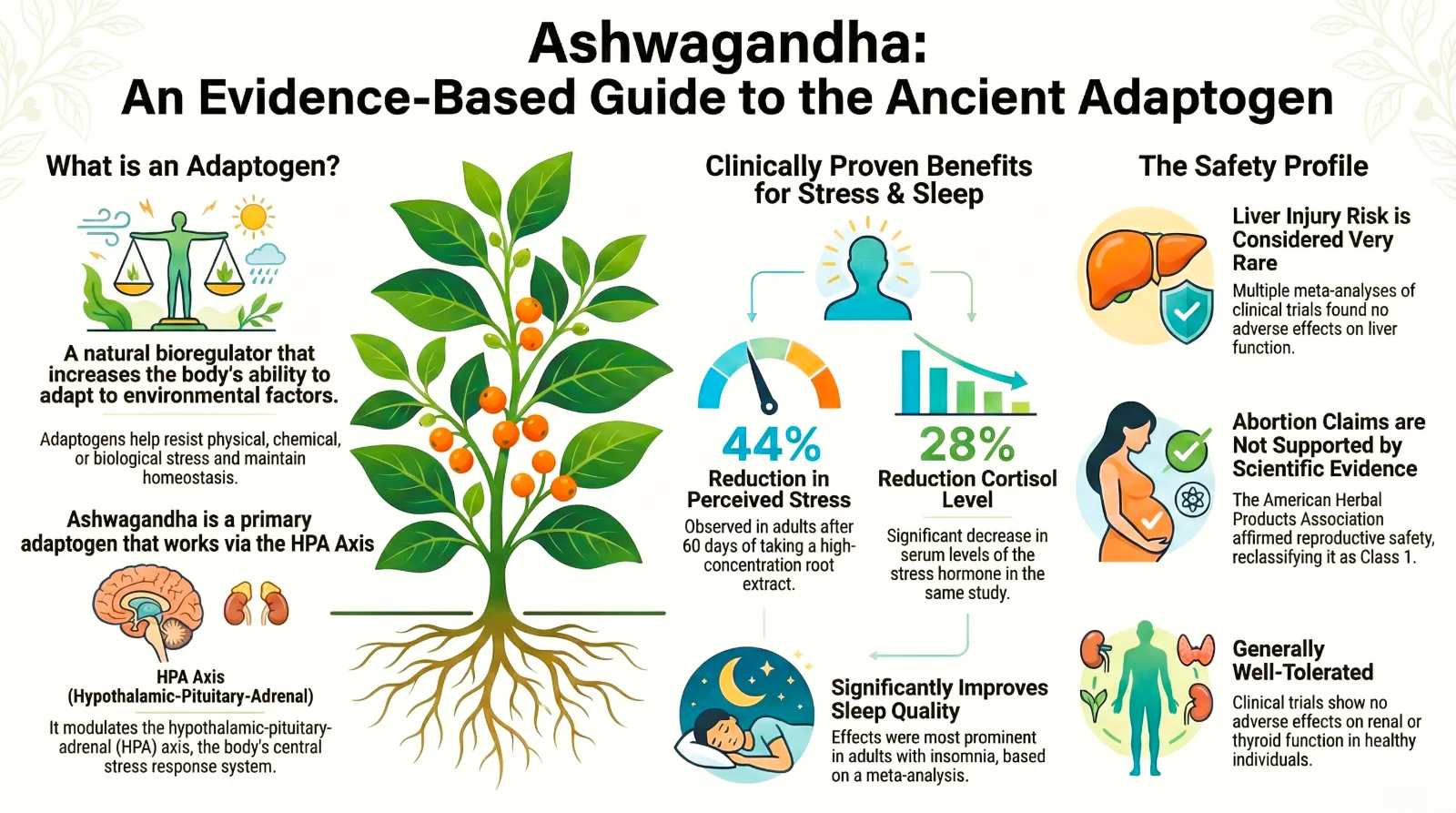
“Adaptogen” is a label used for ashwagandha. To decide whether to use it, the useful evidence is what a particular preparation did in a human trial.
Think of the HPA axis as part of the body’s stress-response system. The “Threat Detection Center” is a teaching analogy, not a diagnosis of a stuck hormonal switch.
- Stress Trigger: Your brain perceives a threat (a difficult email, a heavy squat, or sitting in a bad chair for 12 hours).
- The Signal: Brain and pituitary signals contribute to the adrenal stress response.
- The Response: Cortisol is one part of that response, with normal daily variation.
Some trials measured changes in perceived stress and cortisol. They do not establish that ashwagandha acts as a chemical circuit breaker or that an individual’s tiredness comes from a cortisol problem.
🔹 Timing: Separate the Training and Sleep Evidence
The studies below used particular extracts over several weeks. They do not directly compare morning with evening use or establish an optimal pre-workout or bedtime interval.
A. The Strength-Training Study
- The Timing Question: The trial does not establish a special morning or pre-workout advantage.
- The Studied Dose: Wankhede and colleagues used 300 mg root extract twice daily. A study dose is not a personal prescription.
- The Limits: This was a small trial in men with little resistance-training experience. It does not establish a testosterone treatment or general benefit for every reader.
- The Cell Science: A proposed cellular mechanism is not proof of a testosterone effect in an individual. The training trial did not establish that mechanism.
- Note: Regular meals and appropriate nutrition matter for training. Supplements do not replace them; the meal-planning guide discusses practical planning.
- The Clinical Evidence: In an eight-week trial by Wankhede et al., 57 men were randomized while undertaking resistance training. Reported group differences included:
- Muscle Strength: Significant increase in bench press 1RM.
- Muscle Size: Greater increase in arm muscle size.
- Testosterone: A significant increase in serum testosterone levels compared to placebo.
B. The Insomnia Study
- The Timing Question: There is no proven “45 minutes before bed” rule from this study.
- The Studied Preparation: Langade and colleagues studied 300 mg full-spectrum root extract twice daily for ten weeks. This does not validate the same regimen for every root/leaf product.
- The Mechanism: Replaying conversations at bedtime does not diagnose low GABA. The trial measured sleep outcomes; it did not demonstrate a bedtime switch from beta to alpha/theta brain waves.
- Context: If your physical environment is causing your stress (like back pain from long hours), no pill will fix it alone.
- The Clinical Evidence: A small placebo-controlled trial by Langade et al. in people with insomnia reported improvements in sleep onset and other sleep measures over ten weeks. Larger studies and preparation-specific evidence are still needed.
- The magnesium guide addresses a different supplement. These studies do not prove that the combination is synergistic or necessary.
🔹 Safety Analysis: Is Ashwagandha Safe?
NIH NCCIH guidance says short-term use may be safe for some people, but long-term safety is uncertain. Drowsiness and gastrointestinal effects can occur, and rare liver injury has been reported.
1. Side Effects and Liver Warning Stop use and seek medical advice for concerning symptoms, especially yellowing of the eyes or skin, dark urine, marked itching or persistent abdominal symptoms. A new change in mood also deserves assessment rather than an assumed serotonin-receptor mechanism.
- Cycling: A schedule such as “two months on, two weeks off” has not been established here as a way to prevent adverse effects or make long-term use safe.
2. The Thyroid Warning Ashwagandha is not recommended for people with thyroid disorders and can interact with thyroid medicine.
- If you have a thyroid disorder, this is a discussion with your treating clinician, not a reason to self-start ashwagandha. It may interact with medicines, and rare liver injury has been reported.
- Medicines: Discuss diabetes or blood-pressure drugs, sedatives, anti-seizure medicines, immunosuppressants and thyroid hormone with your clinician before considering it.
3. Other Reasons to Avoid It Avoid use during pregnancy and breastfeeding. NIH guidance also advises against it with autoimmune disease, upcoming surgery or hormone-sensitive prostate cancer.
🔹 The Buyer’s Guide: Check the Preparation
Check the plant parts, extract, serving size and ingredient amount. Root powder, root extract and root/leaf extract are not interchangeable study preparations. The names below remain as original examples, not independently tested recommendations.
1. The Original Lower-Dose Example
Original example: Himalaya Ashvagandha. Check the current pack; a lower capsule amount alone does not establish safety or suitability.
- What to check: Confirm whether the pack contains powder or extract, the plant part, serving size and standardisation. Do not use a trial of the product to “gauge” a thyroid problem.
2. The Original Root-Extract Example
Original example: Kapiva KSM-66 Ashwagandha. A named extract is not proof that the current retail product reproduces a trial outcome.
- What to check: Verify the current label’s extract, amount and withanolide specification. Standardisation describes ingredients; it does not ensure clinical benefit.
- Suitability: Neither a testosterone goal nor a capsule’s dietary label establishes that this is appropriate for you.
- Use: Do not treat a retail serving as a proven breakfast or pre-workout protocol.
3. The Original Root/Leaf Example
Original example: Life Extension Optimized Ashwagandha. Check the current formulation and plant parts.
- What to check: Do not assume leaf-containing extracts are more sedating or superior for evening use. No head-to-head comparison of these retail products is established by the cited studies.
🔹 The Final Verdict
Ashwagandha is a tool, not magic.
- Training: One small trial is not a general testosterone protocol.
- Sleep: Some short-term evidence is not a guaranteed effect or an optimal-time rule.
Choose based on the evidence, the preparation and your medical context. Persistent insomnia or anxiety needs assessment; timing and cycling are not substitutes for it.
(Medical Disclaimer: This article is for educational purposes and does not constitute medical advice. Consult your physician before starting any new supplement, especially if you have thyroid disorders or are pregnant.)
Meerawell’s editorial standards distinguish an evidence update from a clinical check of the exact final version.