Key takeaways
- In the mesh vs foam chair choice, neither wins everywhere. Mesh breathes better; a well-made foam seat may feel more supportive over long sessions.
- In a three-hour comparison, people reported similar comfort and pain on mesh and foam seats, and pain rose on both in the final hour.
- For hot, humid Indian rooms, a mesh back with a foam seat is a sensible default. Avoid cheap PU leatherette.
The Chair Cover That Has to Survive a “Jungle Test”
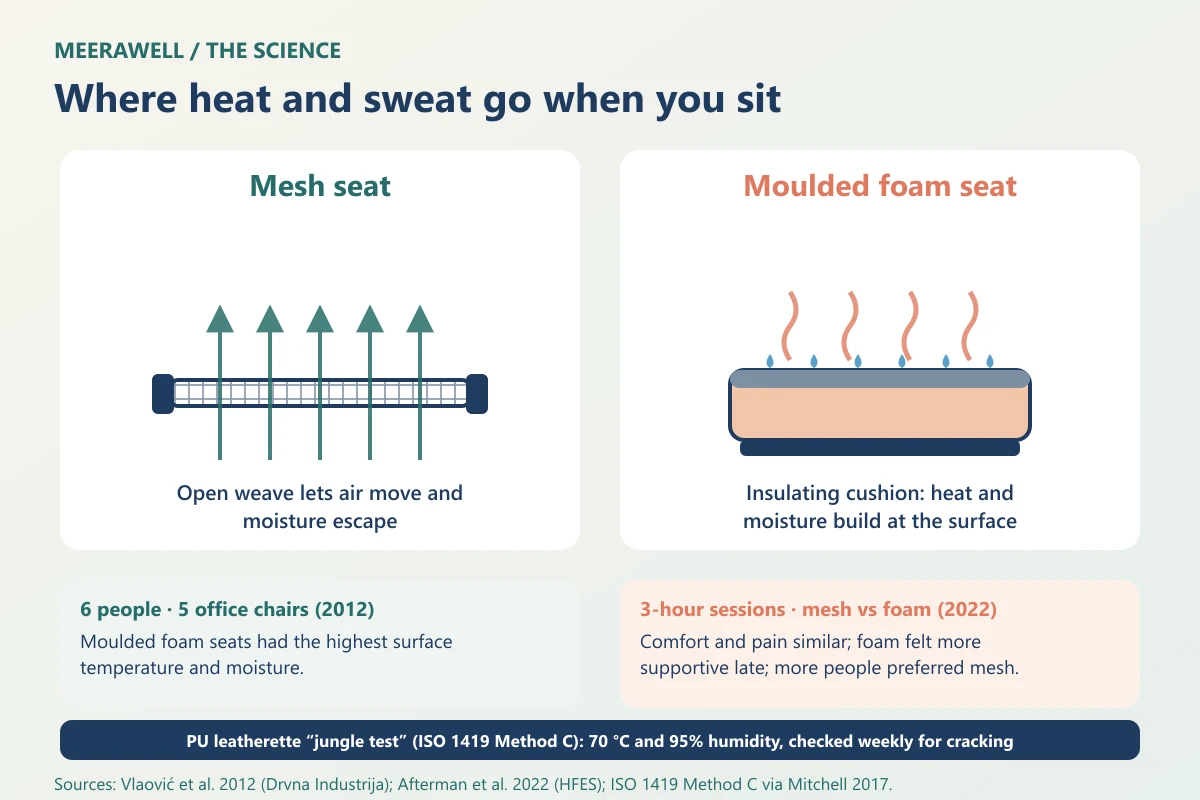
Makers of synthetic leather test their materials with a method the industry literally calls the “Jungle Test”: ISO 1419 Method C. Samples are kept at 70 °C and 95% relative humidity, then checked every week for cracking, peeling and colour change. One industry article puts the usual market expectation at about three weeks for home products and five for commercial ones.
Why such a brutal test? Water slowly breaks down some polyurethanes, a reaction called hydrolysis. It is why cheap PU “leatherette” chairs flake in Mumbai, Chennai and Kochi. You will almost never see the result on a chair listing.
Material matters for comfort too. On a July afternoon, with the fan on and the air like a damp towel, you stand up after two hours and your shirt is stuck to the chair.
The short answer: for hot, humid rooms without air-conditioning, a mesh back is usually the biggest improvement, because your back is where air struggles to reach. For the seat, the choice is closer: mesh lets heat escape, while good foam may feel more supportive. Skip PU leatherette, and do not let the material distract you from fit.
1. The Science: Your Seat Has Its Own Microclimate
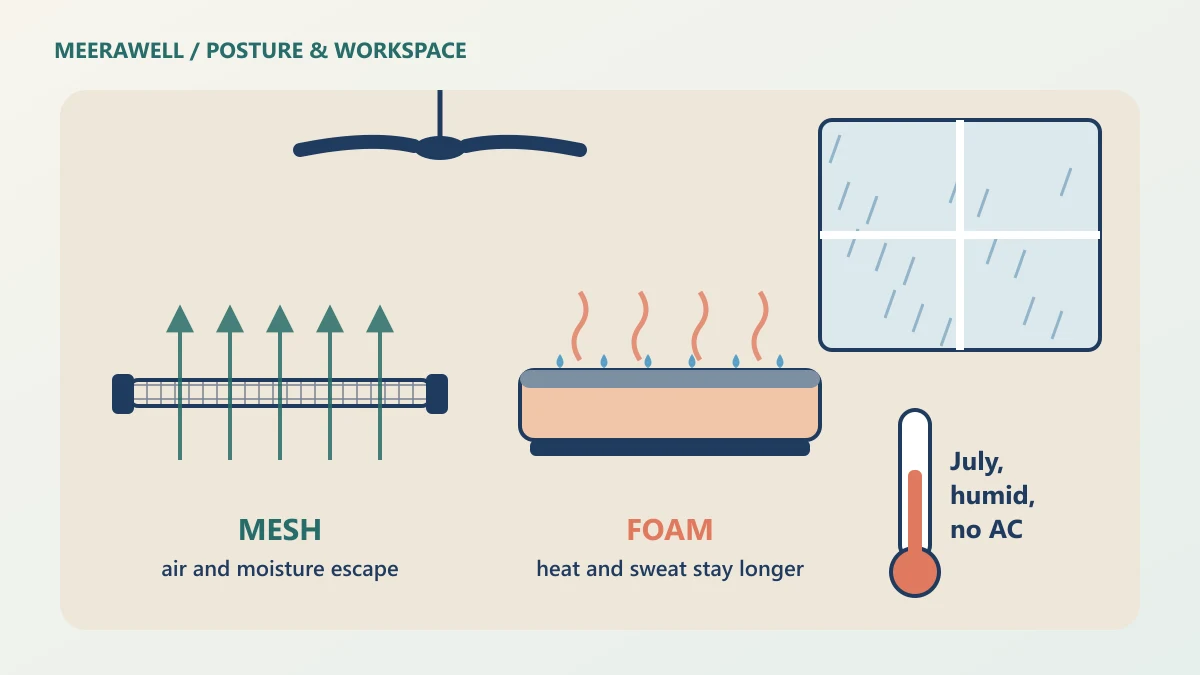
Wherever your body presses against a surface, a tiny climate forms between skin and material. Seating researchers call it the microclimate: the temperature, humidity and airflow at that contact point.
- Mesh is a stretched open weave. Air moves through it, so some heat and sweat escape.
- Foam spreads your weight but insulates, and its cover often traps moisture.
Humidity makes the difference bigger. Sweat cools you only when it evaporates, and in monsoon air evaporation is already slow.
2. Mesh vs Foam Chair: What the Studies Measured
Heat. In a 2012 study, researchers put probes on and inside the seats of five office chairs while six people worked. Moulded foam seats had higher surface temperature and moisture than the other seat types.
Comfort. A 2022 UC Berkeley study compared a mesh-seat and a foam-seat chair over three-hour sessions of computer work.
| Question | What the evidence suggests |
|---|---|
| Which runs cooler? | Mesh; moulded foam seats were warmest in one small study |
| Which is more comfortable over three hours? | No significant difference |
| Which feels more supportive late in a session? | Foam |
| Which do people prefer? | More participants preferred mesh |
| Does material prevent back pain? | Not shown; pain rose in both chairs |
Both studies were small. The honest conclusion is narrow: mesh tends to win on heat, while comfort depends on the particular seat. And since pain rose on both chairs in the last hour, standing up regularly may matter more than either material.
3. Where Each Material Struggles in Indian Heat
- Mesh can sag. It is held by tension, and cheaper frames may loosen until you feel the edge under your thighs. OSHA’s chair guidance favours a rounded “waterfall” front edge.
- Foam can bottom out. Thin, soft foam compresses until you feel the hard base beneath. Firm moulded foam lasts better.
- Fabric over foam absorbs sweat. A removable, washable cover helps.
- PU leatherette can peel in humid cities. Ask what the cover is and whether it has a hydrolysis rating.
Did you know? Mesh office chairs were radical in 1994, when Herman Miller launched the Aeron. Its designers, Bill Stumpf and Don Chadwick, replaced foam upholstery with a breathable suspension textile called Pellicle. Three decades later, a mesh back is common on Indian chairs under ₹10,000.
4. How to Choose for Your Room
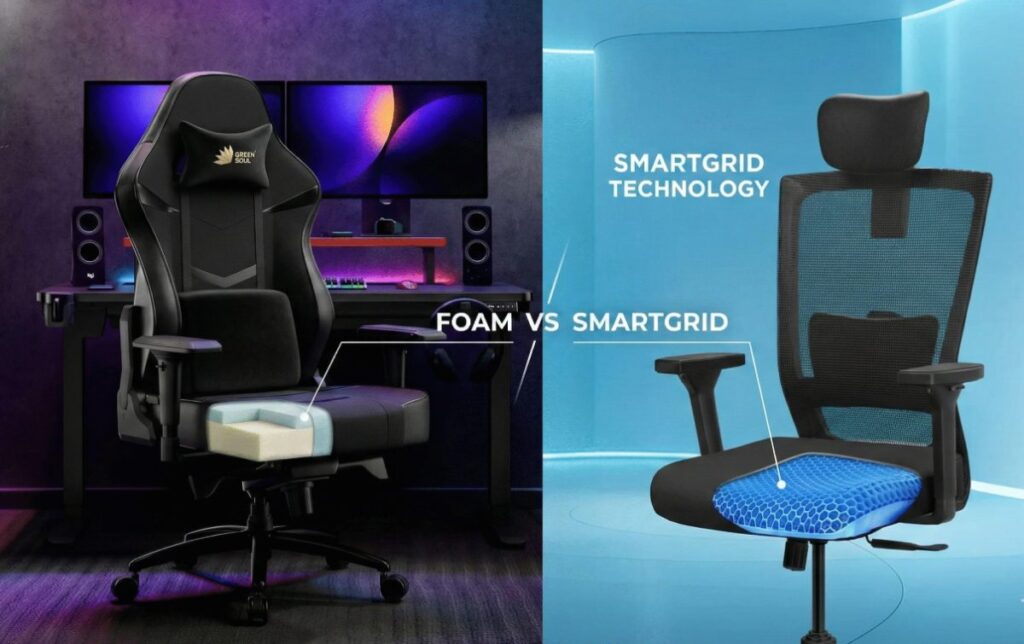
Many Indian budget chairs already combine the two. Green Soul’s 2026 buying guide, for example, lists several models with a mesh back and a moulded or high-density foam seat: breathable material where airflow is worst, cushioning where weight is concentrated.
| Your situation | Back | Seat |
|---|---|---|
| Hot, humid room without AC | Mesh | Mesh, or breathable fabric over firm foam |
| Air-conditioned room | Either | Either; foam may feel more supportive |
| Long sessions of three hours or more | Either | Firm, well-shaped foam or good mesh |
| Coastal city, open windows | Mesh | Washable fabric or mesh; avoid PU leatherette |
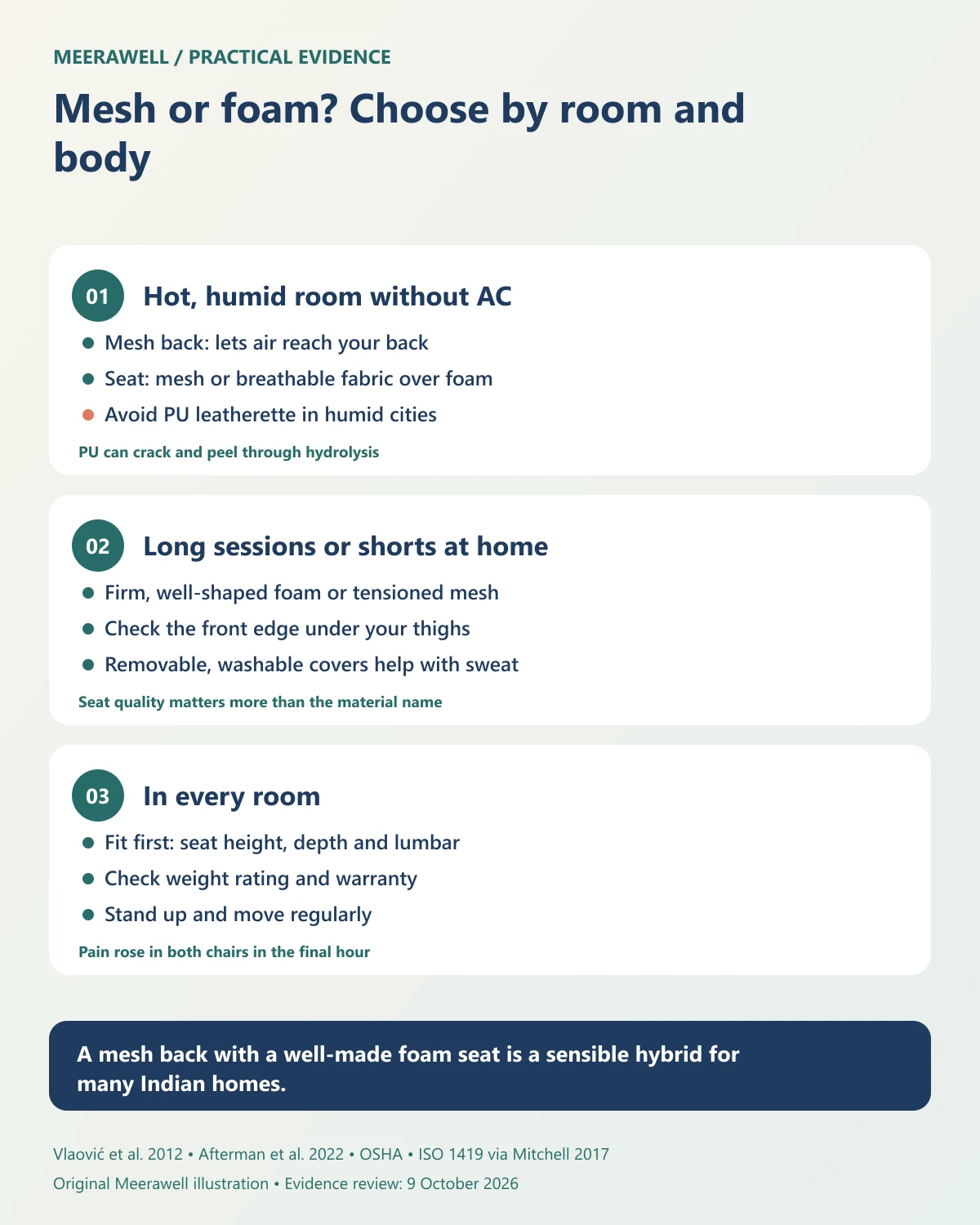
The Verdict: in the mesh vs foam chair decision for Indian heat, a mesh back is the safer default. For the seat, choose the better-made option rather than the material name. Buying on a budget? Read what an ergonomic chair under ₹10,000 can and cannot do. Fit still comes first.
When discomfort is not about the chair
See a doctor for:
- pain, tingling or numbness spreading down a leg, or leg weakness
- back pain that keeps you awake or keeps getting worse
- pain with fever or feeling generally unwell
- skin rashes or sores where you sit that do not settle
For a sudden change in bladder or bowel control, or numbness around the genitals or bottom, seek emergency care.
Frequently asked questions
Is a mesh chair better for hot weather?
Usually, especially for the backrest. Mesh lets more air and moisture escape than an enclosed foam cushion. In one small study, moulded foam seats had the highest surface temperature and moisture.
Is foam more comfortable than mesh?
Not necessarily. In a three-hour comparison, comfort and pain did not differ significantly, though the foam chair felt more supportive at the end. Seat shape and quality matter more than the material label.
Is leatherette a bad idea in India?
It can be in hot, humid places. Many synthetic leathers are polyurethane-based and can crack or peel through hydrolysis. Ask about the material and its durability testing.
Next step
Material decides how a chair feels in July. Fit decides how your back feels in December. Check both before you buy.
Sources and evidence
Evidence checked on 9 October 2026. Studies cited are small and specific to the chairs tested. No chair was tested by Meerawell, and no brand paid for inclusion.
- Mitchell Faux Leathers, 2017: hydrolysis testing methods and the ISO 1419 “Jungle Test”
- Vlaović, Domljan and Grbac, 2012: temperature and moisture during sitting on office chairs (Drvna Industrija)
- Afterman et al., 2022: impact of seat material on comfort, preference and performance (HFES Proceedings)
- OSHA eTool: computer workstation chairs
- Herman Miller: Aeron design story
- Green Soul: ergonomic office chair buying guide, March 2026
- NHS: back pain and when to get urgent help