Key takeaways
- Your caffeine cutoff time should be relative to when you plan to sleep. A fixed “no coffee after 5 PM” rule cannot fit every schedule.
- Dose matters. A small randomized trial found different sleep effects with 100 mg and 400 mg, even at the same timing.
- Chai contains caffeine too. Cup size, tea quantity and preparation make a household cup difficult to assign one exact number.
- Try moving the final caffeinated drink earlier while keeping the rest of the routine steady. Persistent sleep trouble deserves a wider assessment.
The Chai That Doesn’t Count
You stopped the evening coffee. Now the kitchen offers a small cup of chai at seven.
“It’s only tea,” someone says. You drink it, then spend bedtime negotiating with an uncooperative brain.
Was it the chai? Possibly. Was it definitely the chai? One night cannot settle that.
Here is the short answer: choose a caffeine cutoff time by working backwards from your intended sleep, and consider the amount as well as the clock. Chai, coffee, energy drinks and some other products all count. There is no universal hour that makes every dose harmless for every person.
1. Count the Drink Before Choosing the Cutoff
The cup is a container, not a dose.
A small home chai, a large café coffee and a pre-workout serving may contain very different quantities of caffeine. Tea strength, brewing method and serving size change the estimate.
The FDA’s caffeine guidance lists typical US beverage values and stresses that products and containers vary. Those figures should not be assigned unchanged to an Indian chai glass or filter-coffee tumbler.
For packaged drinks, read the caffeine quantity per serving and check whether the container contains more than one serving. For home drinks, record the actual size and preparation instead of pretending you know an exact milligram figure.
Milk or sugar does not turn tea into a caffeine-free drink. Decaf reduces caffeine but does not necessarily eliminate it.
2. What the Dose-and-Timing Trial Found
A randomized crossover trial published in Sleep tested 100 mg and 400 mg caffeine at 12, eight and four hours before bedtime. Twenty-three young adult men with moderate habitual caffeine intake took part. Sleep was assessed using in-home partial polysomnography and diaries.
The researchers found no statistically significant sleep effect from the 100 mg dose compared with placebo at the tested times. The 400 mg dose affected measured sleep, with some changes seen even when taken 12 hours before bedtime and greater disruption closer to bedtime.
That does not make 100 mg four hours before bed a universal safe rule. It was a small study in men, using defined doses under specified conditions. It did not test every chai recipe, all women, pregnancy, every age group or each person’s medication effects.
It does show why timing advice without dose can mislead.
| Evidence | What it supports | What it cannot promise |
|---|---|---|
| 100 mg in the trial | No significant difference detected at the tested timings | That any small drink near bedtime suits everyone |
| 400 mg in the trial | A large single dose can affect sleep well before bedtime | That every daily total has the same effect as one dose |
| NHLBI sleep guidance | Late caffeine can interfere with sleep; effects can last up to eight hours | A precise cutoff that works for every person |
3. Choose a Caffeine Cutoff Time by Working Backwards
NHLBI’s healthy sleep advice says caffeine can interfere with sleep and its effects can last up to eight hours. That provides a practical starting point for a timing experiment, rather than a guarantee.
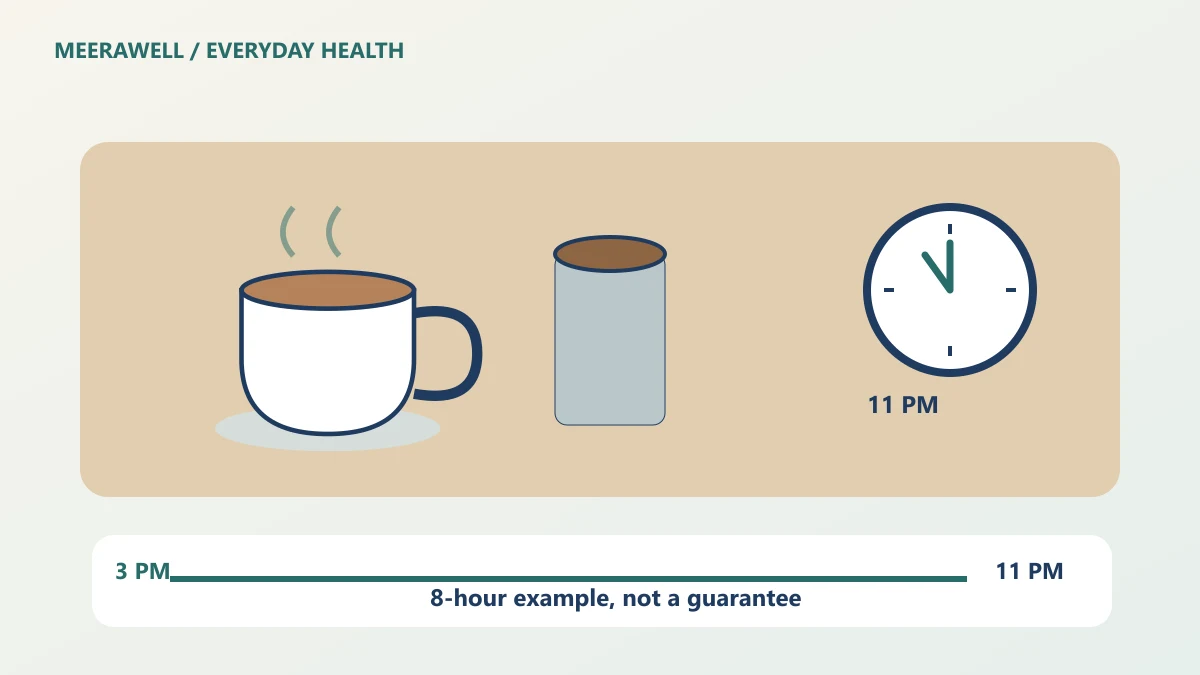
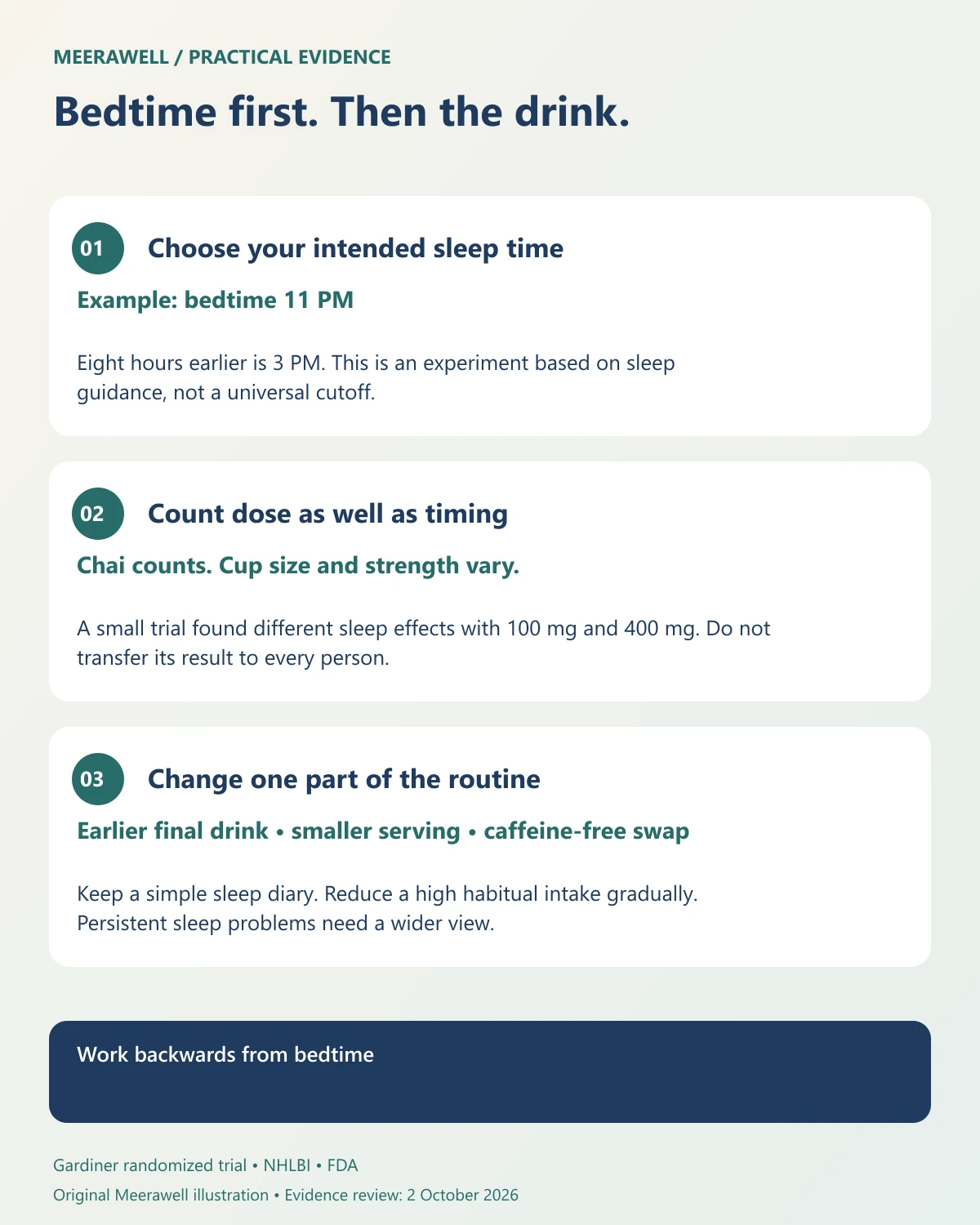
For example, if you plan to sleep at 11 PM, eight hours earlier is 3 PM. If you sleep at 10 PM, it is 2 PM. If you work nights and sleep at 9 AM, it is 1 AM.
These are clock calculations, not individualized prescriptions. A larger dose or greater sensitivity may warrant an earlier cutoff or a lower amount. Moving the last drink earlier while keeping a very high intake may leave the underlying problem unresolved.
For shift work, tie the plan to your actual sleep window. NHLBI advises limiting caffeine to the first part of the shift. A rule built around conventional evening bedtime is not useful when your main sleep happens after sunrise.
4. Run a Small Experiment with Your Routine
For several days, note your drinks, their times, approximate sizes, intended bedtime and how the night went. Include tea, coffee, energy drinks and any caffeine-containing products you use.
Then choose one clear change for the following week: move the final caffeinated drink earlier, make it smaller, or replace it with a caffeine-free option you enjoy. A week is a practical observation window, not a validated diagnostic test.
Keep bedtime and wake time as steady as ordinary life allows. Notice time spent awake at bedtime, repeated waking and daytime sleepiness. Do not use a single wearable score as the verdict.
If you habitually drink a lot of caffeine, reduce gradually. FDA notes that withdrawal can be unpleasant; a sudden change may bring symptoms that confuse your sleep experiment.
If earlier timing helps, keep it. If it does not, caffeine may still be one contributor, but consider the wider picture: sleep opportunity, shift pattern, stress and symptoms.
5. “Within the Daily Limit” Is a Different Question
The FDA cites 400 mg daily as an amount not generally associated with negative effects for most adults. This is US general guidance, not a recommended target or an India-specific personal allowance.
It is also different from a sleep cutoff. A person can remain below that daily amount and still find their evening drink disruptive.
Pregnancy, breastfeeding, medical conditions, medications and individual sensitivity can change what is appropriate. Ask your clinician about your own intake in those situations. Do not use this article’s bedtime arithmetic to override that advice.
6. Keep the Ritual, Change the Ingredient
Sometimes the evening drink is a pause, a conversation or a familiar way to end work. You may not need its caffeine to keep that ritual.
Try warm water, a caffeine-free infusion whose ingredients you tolerate, or another suitable drink. Check the ingredients: a product called “herbal” is not automatically free from tea or caffeine-containing additions.
Avoid making the replacement a complicated supplement routine. The useful experiment is whether a simpler evening drink and earlier caffeine suit your sleep.
If tiredness persists despite enough time in bed, see our guide to sleeping but still feeling tired. Loud snoring, gasping or witnessed breathing pauses need assessment; an earlier chai alone does not resolve those symptoms.
Frequently asked questions
What is the best caffeine cutoff time?
There is no universal hour. Work backwards from your intended sleep, consider dose and sensitivity, and try an earlier final drink. The eight-hour example here is a starting experiment, not a guarantee.
Does chai affect sleep less than coffee?
It depends on the caffeine dose and timing. Cup sizes and preparation vary. A large strong tea may not be equivalent to a small weak one, so the drink name is an incomplete comparison.
Can I have 100 mg four hours before bed?
The small trial did not detect a significant effect at that dose and timing. That finding does not establish that it suits every person or circumstance. Your symptoms and wider context still matter.
Is decaf completely caffeine-free?
Usually not. It contains less caffeine than the regular version, but small amounts may remain. Check the product information, especially if you are very sensitive.
Next step
Write down your intended sleep time and tomorrow’s last caffeinated drink. Make one change you can observe without rebuilding your whole evening.
Sources and evidence
Sources checked on 2 October 2026. The bedtime examples are arithmetic, not personalized advice. The trial’s defined single doses are not treated as estimates for household beverages.