
Sleep deprivation effects extend far beyond tiredness, quietly disrupting the brain, hormones, immunity, and long-term health.
A 2,000-Year Mystery
For most of human history, sleep was treated as downtime.
In 350 BC, Aristotle believed sleep occurred because warm vapors rose from the stomach after digestion. It sounded logical for its time. What we know now is far more unsettling:
Sleep isn’t passive at all.
During sleep, the body performs active maintenance—clearing brain waste, recalibrating hormones, restoring immune balance, and repairing tissues. Yet in modern life, sleep is treated as optional.
That mismatch, between what sleep actually does and how casually we ignore it, is at the core of modern sleep deprivation.

Sleep Isn’t Rest — It’s Biological Maintenance
Sleep is an active biological process, essential for:
- Cognitive control and decision-making
- Hormonal timing and metabolic regulation
- Immune coordination and recovery
Yet more than one-third of adults consistently sleep less than 7 hours per night, according to the CDC.
Clinically, sleep deprivation appears in two forms:
- Acute sleep deprivation — staying awake for 24–72 hours
- Chronic sleep deprivation — losing small amounts of sleep night after night
The second is far more dangerous—because the damage accumulates quietly.
What Sleep Loss Does to the Brain
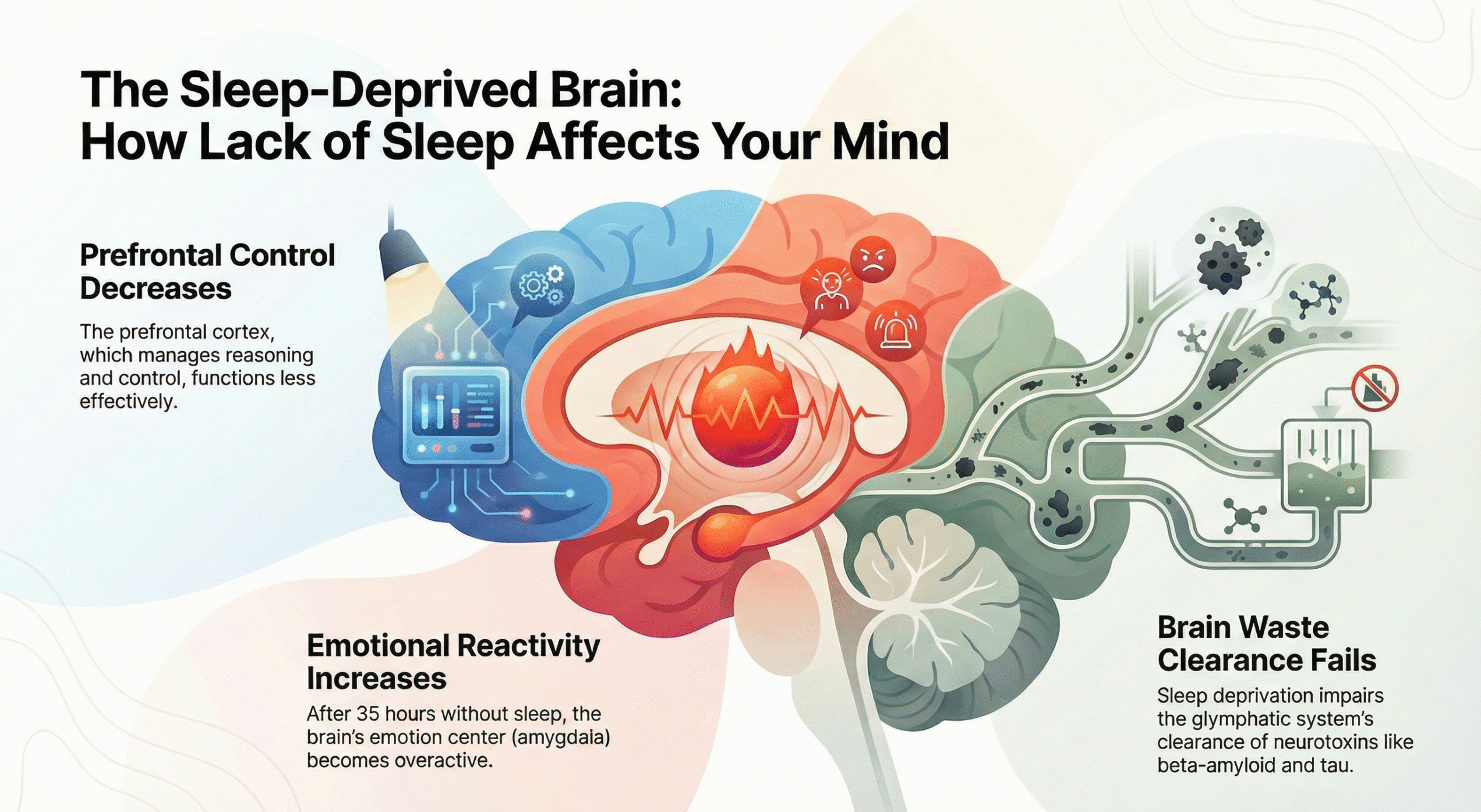
The brain is the first system to suffer—and the slowest to recover.
At the center of this is the prefrontal cortex, the brain’s executive control hub. It governs judgment, emotional regulation, focus, and impulse control.
With insufficient sleep, this control weakens. At the same time, deeper emotional circuits become more reactive. The result is a brain that reacts faster than it can regulate.
That’s why lack of sleep leads to poor decisions, emotional overreactions, and increased risk-taking.
This isn’t personality change. It’s impaired neural governance.
The Brain’s Night-Shift Cleanup
Why Sleep Is “Neurological Sanitation”
Every waking hour produces metabolic waste inside the brain—by-products of intense neural activity.
This waste is cleared primarily during deep sleep, when the brain activates its internal cleaning system. Miss sleep once, and cleanup is incomplete. Miss it repeatedly, and accumulation becomes the baseline.
The Professional Analogy
Think of your brain like a high-frequency trading server.
During the day, it processes millions of data points. If you never take it offline for maintenance, log files pile up, CPU efficiency drops, and errors compound. Research from the National Institutes of Health (NIH) shows this process is essential for long-term brain health:
Sleep is your daily reboot + patch cycle.
Skip it long enough, and the system doesn’t slow down — it misfires.
Microsleeps: When the Brain Fragments Its Workload
With ongoing sleep deprivation, the brain starts to fragment its workload.
Certain regions briefly enter sleep-like states while you’re wide awake. These moments are called microsleeps.
They are brief—but dangerous:
- They last seconds
- You don’t consciously notice them
- Reaction time collapses
This is why fatigue-related mistakes feel sudden—the brain disengages before awareness catches up.
Hormones: When Timing Breaks Down
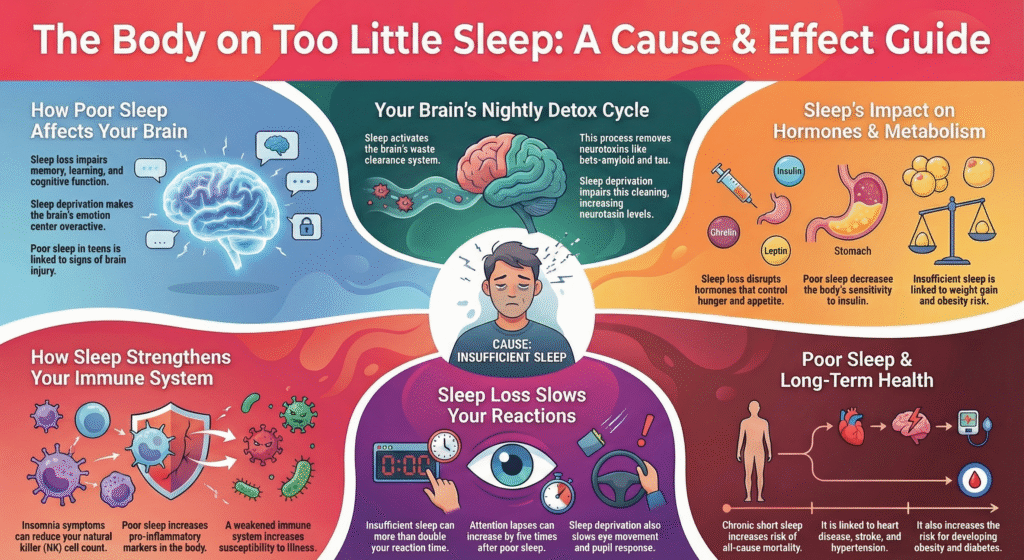
Sleep is when the body resets its internal chemical clock. Without it, hormones don’t just rise or fall—they fire at the wrong time.
The most consistent disruptions include:
- Stress hormones staying elevated, preventing full recovery
- Repair signals being blunted, leaving tissues under-repaired
- Hunger signals becoming distorted, increasing appetite despite adequate intake
This isn’t willpower failure.
It’s hormonal miscommunication.
Immunity: Weaker Defense, Higher Inflammation
Sleep is when the immune system recalibrates.
With insufficient sleep, defensive cells become less effective, inflammatory signals rise, and recovery from illness slows. The body enters a state where it is both under-defended and over-inflamed — a pattern linked to chronic disease.
The Ocular Angle (Doctor’s Perspective)
As an eye specialist, this is where sleep deprivation becomes visibly obvious.
Many patients believe eye strain and dryness are only about screens. They’re not.
During sleep, the eyes undergo re-epithelialization — a nightly resurfacing of the cornea that maintains clarity and comfort. Cut sleep short, and you start the day with a compromised ocular surface.
Think of it like driving with a cracked windshield. Screen time doesn’t cause the crack — it reveals it. This neurological fatigue also worsens screen-related eye strain seen in Computer Vision Syndrome, where prolonged visual demand and poor recovery compound discomfort.
This is why poor sleep worsens burning, blurred vision, and evaporative dry eye symptoms. It also amplifies screen-related eye strain seen in Computer Vision Syndrome, where neurological fatigue compounds visual discomfort.
Poor sleep further destabilizes the tear film and increases ocular surface inflammation — a mechanism commonly seen in Dry Eye Disease, especially in screen-heavy lifestyles.
Long-Term Health Risks of Chronic Sleep Deprivation
When sleep deprivation effects becomes chronic, the damage compounds across systems:
- Cardiovascular strain increases
- Blood-sugar regulation worsens
- Cognitive resilience declines
The American Heart Association now recognizes sleep as a core pillar of cardiovascular health
These changes don’t cause immediate collapse. They accumulate silently.
Myth-Busting: “I’ll Catch Up on Sleep on the Weekend”
The myth:
Weekend sleep fixes weekday sleep loss.
The reality:
The brain doesn’t run overtime on Sundays.
Irregular sleep timing creates social jetlag, confusing circadian rhythms and reducing sleep quality. The brain’s cleanup systems don’t double their efficiency just because it’s the weekend.
Sleep debt isn’t repaid in bulk.
It’s repaid night by night.
The Meerawell Protocol
Practical, Not Generic
This isn’t about “sleep more.” It’s about protecting sleep quality.
The 10-3-2-1 Rule
- Ten hours before bed: no caffeine
- Three hours: no heavy meals
- Two hours: no work or problem-solving
- One hour: no screens
Consistency Over Quantity
- A consistent 7 hours beats an irregular 9
TL;DR — The Core Takeaway
Recovery happens night by night, not on weekends
Sleep is not downtime; it is biological maintenance
Chronic sleep loss quietly erodes brain, hormonal, immune, and visual health.
The Doctor’s Prescription
If you’re sleeping 5 hours to “get ahead” in your career, you’re trading long-term cognitive equity for short-term tactical speed.
In investing terms — that’s a bad trade.
What are the most serious effects of sleep deprivation?
The most serious sleep deprivation effects include impaired decision-making, hormonal imbalance, weakened immunity, increased cardiovascular risk, and reduced metabolic control. These changes develop gradually and often go unnoticed until long-term health problems appear.
Can chronic sleep deprivation be reversed?
Some effects of chronic sleep deprivation are reversible with consistent, high-quality sleep. However, prolonged sleep loss can lead to persistent cognitive, metabolic, and cardiovascular changes that may not fully normalize, especially if poor sleep continues for years.
How many hours of sleep does the brain actually need?
Most adults need 7–9 hours of sleep per night for optimal brain function. Regularly sleeping less than 7 hours increases the risk of impaired cognition, hormonal disruption, and long-term health issues, even if daytime sleepiness feels manageable.
Last medically reviewed: December 2025 in accordance with our terms and editorial policy
Pingback: Does Lack of Sleep Cause Eye Strain? The Real Reason Eye Rest Fails
Pingback: Sleep But Still Tired: Why Your Brain Is Not Recovering
Pingback: The Sleep Company vs. Green Soul: A Doctor’s Review (2026)
Pingback: Best Ergonomic Chair in India (2026) for Long Sitting Hours