In my medical practice, I often see patients who optimized every aspect of their career and finances but left their biology to chance. They waited for symptoms to appear before seeing a doctor. By then, the damage had often already begun. For high-performance professionals, “waiting for symptoms” is a failed strategy.
Artificial Intelligence (AI) is moving medicine from Reactive (treating sickness) to Predictive (preventing it). This guide analyzes how AI disease detection is finding “silent” risks like heart dysfunction and diabetic complications early, and which clinical-grade tools you can use to monitor your own health trends today.
Can AI Actually Detect Diseases Earlier Than Clinicians?
The short answer is: Yes, in specific domains.
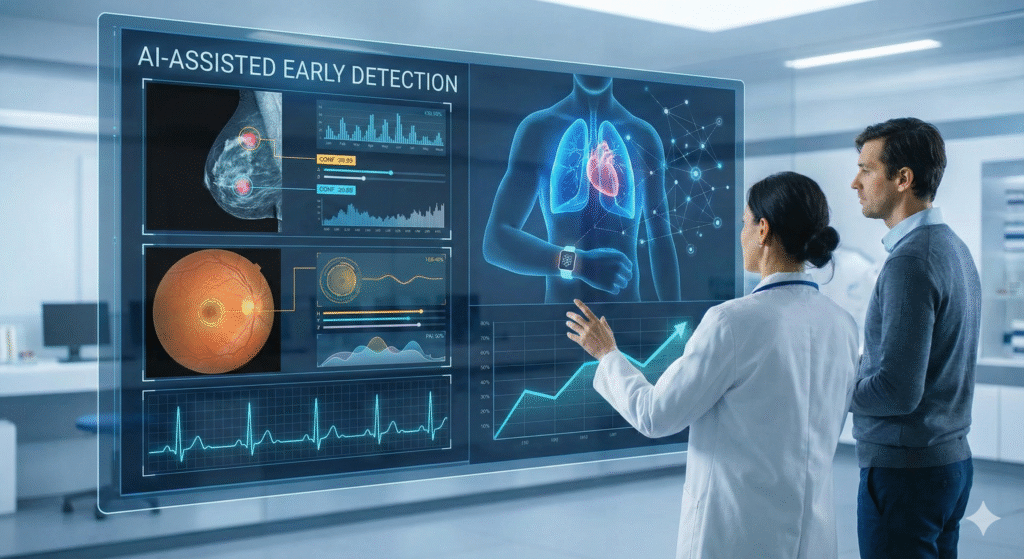
Based on current clinical evidence, AI models trained on millions of data points can now match—and sometimes outperform—specialists in detecting specific patterns that the human eye might miss.
This does not replace doctors; it gives them a “Super-Sight.” Here is the evidence from three critical fields where AI disease detection is already saving lives.
1. The Heart: Finding “Silent” Dysfunction
Some forms of heart failure, such as Left Ventricular Systolic Dysfunction (LVSD), can remain hidden for years. You might feel fine, but your heart pump is slowly weakening.
- The Breakthrough: Researchers at Mayo Clinic developed an AI model that analyzes standard ECG recordings.
- The Result: The AI identified patients with early dysfunction even when the ECG appeared “normal” to human cardiologists.
- Why it Matters: This allows for treatment years before a heart attack occurs.
2. The Eyes: Predicting Systemic Disease
The eye is a window to the body. Diabetic retinopathy is a leading cause of blindness, but it is often caught too late.
- The Breakthrough: FDA-cleared autonomous AI systems (like IDx-DR) can now analyze retinal photos without a specialist present.
- The Result: In clinical validation, these systems demonstrated sensitivity and specificity comparable to expert graders, allowing for instant referrals.
3. Cancer Screening: Reducing False Positives
Breast cancer screening aims to find tumors before they can be felt.
- The Breakthrough: A major study published in Nature (2020) evaluated an AI model from Google Health against expert radiologists in the US and UK.
- The Result: The AI reduced both false positives (unnecessary scares) and false negatives (missed cancers), proving it can be a powerful “second pair of eyes.”
🩺 Doctor’s Analysis: The “High-Performance” Health Stack for AI Disease Detection
You do not need to wait for a hospital visit to benefit from this technology. While you cannot run a CT scan at home, you can use wearable AI to monitor your biomarkers 24/7. As an Amazon Associate, I earn from qualifying purchases at no extra cost to you.
Here are the tools that actually meet the standard for predictive monitoring (not just fitness tracking).
1. The Background Guardian (Continuous Monitoring)
For busy professionals, the best health tool is one you don’t have to think about.
- The Clinical Pick: Apple Watch Series 11
- The “AI” Function: This is a complete bio-dashboard. It uses sensor fusion to track Hypertension Load (vascular stress trends) and Sleep Apnea Risk by analyzing breathing disturbances overnight.
- Key Vitals: It continuously monitors your Blood Oxygen (SpO2) and respiratory rate in the background. A sudden drop in baseline SpO2 or HRV (Heart Rate Variability) alerts you that your body is under-recovered or fighting an infection before you even feel sick.
- Verdict: The ultimate passive monitor for heart, lung, and vascular health
2. The Validator (AI-Enhanced Accuracy)
If your wearable flags an issue, or if you have high stress, you need a confirmed reading.
- The Clinical Pick: Omron Platinum / 7 Series BP Monitor
- The “AI” Function: This is not just a standard cuff. It uses “Intellisense” AI algorithms to detect Atrial Fibrillation (AFib) while measuring your blood pressure.
- Why it fits: Standard monitors often give errors if you have an irregular heartbeat. This device uses AI to recognize the irregularity and flag it with high specificity.
- Verdict: Essential for validating the alerts you get from your watch.
Current Limitations of AI Disease Detection
While promising, AI is not magic. It has boundaries:
- Data Dependence: AI is only as good as the data it was trained on.
- The “Human Loop”: AI flags the issue, but a doctor must diagnose it. An Apple Watch notification is not a diagnosis; it is a signal to seek professional care.
- Regulation: Medical AI tools undergo strict FDA/CE approval. Consumer gadgets often have “wellness” disclaimers.
Conclusion: Don’t Guess, Measure
AI disease detection is transforming medicine from an art into a data science. For the high-performance individual, this means the era of “unexplained” health crashes is ending.
By combining clinical screenings with smart, AI-driven wearables, you can build a defensive moat around your health.
- Next Step: Once you have your monitoring set up, the next step is optimizing your fuel. Read my guide on Automating Your Nutrition with AI to fix your diet protocols.
Q: Can AI detect diseases earlier than doctors?
Yes, in specific areas like radiology and heart rhythm analysis, AI disease detection can identify subtle patterns that human eyes might miss, allowing for earlier intervention.
Q: Does the Apple Watch measure blood pressure?
No, it does not measure systolic/diastolic pressure like a cuff. However, newer models use sensors to detect trends and patterns consistent with hypertension, serving as an early alert system.
Q: Is AI used in hospitals today for early diagnosis?
Yes. AI is actively used in hospitals for stroke detection, reading mammograms, and flagging sepsis risk in ICUs across the US, Europe, and parts of India.
References :
1. Breast Cancer Screening and AI
McKinney, S. M., et al. (2020).
International evaluation of an AI system for breast cancer screening. Nature.
This study compared an AI system to radiologists using mammography datasets from the United States and the United Kingdom. Results showed reduced false positives and false negatives, with performance comparable to expert readers in controlled settings.
🔗 https://www.nature.com/articles/s41586-019-1799-6
2. AI-Assisted Diabetic Retinopathy Screening
Alqahtani, A. S., et al. (2025).
The efficacy of artificial intelligence in diabetic retinopathy screening: A systematic review and meta-analysis.
This large analysis reviewed multiple studies evaluating AI systems used for diabetic eye disease screening. The pooled findings showed high diagnostic sensitivity and specificity, supporting AI use as a screening tool in appropriate settings.
🔗 https://journalretinavitreous.biomedcentral.com/articles/10.1186/s40942-025-00670-9
3. ECG-Based AI Detection of Heart Dysfunction
Mayo Clinic Research Team (Reviewed 2024).
Artificial intelligence–enabled ECG screening for asymptomatic left ventricular dysfunction.
This clinical project from Mayo Clinic explored the use of AI algorithms to identify early signs of ventricular dysfunction from standard ECGs. The research suggests that silent heart conditions could be flagged earlier using AI-supported screening.
🔗 https://www.mayoclinic.org/medical-professionals/cardiovascular-diseases/news/artificial-intelligence-enabled-ecg-screening-for-asymptomatic-left-ventricular-dysfunction/mac-2046
Pingback: How AI Is Transforming Personalized Healthcare, Simple Guide
Pingback: Free AI Diet Plan: How to Use AI to Plan Your Diet (2025 Guide)