Blue light sleep disruption has become one of the most misunderstood health issues of the smartphone era.
A Short History That Explains the Problem
For nearly four billion years, life on Earth followed a strict and unforgiving rule:
bright days and almost complete darkness at night.
This rhythm became so deeply embedded in biology that every cell in the human body learned to anticipate sunrise and sunset on its own.
Electric lighting appeared only about 140 years ago, which is barely a moment in evolutionary time.
Screens arrived even later, placing intense, self-luminous light just inches from our eyes after sunset.
For most of medical history, scientists believed the eye had only one purpose: vision.
That assumption turned out to be incomplete.
In the late 20th century, researchers discovered a hidden light-sensing system in the eye, one that exists solely to tell the brain what time of day it is.
This discovery explains why night mode does not work the way most people expect.
The Biological “Daylight” Sensor You Didn’t Know You Had
Inside the eye is a small group of cells called intrinsically photosensitive retinal ganglion cells, or ipRGCs.
These cells do not help you see shapes or colours.
Their only job is to signal your brain’s master clock.
They respond primarily to:
- overall brightness
- duration of exposure
- timing of light
- how close the light source is to the eyes
This same light signalling system is also central to digital eye strain, especially during prolonged near-screen work.
Blue light plays a role, but it is not the dominant signal.
When you hold a phone inches from your face in a dark room, these cells receive a strong daytime signal, even if the screen appears warm and dim.
The Core Misunderstanding About Blue Light Sleep
Most advice around blue light and sleep follows a simple logic.
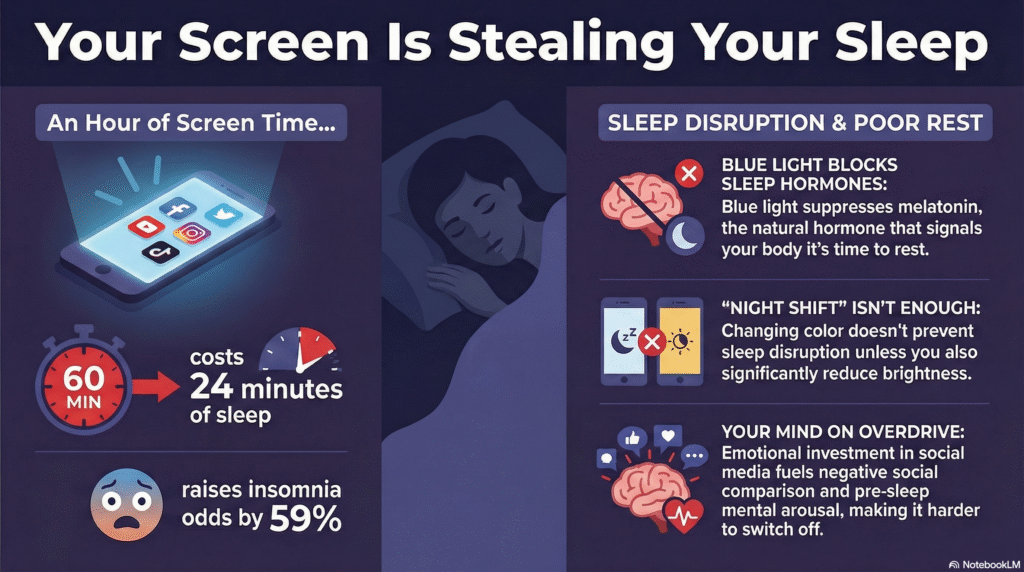
Blue light suppresses melatonin.
Block blue light.
Sleep improves.
But sleep regulation is not controlled by colour alone.
It is governed by total biological stimulation.
Night mode changes how the screen looks to your eyes.
It does not necessarily change how your brain interprets the light.
Why Night Mode Still Disrupts Sleep at Night
1. Intensity Still Wins
Human research consistently shows that bright light suppresses melatonin regardless of colour.
If your screen is bright enough to read comfortably, it is bright enough to delay sleep.
2. Proximity Magnifies the Effect
A television across the room produces a very different signal than a phone held a few inches from the face.
The reality of phone use before bed is that close-range, self-illuminating screens deliver a much higher circadian light dose.
This same exposure pattern is a major contributor to computer vision syndrome, even in people without diagnosed eye disease.
3. Cognitive Alertness Cannot Be Filtered
Emails, messages, social media, and endless scrolling activate attention and stress circuits in the brain.
No colour filter can remove the dopamine spikes or emotional arousal caused by interactive content.
What Research Consistently Shows
When researchers compare people reading on an iPad with those reading a physical book before bed, the results are almost always the same.
People using screens in the evening, even with night mode or blue-light filters enabled:
- take longer to fall asleep
- experience less deep, restorative sleep
- feel more groggy the following morning
This pattern has been discussed extensively by sleep researchers studying, circadian rhythm and light exposure
and how modern lighting alters biological night.
The problem is not poor discipline or bad settings.
It is a mismatch between modern behaviour and ancient biology.
Your biological clock functions like an old mechanical watch designed to be wound only by the rising sun.
Modern screens give us a duplicate key, and we wind that watch every night.
A Realistic Protocol for Better Sleep
If you want to work with your biology instead of against it, these steps matter more than any setting.
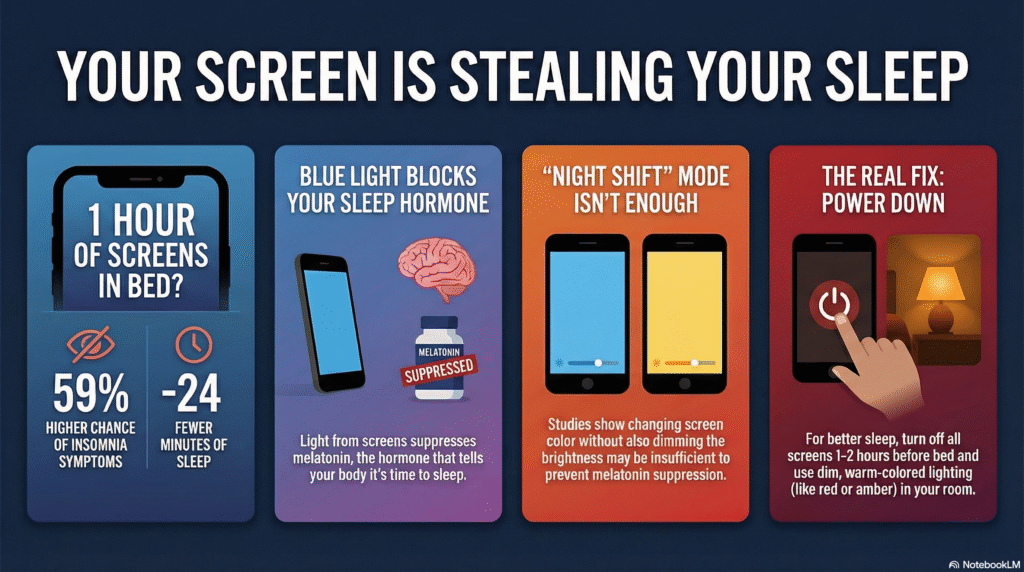
The 60-Minute Rule
Whenever possible, stop screen use one hour before bed.
This allows both light exposure and mental alertness to decline naturally.
Lowest Possible Brightness
If screen use is unavoidable:
- reduce brightness to the absolute minimum
- use dark mode with light text on a dark background
- keep usage brief and intentional
Replace the Stimulus
Instead of scrolling, try:
- a physical book
- a calm audiobook or podcast
- gentle stretching or journaling
These align with established principles of healthy sleep hygiene
outlined by the National Institutes of Health.
The Takeaway
Night mode reduces one stressor.
Sleep depends on the combined signals of brightness, timing, proximity, and attention.
Better rest is not achieved by changing screen colour.
It comes from creating a true digital sunset, a clear signal to the brain that the day has ended.
Does night mode actually help with blue light sleep?
Night mode reduces the amount of blue light emitted by a screen, but it does not eliminate sleep disruption. Brightness, screen proximity, timing, and mental engagement still signal the brain to stay alert, which is why sleep problems can persist even with night mode enabled.
Is blue light the main reason screens affect sleep?
Blue light plays a role, but it is not the only factor. The brain responds to the total intensity of light, how long you are exposed to it, and how close the screen is to your eyes. Cognitive stimulation from scrolling or messaging also delays the natural wind-down process before sleep.
How long before bed should I stop using my phone?
Ideally, screen use should stop about 60 minutes before bedtime. This allows both light exposure and mental alertness to decline naturally, helping the brain transition into a sleep-ready state.
Are blue-light blocking glasses effective for sleep?
Blue-light blocking glasses may reduce glare and eye discomfort, but they do not reliably improve sleep on their own. They do not address brightness, screen proximity, or the mental stimulation caused by screen use before bed.