Introduction: The End of “Average”
Personalized health is the shift from medical guesswork to biological engineering. For decades, medicine has operated on a “Bell Curve” model. Physicians relied on broad guidelines designed for the “average” person. If you had high blood pressure, you got the standard pill. If you had sleep issues, you got the standard advice.
But you are not “average.” Your biology, genetics, and lifestyle form a unique fingerprint.
We are finally moving away from this one-size-fits-all model. Driven by Artificial Intelligence (AI), we are entering the era of Personalized Health (or Precision Medicine). This isn’t just about treating sickness; it’s about optimization. It is the difference between a generic off-the-rack suit and one tailored to the millimeter.
What is Personalized Health? (The N=1 Concept)
In statistics, “N” represents the sample size. Traditional medicine studies N=10,000 to guess what works for you. Personalized Health focuses on N=1: You.
It replaces assumption with data. Instead of trial-and-error, we use technology to pinpoint exactly what works for your specific metabolic profile.
The logic is straightforward: Two executives with the same diagnosis often react differently to the same treatment.
- Patient A might solve their hypertension with magnesium and sleep architecture optimization.
- Patient B might need a specific beta-blocker because of a genetic variant in how their liver processes enzymes.
In the past, finding this out took months of guessing. Today, data reveals the answer before we even write the prescription.
How AI is Powering This Shift
AI is not replacing doctors—it is upgrading us.
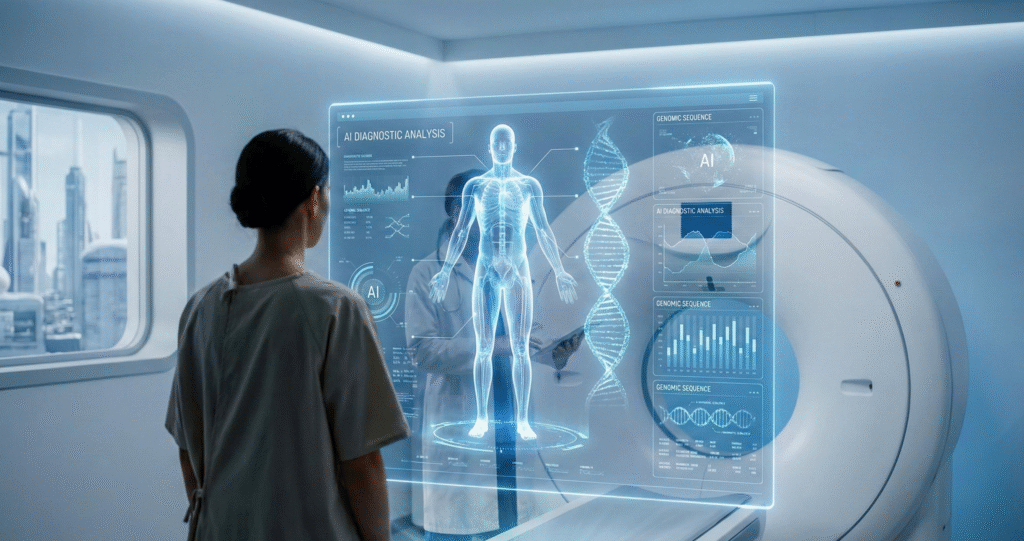
The human brain can look at a few variables at once (blood pressure, age, weight). AI can analyze millions. By processing medical scans, lab results, genetic markers, and real-time wearable data, machine learning models turn raw noise into a clear signal.
The “Doctor’s Perspective”: The Eye as a Data Port
As an medical specialist, I see this revolution first-hand. The eye is the only place in the body where we can see blood vessels and nerves directly without surgery.
In my field, AI algorithms can now analyze a simple retinal scan in seconds. These tools don’t just detect eye diseases like Diabetic Retinopathy; they are beginning to identify early warning signs of cardiovascular risk, stroke potential, and Alzheimer’s—often years before a patient feels a single symptom.
This is the power of AI: it makes the invisible, visible.
Real-World Applications for the High-Performer
This is no longer theoretical. Here is how personalized health is active right now for those who want to optimize performance:
- Predictive Metabolic Monitoring: Continuous Glucose Monitors (CGMs) paired with AI can tell you exactly which foods spike your blood sugar (killing your afternoon focus), rather than just giving generic diet advice.
- Cardiovascular Early Warning: AI analyzes ECG data from wearables (like the Apple Watch or Ultrahuman Ring) to detect arrhythmias like Atrial Fibrillation days before a clinical event.
- Pharmacogenomics: Before prescribing medication, we can now check your DNA to see if you will metabolize the drug effectively or suffer side effects.
- Sleep Architecture: Apps don’t just track how long you slept; they analyze your HRV (Heart Rate Variability) to tell you how recovered your nervous system is for the day’s stress.
The Challenges We Must Solve
While the potential is limitless, the roadmap has hurdles that we must navigate carefully:
- Data Privacy: Your genetic and health data is the most sensitive information you own. Security is non-negotiable.
- The “Black Box” Problem: AI can give a recommendation, but it cannot always explain “why.” Physicians must remain in the loop to validate these insights.
- Cost & Access: Currently, advanced genetic panels and AI diagnostics are premium services. The goal is to democratize this technology.
Summary: The Future is Data-Driven
The transition has already begun. The tools—from smart wearables to AI-assisted diagnostics—are here. The question is no longer “Can AI help us?” The question is: “Are you using the data available to optimize your biology, or are you still guessing?”
For the high-performance professional, the ability to measure, analyze, and optimize health is the ultimate competitive advantage.
Frequently Asked Questions
Is personalised healthcare available to everyone?
Not at this stage. Availability will depend on access to technology, data infrastructure, and trained medical staff.
Can AI replace doctors?
Not at present and not in all fields. AI supports clinical decisions but does not replace clinical judgment or patient care or surgical intervention yet.
Will personalised healthcare become common?
It is expected to grow as technology improves and costs decrease in future.
Pingback: AI Disease Detection: AI Detect Diseases before Doctors